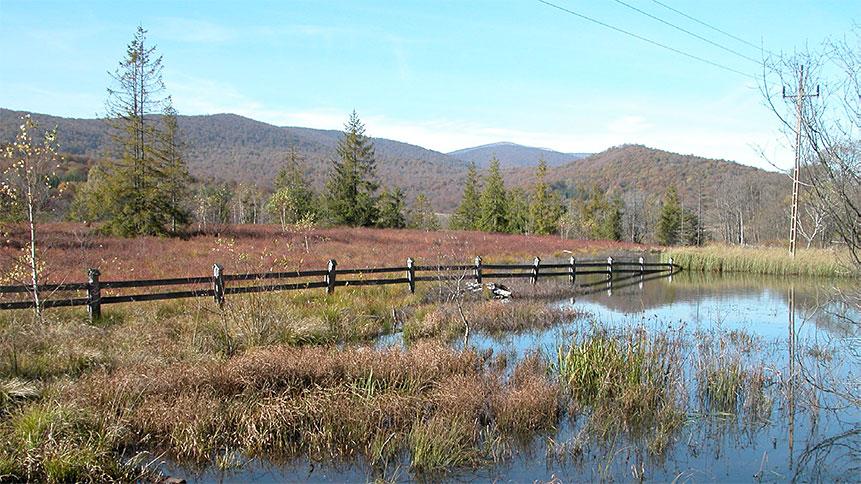


The International Biosphere Reserve ”Eastern Carpathians”, acknowledged by UNESCO in 1998, was the first trilateral biosphere reserve in the world, and it is one of the ten biosphere reserves located entirely or partially in Poland.
The International Biosphere Reserve ”Eastern Carpathians” encompasses six neighbouring large protected areas, located on the border of Poland, Slovakia and Ukraine. In Poland, the Reserve is composed by the Bieszczady National Park, Cisna-Wetlina Landscape Park and San Valley Landscape Park.
NIK assessed that the activities undertaken in the ”Eastern Carpathians” Reserve in 2012-2016 by its constituent parks in Poland, were in line with activities foreseen and recommended by UNESCO in order to implement the three functions of a biosphere reserve: protection, development and logistics support. The parks conducted their actions on the basis of specific legal and organizational arrangements, because tasks of a biosphere reserve were neither defined in the national legislation, nor in any other document fundamental for the functioning of such parks.
The environmental protection tasks were not based on any joint strategy or coordinated activity carried out in order to protect the core zone of the reserve. Lack of such strategies means that the ”Pamplona Recommendations” (2000) have not been implemented. According to this document, joint or coordinated strategies to protect the core zone of the reserve should be prepared, for instance a protection strategy regarding species that are known to migrate to other countries. A biosphere reserve has not been defined by the Polish law, therefore such an entity may be deemed an informal form of environmental protection only, and the UNESCO documents regarding its functioning are not legally binding.
Tasks performed by the parks resulted mainly from the Environmental Protection Act, however, because of their type, nature and scope, NIK recognised that they contributed to the implementation of the three functions of a biosphere reserve, defined in the ”Statutory Framework”, ”Pamplona Recommendations” and ”Seville Strategy”. Audit findings indicate that the audited parks performed the development and logistics support functions in the ”Eastern Carpathians” Reserve by carrying out their statutory tasks, because scopes of both activities are compliant. The protection and logistics support functions were performed in the core and buffer zones of the Reserve, - the Bieszczady National Park - and the development function was mainly implemented in the transition zone of the reserve, located in the two landscape parks. According to NIK, the transition zone of the Reserve is adjacent to its core zone, against the zoning regulations defined in the ”Statutory Framework”, which hinders a proper performance of the protective function in the Reserve.
NIK finds the cooperation concerning joint activities and management of the Polish parks constituting the Reserve (as well as the cross-border cooperation with the Slovak and Ukrainian parks), to have been more formal than practical. Despite having declared the will to conduct joint activities, neither the Polish parks nor the international parties, did plan and perform statutory tasks together, no joint undertakings were implemented to the benefit of the ”Eastern Carpathians” Reserve.
There is no up-to-date map available that would illustrate, among others, the actual area of the core zone, which questions the complexity of species that should be protected within its borders. In the opinion of NIK, setting borders of individual Reserve zones will enable to specify the real area of each zone and to precisely define the object and scope (standards) of protection, which should be applied to a given area.
As the reserve has no legal setting, its Coordination Board, appointed by the heads of the Reserve constituting parks, is, according to NIK, an informal body. It has not been defined by the legislation of any of the three states, therefore it is not able to manage effectively. The Board has neither empowerments nor competences to coordinate joint activities and projects and to effectively supervise the implementation of jointly planned tasks. The Schengen arrangements separate the Ukrainian part from the Polish and Slovak area, and, moreover, each country has its own regulations, competences and financing systems. The Board does not fulfil the coordination body requirements specified in the ”Pamplona Recommendations”.
The environmental protection activities of the Bieszczady National Park, undertaken in order to protect biodiversity and enable research, supervision, training, tourism and environmental education, were identical with the tasks of a biosphere reserve defined in the ”Pamplona Recommendations”.
Activities undertaken by landscape parks comprising the International Biosphere Reserve ”Eastern Carpathians” were in line with tasks recommended in the ”Pamplona Recommendations” and enabled to conduct trainings, environmental education, as well as supervision, and facilitated sustainable forms of economic development and protection of cultural heritage.
Cooperation of the Bieszczady National Park with the local government and other institutions assured environmental protection of the Reserve area located in the Park, in the scope defined in the ”Statutory Framework” and the ”Pamplona Recommendations”, and enabled to achieve goals defined in the documents. The supervision activity of the forest service contributed to a proper implementation of protection tasks.
Suggested recommendations
NIK did not formulate any post-audit recommendations directly concerning the functioning of the International Biosphere Reserve ”Eastern Carpathians”, because the reserve has not been established in the national legal order and does not have a legal definition.
However, NIK deems it advisable for the Minister of Environment to act in order to conclude an international agreement with the Slovak and Ukrainian ministers responsible for environmental protection, regarding the reserve. Such an agreement would be a basis to appoint a managing body of the Reserve, responsible for the preparation and implementation of joint or coordinated strategies aimed at its protection, in compliance with the UNESCO requirements, as well as a body supervising whether the objectives and functions of the Reserve are implemented in a correct manner.
NIK also notices the need to introduce a regulation concerning the biosphere reserve, including its legal definition, to the national legal order. This would enable to specify financial resources needed to implement tasks by entities composing the Reserve in particular countries, as well as to apply for funds from other sources, including the EU10. Granting of such resources would enable Ukraine, Slovakia and Poland to perform respective tasks in this matter.
NIK conducted the audit as part of the international audit coordinated by NIK Regional Branch in Rzeszów, which was also carried out by the Supreme Audit Office of the Slovak Republic and the Accounting Chamber of Ukraine. NIK comments are similar to the recommendations made by the Slovak and Ukrainian SAIs, which audited parks composing the Reserve in their countries and submitted recommendations to their governments respectively.
The term ”biosphere reserve” is not a legal category of a protected area in Poland (similarly in Slovakia). Biosphere reserves should meet the criteria and functions defined in the ”Statutory Framework of the World Network of Biosphere Reserves” and follow guidelines included in the ”Seville Strategy” (1995) as well as the ”Pamplona Recommendations” (2000). The ”Statutory Framework” defines three fundamental functions of a biosphere reserve: protection, development and logistics support, and the ”Pamplona Recommendations” responding to the main goals of the ”Seville Strategy”, include suggested recommendations.