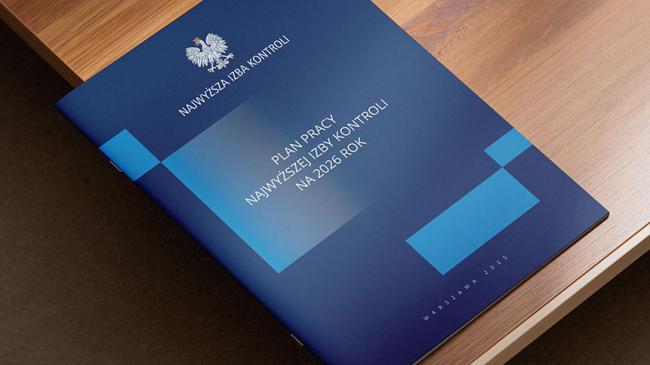


NIK’s work plan for 2026 was developed in a new formula based on six key thematic areas laid out in the Charter of NIK adopted in October last year.
“Updating NIK’s work plan is an important step towards a more cross-cutting approach to audit planning, responding to current challenges the state is currently facing. Security has been adopted as a supreme priority, setting directions for NIK’s activities for 2026” – says Mariusz Haładyj, President of the Supreme Audit Office of Poland.
Security is perceived in a multidimensional way in this document: not only in military terms but it also refers to citizen security, economic stability, protection of infrastructure and resources, resilience of public institutions and social affairs. The work plan has been divided into thematic areas, which enables focusing audit activity on processes being fundamental for the state. Emphasis was also laid on assessment of the state activities aimed at strengthening public trust and effectiveness of the state functioning.
The 2026 work plan covers the following thematic blocks:
- National Security,
- Finance and Public Affairs,
- Development and Economy,
- Cohesion and Infrastructure,
- Social Affairs,
- Natural Resources.
This division makes it possible to carry out audits covering organisational, financial and social aspects and facilitates a more effective threat response.
Key subjects of audits planned for 2026
- Audits scheduled in the National Security area are to deal with the state’s defence capabilities, internal security and civil protection. They will involve, among others, assessment of meeting needs of the Armed Forces of the Republic of Poland in the field of large-calibre ammunition, functioning of the Central Cybercrime Bureau as well as preparedness and operation of the national security management system. A crucial element will also be audits of human resources management in secret services.
The audit scope in this area will be complemented with an assessment of preparedness of the civilian healthcare system to operate in the conditions of an armed conflict, support of shooting training under government programmes and measures related to psychological aid and support for uniform service officers.
In the area of Finance and Public Affairs audits of key processes related to planning, execution and supervision of the state finance were scheduled. They will encompass assessment of the execution of the state budget and the EU funds budget in 2025, implementation of the monetary policy assumptions by NBP and planning of the state’s financial policy for 2026.
The audits will also address selected elements of the activity and financial management of the National Bank of Poland (NBP), efficiency and effectiveness of measures taken by the National Revenue Administration, recovery of receivables and management of free funds by local government units as well as financing of public tasks, including support of the Polish community and Polish people abroad.
- The Development and Economy area will involve audits of efficiency of using public funds and effectiveness of measures fostering the country’s economic development and structural transformation. The following areas will be taken under the microscope: spending of the Reprivatisation Fund, effects of implementing the country’s economic development strategy and implementation of the energy policy in terms of transformation of energy generation sources, taking energy security into account.
- In the Cohesion and Infrastructure area audits have been planned regarding resilience of critical infrastructure, technical and digital security and implementation of policies supporting territorial homogeneity. They will investigate ability to restore road infrastructure after disasters, security at civilian airports in the event of threats involving unmanned aerial vehicles and use of the State's Common IT Infrastructure by the public administration.
NIK auditors will also focus on the functioning of the construction supervision system, implementation of road investments by local governments and conduct of housing policy in selected municipalities. A significant part of audits will be devoted to cybersecurity and information protection, including cybersecurity of information systems and personal data in healthcare facilities, educational institutions and security of water and sewage infrastructure in the face of cyber-attack threats.
- The Social Affairs area comprises audits of quality and availability of public services, as well as effectiveness of the state’s activities in favour of health protection as well as support of families and persons needing help.
Audits in this area will also involve healthcare, including adverse events in healthcare facilities, prevention of HPV infections, implementation of oncology initiatives and financing of clinical trials, performance of social welfare tasks in crisis situations, as well as assessment of the functioning of selected public programmes and institutions, such as: the Institute of Solidarity and Courage, ‘A Good Meal in Hospital’ programme or Youth Sociotherapy Centres.
- Audits in the Natural Resources area will focus on adequacy, efficacy and economy of activities on part of the public administration in the field of environmental protection, agriculture and water management. The audits will cover the following topics: management of agricultural properties, implementation of the “Clean Air” programme, combating bird flu, noise and flood protection, reconstruction of infrastructure after disasters and flood prevention investments.
Additionally, measures supporting agricultural producers affected by natural disasters will be investigated, taking into consideration the social function of forests and implementation of projects increasing the potential of sustainable water management as part of the National Recovery Plan.
A full Polish version of NIK’s work plan for 2026 can be found at the following link: Plan pracy NIK na 2026 r.