

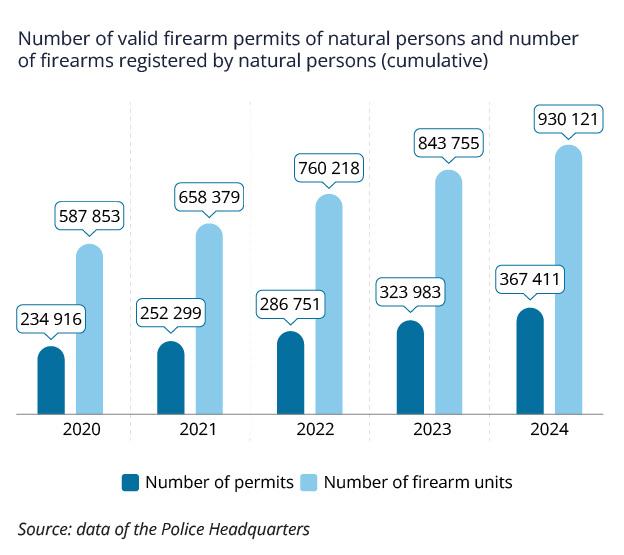
The system of restrictions on firearm access and its supervision in Poland do not include all risk-mitigation mechanisms related to firearm possession, according to NIK. These irregularities are not only of formal nature but they may have adverse impact on citizens’ safety in real terms. This is even more important as in recent years the number of civilian firearm permits issued by the Police has increased by almost 200% - from over 15 thousand in 2020 to nearly 46 thousand in 2024. It needs to be underlined that the data does not say anything about the number of firearm owners because each of them may have more than one permit. Therefore, it remains unknown how many persons in Poland have firearm permits and how many persons are actual firearm owners.
Regulating firearm access stands for administrative control of the state over its possession and use. In EU countries the firearm access is restricted and detailed principles are stipulated in the laws of individual countries. The regulations, though, should meet minimum norms set out in the EU Directive on control of the acquisition and possession of weapons (2021/555 of March 2021). It requires among others that the national regulations establish a system to monitor the compliance with the conditions for granting the firearm permit for the entire period of its validity, and that relevant medical and psychological information be evaluated. The permits should be reviewed in this regard not less than once in five years. Incomplete transposition of the EU regulations into the domestic law exposes Poland to the risk of financial sanctions.
Despite attempts, we did not manage to cover e.g. hunters, holders of sports or collector’s firearm permits with periodic physical and mental health checks. Such persons undergo only one-off Assessment of Motor and Process Skills (AMPS). This is done at the stage of applying for the permit which is granted for an unlimited period. NIK has found that firearm owners in Poland are persons up to 100 years of age.
We also did not implement mechanisms enabling verification if the permit holder still meets the conditions, based on which the document was issued to him or her, e.g. if s/he still is a member of a collectors association (if the permit was issued for collecting purposes). If not, that person may lose this document. In such cases the Police or Military Gendarmerie are authorised, though not obliged, to revoke the permit.
In line with the EU requirements we have launched the Weapons Registration System but with a 5-year delay (in 2024 instead of 2019) and without complete data covering every firearm and each of its significant element.
Creating reliable statistics on the number of persons who received a civilian firearm permit and the actual number of actual firearm owners would require gathering information both from the Police and the Military Gendarmerie.
In reality, by the end of the NIK audit (in June 2025), the Police Headquarters – although it published information on its website about the number of firearm permit holders, it concerned only the number of granted permits which are issued depending on the firearm purpose – hunting, sport shooting or collecting.
The Police has changed the description of the published statistical data from “number of persons” to “number of permits” only following the NIK audit.
This is not the only problem, though. The permit specifies how many firearms the applicant may own for a concrete purpose (e.g. hunting). However, this is the applicant’s decision to what extent they make use of the permit.
Another problem is the lack of information about the death of firearm permit holders. The query made by NIK has shown that firearms left after their owners’ death remained unsecured for up to 30 years.
None of the audited provincial Police offices - despite their access to personal identification numbers - conducted systemic verification of data in terms of possible death of firearm owners. If not secured in time the weapon left after its owner’s death may be lost. Unfortunately, it may also potentially be used by unauthorised persons, including criminals.
NIK stands in a position that reliable data on the number of firearm permit holders and firearm owners are pivotal.
The NIK audit – covering the period from 1 January 2022 to 8 August 2025 – has shown that we have implemented the EU regulations on the activity of dealers and brokers in weapons trade.
Who may get a firearm permit?
The constitutional right to own firearms exists in the USA, whereas in the EU countries firearm access is restricted and detailed principles and the regulation methods are set out in the national laws of individual countries. The law in the Czech Republic is considered as one of the most liberal one across the EU. One can obtain the firearm permit there in a similar way as the driving licence – after submitting e.g. medical test results and the certificate of no criminal record. On the other hand, the regulations in Germany are viewed as the strictest ones: obligatory procedures under the German law involve e.g. credibility check. Also, the persons applying for the firearm permit in Germany are required to prove the need to own the weapon and sign the civil liability insurance agreement for at least EUR 1 million.
Legal firearm possession in Poland currently requires obtaining the following documents:
- private firearm permit – in case of natural persons (it is not granted for particularly dangerous weapons, such as e.g. machine gun),
- bearer firearm permit – issued e.g. to security companies or sports clubs,
- or consent to possess firearms which enables e.g. security workers, members of shooting galleries to use weapons being the possession of the company or the club.
Black-powder (historic) firearms created before 1885 and their replicas can be possessed without a permit. However, the kinetic energy of projectiles fired from such weapons is often comparable to, or even exceeds, that of modern firearms chambered for fixed ammunition. Since these weapons are not subject to mandatory registration, they are untraceable in circulation and may be used e.g. by criminals as an alternative to modern firearms.
In 2019 - 2024 (July), 73 offences involving black-powder firearms were recorded, including 28 cases of homicide or attempted homicide. Weapons of this type were also used against Police officers on duty. Therefore, the Police Commander-in-Chief made a proposal to the Minister of the Interior and Administration to regulate access also to black-powder weapons. By the end of the audit, legislative work aimed at changing the regulations was ongoing.
The conditions for obtaining rights to use firearms include, among others: indicating an important reason to possess the weapon, adequate mental and physical state (confirmed by medical and psychological certificates), no criminal record, posing no threat, passed test on specific regulations and firearm skills.
In the audit period, the Police issued bearer firearm permits only to eligible persons, whereas the issuance of private firearm permits and consents to firearm possession was not always preceded by proper verification if the applicant met the conditions set out in the Weapons and Ammunition Act.
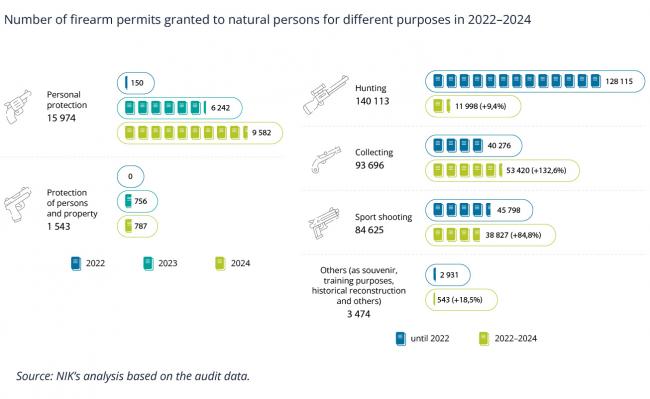
NIK auditors revealed e.g. the following cases: issuing firearm permits for personal protection despite the absence of permanent, real and above-average threat to life, health or property. The auditors also found irregularities in the process of verifying compliance with meeting requirements for obtaining authorisation to possess firearms – if they had no criminal record or if they did not pose any threat to themselves, to public order or safety. Besides, permits were issued without testing the applicants for their knowledge of regulations on firearm possession and use or firearm skills.
As a rule, proving good reason to possess firearms comes down to submitting documents which confirm having specific rights or membership in an organisation whose statutory activity is related to the purpose of possessing the weapon. The loss of rights or e.g. resignation from membership may result in withdrawing the permit. The Weapons and Ammunition Act of 1999 contains provisions which may be used for this purpose but only with regard to the holders of permits issued for hunting and sport shooting purposes. The Polish Hunting Association and management boards of shooting associations are obliged to annually provide relevant Police authorities with updated lists of members doing hunting or sport shooting using their own firearms. The problem is that none of seven audited provincial Police offices enforced annual lists of members from all obliged unions and associations – although such lists could be the source of information about the deaths of firearm owners.
As for the holders of other firearm permits, against the EU law, there are no mechanisms to allow verifying if the firearm permit holder still meets the requirements, based on which the permit was issued.
Periodic health checks obligatory, but not for all
In line with the EU regulations each firearm permit holder should undergo periodic physical and mental health checks at least once in five years. In Poland this obligation covers only civilians having firearm permits for personal protection and for the protection of persons and property. In the audit period, in one of seven provincial Police offices the verification of compliance with the obligation to submit periodic medical and psychological certificates was started only in 2025 and in five Police offices the health checks expired. In an extreme case the expiration date was exceeded by three years.
Other firearm permit holders – such as hunters, persons using firearms for sport shooting or collecting – do not have to undergo periodic physical and mental health checks. In their case the physical and mental skills are evaluated only once, at the stage of applying for the permit.
Police officers, professional soldiers and officers of other uniformed services (e.g. Internal Security Agency or Central Anti-Corruption Bureau) having a service firearm are subject to their own, internal periodic health checks. But when applying for a personal firearm permit they do not have to submit medical or psychological certificates.
In line with the provisions of law such documents may not be required from them, even if the Police or the Military Gendarmerie have information or even evidence pointing to the applicants’ problems with addictions or mental disorders. Therefore, both the Police and the Military Gendarmerie demand changes in the law. According to these services submitting the results of medical and mental health checks by officers and soldiers prior to obtaining a personal firearm permit will help eliminate doubts as to whether they pose a threat or not.
At the same time, the law enables the Police to appeal against the medical certificate issued to persons who – according to the Police - may pose a threat to themselves or to public safety and order. Each of the audited provincial Police offices exercised that right, and reasons included suspected alcohol or drug addiction or domestic violence applying for the permit. Doctors and psychologists, against whom the appeals were filed, did not confirm the judgement in the first instance about firearm skills in case of 32% to 100% reviewed cases (depending on the provincial Police office).
Also, the person applying for the firearm permit also has the right to appeal against medical or psychological opinion. The Military Gendarmerie may not appeal, therefore they demand a change in the law also in that matter.
Attempts made but without effects – will the law be changed?
An attempt to change the law on covering firearm permit holders with physical and mental health checks have been made twice recently. The deputies' project of 2024 assumed e.g. extending the periodic health check obligation to hunters firearm permit and increasing the frequency of health checks – once in two years for persons of over 70 years of age. The Sejm rejected the bill at its first reading in January 2025.
In September 2025, another bill was prepared which extended the periodic health check obligation to hunting, sport shooting and training firearm permits. However, by the end of the audit it was not submitted at the Sejm.
Recommendations
In view of the audit findings NIK has made, among others, de lege ferenda proposals to the Minister of the Interior and Administration to take efforts aimed at implementing the following legal regulations:
- obliging all firearm owners to undergo periodic physical and mental health checks;
- obliging bodies issuing firearm permits to monitor if the factual circumstances, based on which the permit was issued, persist;
- regulating the ownership of black-powder firearms;
- enabling the authorisation of the Police officers from units reporting to provincial commanders of the Police/ the Commander-in-Chief to control the conditions of storing firearms and ammunition by natural persons;
- extending the group of authorities entitled to appeal against medical or psychological certificates to relevant commander of the Military Gendarmerie unit;
- obliging officers and professional soldiers applying for personal firearm permit to submit medical and psychological certificates;
- ensuring that the Police obtain information on the termination of service in a systemic manner by officers of the state armed services who have a firearm permit other than for service purposes.
Apart from that NIK has made the following recommendations:
To the Minister of the Interior and Administration:
- to make sure the existing register of firearm permit holders and the register of firearms and their significant components operate in line with the initial assumptions;
to the Police Commander-in-Chief:
- to make essential modifications to the „Weapons” register in a manner allowing preparation of statistics based on the entire informational scope of the module, including the number of firearm permit holders and the number of firearm owners.