

Preventative healthcare services for children and young people up to the age of 19 should be provided by a primary healthcare doctor, nurse or midwife, according to the provisions of the Minister of Health’s Regulation on guaranteed primary healthcare services. According to this Regulation, a guaranteed service provided by the primary healthcare doctor is a postnatal visit (the first consultation with a doctor carried out between the first and fourth weeks of the child’s life, to assess the newborn’s health and educate parents on care and feeding, conducted at home or in an outpatient setting) followed by a routine child health surveillance (including health screening). For primary healthcare nurses, these services comprise a postnatal visit and a health screening test, while for primary healthcare midwives, they comprise a postnatal visit. The regulations also set out in detail a catalogue of tests for the relevant age groups, which should be performed as part of these services.
The lack of systematic and comprehensive preventive healthcare hinders the early detection of serious illnesses and congenital anomalies in children and young people, as well as cases of abuse by parents, legal guardians, or those closest to them. Such situations can be detected at an early stage by a doctor, nurse, or midwife when conducting systematic preventive check-ups.
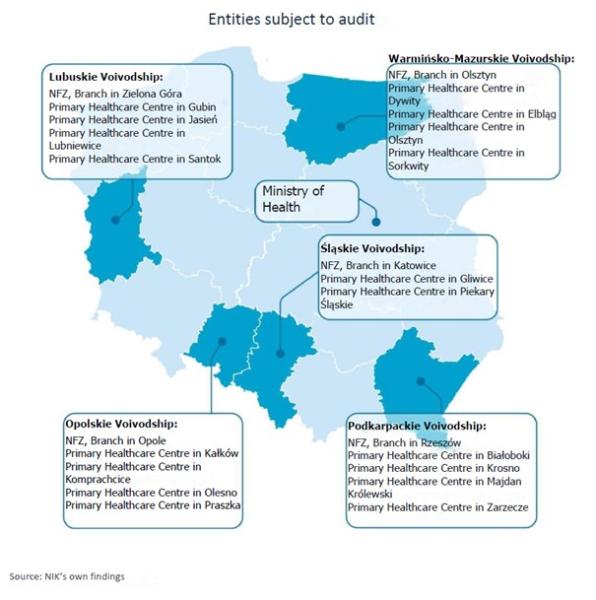
The NIK carried out an audit at the Ministry of Health, five Voivodship Branches of the National Health Fund (Narodowy Fundusz Zdrowia, NFZ) and eighteen primary healthcare centres in the following voivodships: Lubuskie, Opolskie, Podkarpackie, Śląskie and Warmińsko-Mazurskie.
A small number of children and young people have undergone preventive examinations
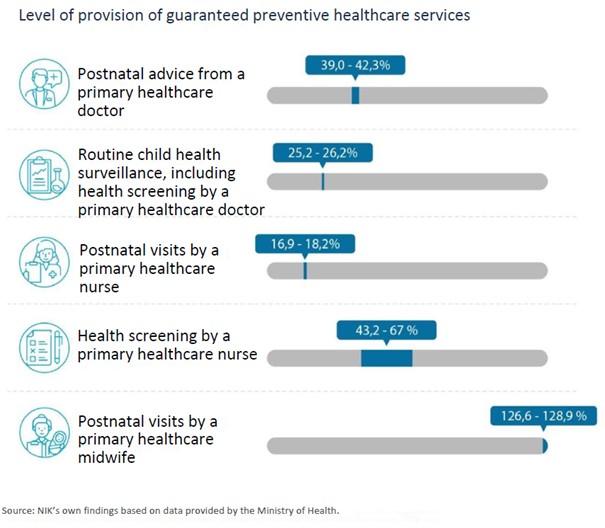
Primary healthcare centres, apart from postnatal visits by primary healthcare midwives, have provided preventive examinations to only a small number of eligible children and young people. According to data from the Ministry of Health, nationwide in the individual years under review, primary healthcare doctors covered only between 25.2% and 26.2% of the population with routine child health surveillance, and between 39% and 42.3% with postnatal visits. In contrast, primary healthcare nurses covered with health screening between 43.2% and 67%, and with postnatal visits only between 16.9% and 18.2% of the population. More preventive examinations (compared to primary healthcare doctors and nurses) were carried out by primary healthcare midwives as part of their postnatal visits. Data from the Ministry show that they covered by preventive examinations between 126.6% and 128.9% of the population. The fact that the number of children covered by these services exceeded the number of children born in a given year, according to the Statistics Poland (GUS), was due to the fact that children born in the last week of December had their postnatal visits in January and February of the following year. The examinations performed by primary healthcare midwives were funded, in addition to the capitation rate (an amount set by the National Health Fund), by additional public funds for each visit.
Funding for primary healthcare, including preventive examinations
Between 2022 and 2024, the following amounts were spent from the state budget’s capitation rate to fund primary healthcare services, including preventive examinations for children and young people up to the age of 19, respectively: PLN 3.2 billion, PLN 3.6 billion, and PLN 3.8 billion. An additional PLN 37 million was paid in 2022 for postnatal visits by primary healthcare midwives, and approximately PLN 36 million in both 2023 and 2024.
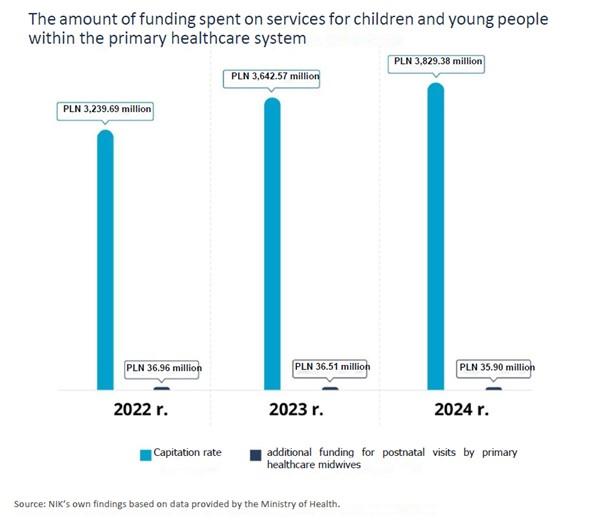
Under current regulations, the National Health Fund pays healthcare providers a capitation rate for registered patients, regardless of whether they use the services or not.
No entries in medical records confirming that examinations had been carried out
The NIK audit found that in as many as 17 out of 18 primary healthcare centres audited, there were no entries in patients’ medical records confirming that a full range of preventive examinations for children and young people had been carried out by a primary healthcare doctor, nurse or midwife, as required by the Regulation on guaranteed primary healthcare services. The audit findings showed that either the required scope of examinations had not been carried out, or this had not been reflected in the medical records. The NIK concluded that the reasons for this situation were that preventive examinations were carried out during visits associated with a child’s illness, the complexity of the health problems reported by parents, and a lack of knowledge about the current regulatory requirements.
The Minister of Health’s lack of reliable knowledge about the state of preventive healthcare and failure to exercise oversight
The Minister of Health had limited knowledge about the state of preventive healthcare. The Minister was unaware of the actual number of children and young people covered by primary healthcare doctor services, the number of children covered by postnatal visits by primary healthcare nurses, the number of health screenings carried out by these nurses, and the number of children covered by primary healthcare midwife services. Despite the obligation to conduct statistical surveys, the Minister did not enforce the submission of MZ-11 statistical reports by primary healthcare centres, which were one of the sources of information on preventive healthcare services provided to children and young people. In 2022, 78.1% of the required entities submitted them; in 2023, 77.4%; and in 2024, 71.5%. The Minister attributed this to a lack of instruments that would effectively incentivise the submission of data. However, in the opinion of NIK, the Minister may, as part of the supervision exercised, take measures to encourage primary healthcare centres to submit such data by emphasising, in particular, that the provision of statistical data inconsistent with the facts, refusal to fulfil statistical obligations, and the submission of statistical data after the specified deadline are acts for which the Act on Public Statistics provides for criminal liability.
The Minister of Health failed to supervise the activities of the National Health Fund concerning preventive healthcare for children and young people within the framework of primary healthcare, as well as healthcare providers, despite being under an obligation to do so (as set out in the provisions of the Act on Healthcare Services Financed from Public Funds). The Minister did not request documents, information or explanations from the National Health Fund or healthcare providers and did not conduct any inspections at their premises. The Minister attributed this to the absence of any indications of irregularities.
In carrying out the coordination and monitoring tasks set out in the Public Health Act, the Minister failed to consider issues directly related to preventive healthcare for children and young people provided under primary healthcare.
This resulted in ineffective management, and the isolated measures taken by the Minister in this area did not lead to an increase in the number of preventive examinations performed.
Furthermore, the Minister was slow to proceed with work on amending the regulation on guaranteed primary healthcare services, the provisions of which – when setting out the deadlines for routine health checks and health screenings – continued to refer to lower secondary and upper secondary schools that had already been closed.
Lack of monitoring by the National Health Fund and failure to analyse data
The President of the National Health Fund, apart from isolated cases, did not monitor the implementation of preventive examinations for children and young people. The Voivodship Branches of the National Health Fund did not analyse the reports submitted by primary healthcare centres, even though the directors of these branches are required to monitor the implementation of contracts for the provision of publicly funded healthcare services. Only one of them analysed some of the services. However, in each of the audited branches, cases were identified where primary healthcare centres failed to report the provision of services; yet it was not established whether this was due to the services not being provided or to the examinations conducted not being included in the reports submitted. This resulted in a lack of reliable data on the level of service delivery.
Errors in the reporting of data on preventive examinations
The audit revealed inconsistencies between medical records and reported data. Only five out of the 18 primary healthcare centres audited submitted accurate data to the National Health Fund about preventive healthcare services provided to children and young people by doctors, nurses and midwives. Furthermore, in as many as 12 cases, the information provided in the annual Reports on the activities and personnel in outpatient health care (MZ-11) was inconsistent with the data established during the Office’s audit and with the data submitted to the Voivodship Branches of the National Health Fund. As established during the audit, the Minister did not use data from the National Health Fund (NFZ) to draw up the Health Needs Map because, in the Minister's view, it was of little informational value.
Conclusions and recommendations
To the Minister of Health for:
- taking measures to extend preventive healthcare within primary healthcare to cover a greater number of children and young people than at present, with a view to ensuring the early detection of serious diseases and congenital anomalies. One way of achieving this could be for primary healthcare centres to inform parents about the benefits of regular preventive examinations, including routine child health surveillance and health screening, and to send reminders about appointment dates via ICT systems, electronic means of communication or publicly available telecommunications services (e.g., the Internet Patient Account (IKP), the mObywatel app, text message alerts);
- amending legislation to enable the recording of the results of preventive examinations for children and young people in an electronic system, with the option of making these results available to doctors outside the primary care centres conducting the examinations. This would facilitate a more efficient flow of information on patients’ health status, improve the coordination of care, and enable faster diagnostic and therapeutic decision-making;
- requiring primary care centres providing publicly funded preventive healthcare services for children and young people to provide reliable information on the actual scale and types of services provided, to ensure a sufficient level of information for initiating, developing and monitoring the Council of Ministers’ policy on preventive healthcare for children and young people;
- placing the activities of the National Health Fund (including through audits) related to preventive healthcare for children and young people provided within the primary healthcare system under supervision, to ensure that preventive examinations are carried out and documented correctly;
- updating the provisions of the Regulation on guaranteed benefits in the field of primary healthcare by removing, from Annex 1, Part III, the provisions concerning already-closed lower and upper secondary schools and replacing them with the current stages of school education (primary and secondary schools), according to which preventive examinations are carried out.
To the President of the National Health Fund (NFZ) for:
- conducting inspections of primary healthcare centres regarding the provision, documentation and reporting of preventive healthcare services for children and young people, in a manner that enables an assessment of whether these services were actually provided and whether they were delivered in compliance with all the requirements set out in the applicable legislation.
To the Directors of Voivodship Branches of the National Health Fund (NFZ) for:
- the reliable monitoring of the implementation of contracts covering preventive healthcare services provided within the primary healthcare system, including, in particular, by verifying the data reported by healthcare providers on the provision of preventive examinations for children and young people.