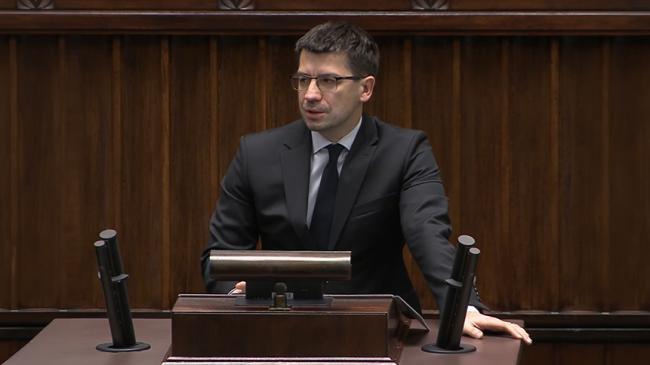


The answer to this question is provided by the Analysis of the Execution of the State Budget and Monetary Policy Guidelines in 2025, presented today by the President of the Supreme Audit Office (Najwyższa Izba Kontroli, NIK), Mariusz Haładyj, in the Sejm. Along with this document, we are publishing a map of State expenditure, the key findings of the audit, and a full set of the results of budgetary controls in individual institutions.
The analysis of the Execution of the State Budget and Monetary Policy Guidelines is the most important annual report prepared by the Supreme Audit Office. It summarises over a hundred audits carried out in government administration, state legal entities, executive agencies, and other bodies using public funds. Based on the findings of these audits, the NIK assesses how the state budget is being implemented and presents the key conclusions on the management of public funds.
– I hope that our conclusions will help in the conduct of the State's economic policy, because the ability to pursue effective public policies in every area – economic, social, defence, healthcare, environmental protection, infrastructure, digitalisation, etc. – depends on the state of public finances – said the President of the NIK.
The NIK pointed out that systemic problems rarely arise overnight. They are usually the result of a build-up of decisions taken over the years.
Key findings of the budgetary audit
In 2025, the state budget was characterised by a significant imbalance. Expenditure significantly exceeded revenue. The largest expenditure items were compulsory social insurance, national defence, family support and – less favourably – debt servicing costs. One of the factors enabling a significant rise in expenditure was the relaxation of the stabilising expenditure rule, which was intended to curb excessive growth in spending.
At the same time, central government revenue fell. On the one hand, this was the result of the reform of local government funding, which was viewed positively. A portion of tax revenue was transferred to local authorities, thereby enhancing their financial stability. This enables them to plan their investments and services for residents more effectively. On the other hand, for the third year running, tax revenues turned out to be lower than planned. The shortfall in planned revenue hampered the implementation of the State budget and contributed to an increase in extra-budgetary debt financing. This financing was not as high as in previous years, but it was still maintained. This contributed to an increase in public debt. Although this increased the size of the budget deficit, NIK viewed favourably the use of state budget funds to repay part of the liabilities incurred in previous years by the Polish Development Fund (Polski Fundusz Rozwoju, PFR) and the National Development Bank (Bank Gospodarstwa Krajowego. BGK), as it reversed the effects of financing expenditure outside the budget.
A positive trend in 2025 was the improvement in the transparency of public finances and greater financial discipline. The highest proportion of positive assessments in recent years was recorded across the various audited entities.
For the first time in its history, the NIK carried out an indicator-based comparison of the effectiveness of selected expenditure incurred by voivodes. Similar public services in different regions generated varying costs. Therefore, in the NIK’s view, it would be worthwhile to introduce uniform standards for the provision of these services and rules for their funding.
The NIK calls for planned, specific, and gradual measures
– Serious threats rarely arise overnight. They are usually the result of a build-up of decisions taken over the years. We also wish to highlight potential risks and possible ways of countering them. With this in mind, in our Risk Analysis we have identified the risks we perceive, diagnosed the problems and formulated recommendations that can be implemented in the long term – emphasises Mr Haładyj, the President.
The Supreme Audit Office points out that it would be advisable to take steps to reduce budgetary imbalances. The relatively favourable economic situation should be used to build resilience for harder times. Increasing fixed expenditure at a time when revenue growth is failing to keep pace with the rate of increase in such expenditure does not enhance financial security. In such circumstances, even a gradual reduction of the imbalance becomes a challenge, as it is necessary to avoid undermining the economy’s long-term growth potential and to maintain the State’s ability to finance security, public investment, and social expenditure. The Office recommends placing greater emphasis on reviews of public expenditure to eliminate those items that do not deliver the expected results. This could increase public acceptance of the adjustment measures resulting from a substantive, data-driven review.
– The State budget in 2025 was not in a state of crisis. Poland did not lose access to funding. However, to improve the long-term stability of public finances, it is essential to plan in advance measures to reduce the budget deficit and curb the rise in the public debt-to-GDP ratio. The problem is not even a high deficit in a single year, but its persistence over the longer term, which contributes to a high rate of public debt accumulation despite a favourable economic situation. Correcting the trajectory of growing fiscal imbalances at a sufficiently early stage will help to limit the risk of far more drastic and costly measures in the future, should it become necessary to apply precautionary procedures. This is the aim of the NIK’s conclusions and recommendations. We are not calling for sudden and radical measures, which could have a negative impact on the economic situation and hamper economic growth. We are recommending that gradual, yet concrete, measures should be planned and undertaken so that they can be implemented optimally and effectively in a timely manner – states President Haładyj.
What was the public money spent on?
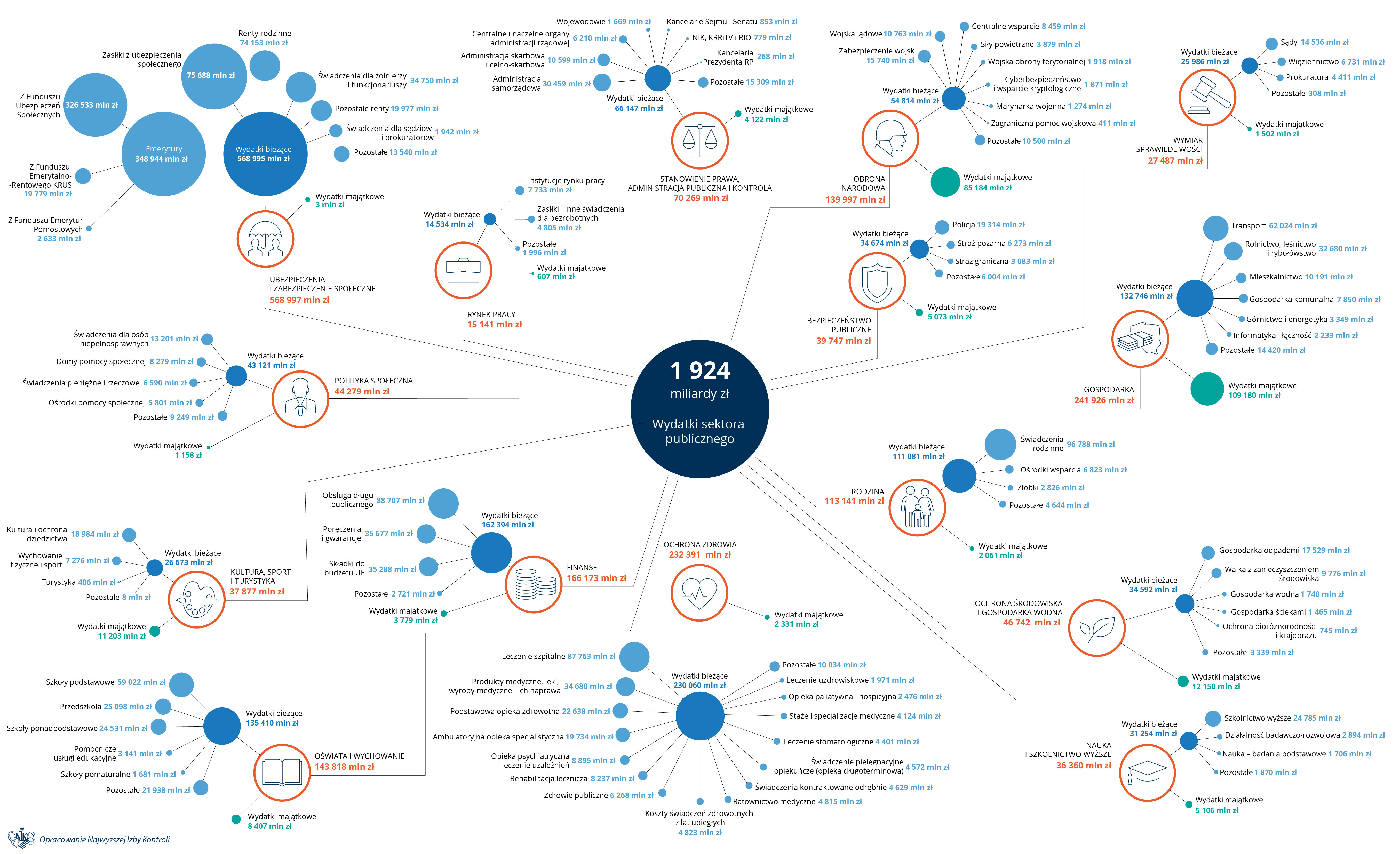
Opis grafiki
The infographic "Public Sector Expenditure Map 2025" (prepared by the Supreme Audit Office of Poland) presents public sector expenditures totaling PLN 1,924 billion, divided into 15 categories. For each category, the graphic provides the total amount, a breakdown into current and capital expenditures, and the amounts of the main detailed expenditure items. All figures are expressed in millions of Polish zlotys (PLN million).
| Expenditure Category | Amount (PLN million) |
|---|---|
| Social Insurance and Social Security | 568,997 |
| Economy | 241,926 |
| Healthcare | 232,391 |
| Public Finance | 166,173 |
| Education | 143,818 |
| National Defence | 139,997 |
| Family Policy | 113,141 |
| Legislation, Public Administration and Oversight | 70,269 |
| Environmental Protection and Water Management | 46,742 |
| Social Policy | 44,279 |
| Public Safety | 39,747 |
| Culture, Sports and Tourism | 37,877 |
| Science and Higher Education | 36,360 |
| Justice System | 27,487 |
| Labour Market | 15,141 |
Description of the methodology for compiling the 2025 public expenditure map
This year, for the first time, we are also publishing a map of State expenditure. This tool allows users to trace the structure of public expenditure and see which areas of State activity absorbed the largest amounts of funding.
– The State budget comprises thousands of items and hundreds of billions of Polish zlotys (PLN). For the first time, we are also presenting State expenditure in the form of a map. We want data on public finances to be more accessible and understandable to citizens – explains President Haładyj.
Take a look at the documents: full analysis and audit findings
In addition to the Analysis of the Execution of the State Budget and Monetary Policy Guidelines in 2025, we are also making available a publication setting out the key audit findings and a comprehensive set of information on the results of the audit of the implementation of the State Budget in individual budgetary sections and financial plans.