

The Supreme Audit Office has given a negative assessment of the functioning of the Justice Fund during the period under review – from 1 January 2021 to 9 May 2025. It also gave a negative assessment of the actions taken during this period by the Minister of Justice (the Fund Administrator) regarding the establishment of the legal and organisational framework for the Fund operation. It has been established that the Fund financial management between January 2021 and December 2023 was conducted in gross breach of the overarching principles of public finance, namely the principles of transparency, and purposefulness and economy in expenditure. Nor did it comply with the principles governing the operation of special-purpose funds, which are intended to serve the purpose of carrying out specific and clearly defined public tasks. As a result, funds that should have been allocated primarily to supporting victims of crime and reintegration of former prisoners were, to a large extent, spent inappropriately and wastefully – the total amount of irregularities identified during the audit amounted to nearly PLN 270 million
State special-purpose funds are a specific organisational form of public finance sector entities. They constitute an exception to the principles of unity and universality of the state budget by setting aside specific categories of revenue and allocating them to finance a precisely defined, narrow range of state tasks. In theory, this should lead to improved operational efficiency and ensure stable funding.
The Fund for Victim Support and Post-Penitentiary Assistance – the Justice Fund (the Justice Fund or the Fund) was established in 2012, primarily to assist victims of crime. Legal, psychological or financial support for these individuals, funded from sums awarded against the convicted persons, was intended, on the one hand, to be an expression of social justice and, on the other, to demonstrate the state’s concern for victims.
The implementation of these objectives has been regularly scrutinised by the Supreme Audit Office (Najwyższa Izba Kontroli, NIK) in recent years (Assistance to victims of crime under the Victim Support Fund – in 2018; Implementation of the state budget in 2018, part 37 - Justice and the implementation of the financial plans of the Victim Support and Post-Penitentiary Assistance Fund – the Justice Fund and the Fund for the Vocational Activation of Convicts and the Development of Prison Work Schemes – in 2019; Implementation of the tasks of the Victim Support and Post-Penitentiary Assistance Fund – the Justice Fund – in 2021), and the findings of the audit were forwarded to the Fund Administrator, namely the Minister of Justice. “The findings of these audits revealed that funds intended primarily for victims of crime were in fact spent on other purposes, and in an uneconomical and irresponsible manner,” says Paweł Gibuła, the acting deputy director of the NIK’s Department of National Security, who oversaw the audit. Given that those acting as Fund Administrators until December 2023 rejected requests/motions made by the Supreme Audit Office (NIK), either by failing to act on them or by implementing them in a manner entirely at odds with their actual content, the NIK Council, in August 2023, included a further audit of the functioning of the Justice Fund in the NIK Work Plan for 2024.
Circumstances surrounding the conduct of the audit
The audit by the Supreme Audit Office (NIK ), which began in May 2024 (covering the period from 1 January 2021 to 9 May 2025) was intended, in addition to summarising previous audits, to enable the development of recommendations that would systematically counteract the wasteful use of public funds and restore to victims of crime the funds due to them. The audit coincided with law enforcement activities in connection with an investigation into irregularities in the expenditure of funds from the Fund. It was therefore conducted under exceptional circumstances, which included: the seizure of documentation by law enforcement bodies; the detention of senior management from certain audited entities in a remand centre; and the refusal of those responsible for the identified irregularities to give evidence or provide explanations, invoking the threat of criminal liability. This resulted in the need to extend the audit at the audited entities, but did not affect the scope or significance of the findings made by NIK.
– As part of this audit, NIK once again conducted a comprehensive examination of all aspects of the Justice Fund operations, focusing on the proper and effective use of funds by the Fund Administrator and 22 beneficiaries: one university and 21 non-governmental organisations, with which 30 contracts were concluded with a total value of over PLN 260 million, representing just over 30% of the total value of contracts in force during that period – explains Paweł Gibuła. The audit covered all areas of the Fund activities:
- post-penitentiary assistance;
- assistance provided to victims of crime and witnesses;
- crime prevention.
The free and uncontrolled use of funds
Legislative changes introduced in 2017, which broadened the Fund objectives to include the broadly defined and vague concept of ‘crime prevention’, resulted in funds being allocated to such a wide variety of tasks that , in the opinion of the NIK, the Justice Fund has, in practice, ceased to function as a dedicated fund. By introducing the so-called non-competitive grant allocation procedure, the Minister of Justice has ensured that funds could be allocated to virtually any institution and for any purpose. Those who held the post of Fund Administrator until December 2023 consistently disregarded the assessments, comments and motions made following successive audits by NIK and awarded grants for projects that only appeared to fulfil the objectives of the Justice Fund. As part of crime prevention measures, funding was provided, for example, for: a construction project used for the Foundation’s own purposes; the development and maintenance of websites on which material supporting specific political parties was published; the purchase of a camper van (under the guise of providing, amongst other things, legal advice); mountain and road races; film festivals; and legal and management training for selected groups of people. As part of the support provided to victims of crime, over PLN 66 million was allocated to a project implemented by the Profeto.pl Foundation, which was required to provide such support for just one year (for more information on the use of public funds by beneficiaries of the Justice Fund, see The Functioning of the Justice Fund).
Contests in name only
“NIK’s negative assessment primarily concerned the way in which grants were awarded from the Justice Fund. When allocating these funds, the Administrator not only failed to ensure equal treatment of all entities applying for funding, but actually favoured certain applicants and made arbitrary decisions as to which of them should receive support” emphasises Paweł Gibuła. In doing so, the Administrator took steps to counter allegations that his decisions were arbitrary by securing favourable recommendations from selection boards for the entities he favoured.
A detailed examination of 15 open tenders (contests) for the award of contracts to non-governmental organisations revealed flagrant breaches of the principles of fair competition. These mainly involved staff at the Ministry of Justice providing informal assistance to certain entities in preparing their bids even before they were officially submitted, and even before the respective contests were announced. The selected bidders (Fundacja Mocni w Duchu, Stowarzyszenie Fidei Defensor, Fundacja Centrum Pomocy Pokrzywdzonym i Prewencji Przestępczości, Stowarzyszenie Przyjaciół Mediów, Instytut Prawa Ustrojowego, Fundacja Warszawskie Seminarium Aksjologii Administracji) were thus given guidance on how to amend or supplement their applications to improve their chances, whilst the Minister thereby had grounds to argue that he was indeed supporting the highest-quality bids.
Pressure on members of selection boards
Another mechanism used to subsidise bids favoured by the Ministry’s leadership at the time was to exert influence over selected members of the selection boards and the substantive assessments they made. The substantive assessment forms were reviewed by the management of the Justice Fund Department or other staff designated for this task, following which these individuals submitted their suggestions regarding changes to the assessments in order to achievethe scores for individual bids expected by the Ministry of Justice. This mechanism was applied, amongst other things, in the case of the Profeto.pl Foundation, resulting in that organisation being awarded a higher score, and the scores of the other participants in the contest being reduced.
Another mechanism identified during the audit that influenced the outcome of the tenders was the referral of selected bids for re-evaluation. It was applied to at least four bids that had initially received a low score and were ineligible for funding. They were then forwarded to other assessors, who this time awarded them marks and scores sufficient to secure funding.
The lack of fairness in contests
The contests examined were organised in an unreliable manner and did not provide the conditions necessary for an objective and independent evaluationof the bids. First and foremost, the Administrator has not drawn up guidelines specifying which elements should be awarded extra marks and in which cases negative marks should be awarded. As a result, members of the selection boards made their assessments on a discretionary basis, evaluating, for example, identical bids and identical circumstances in completely different ways. This has even been sanctioned by the Administrator, who has introduced an additional, entirely subjective evaluation criterion in certain crime prevention tenders – the so-called overall (letter) grade. The letter grade took precedence over the official assessment criteria set out in the Fund Regulation and the number of points awarded.
Competitions for grants from the Fund, which were poorly organised, lacked transparency and were decided on a discretionary basis, were one of the main causes of irregularities in the other areas covered by the audit. – In the case of contests in the field of crime prevention, NIK went so far as to conclude that they were not designed to address real-world problems. Instead, they served as a pretext for using public funds to support a specific group of entities – they financed their day-to-day operations rather than the implementation of the Justice Fund objectives. This resulted in 16 out of the 18 grants in this area being awarded inappropriately, amounting to a total of PLN 98.7 million – adds Paweł Gibuła.
Unsecured contracts, unchecked funds
The Fund Administrator failed to adequately safeguard the interests of the State Treasury in the contracts entered into. He allowed a situation in which a significant proportion of contractors received unjustified, substantial revenue from administrative costs that were settled on a lump-sum basis and were not properly documented. He failed to prevent conflicts of interest involving those responsible for deciding on the allocation of public funds and the beneficiaries of those funds, and did not put in place effective mechanisms to oversee the implementation of contracts. Nor did he carry out a thorough review of the outcomes and costs of the tasks assigned to contractors under grant contracts. The findings of the NIK auditors indicate that the actions of persons acting as the Administrator of the Justice Fund between 2021 and 2023 were unreliable. What is more, such actions were often deliberate and stemmed from a desire to use the Fund resources to support a specific group of entities.
A similar situation arose in relation to activities designed to promote the Justice Fund – decisions regarding the focus and intensity of the promotion, as well as the communication channels used, were made on an ad hoc basis and were discretionary in nature. The contractors for the promotional activities were selected in an unreliable manner, in breach of the regulations, i.e. without applying public procurement law or by maintaining only the appearance of competition, and the activities themselves also served to promote the image of specific individuals. A particular surge in such activities was observed in 2023, during the election campaign for the Sejm and Senate.
Fund management costs have exceeded the limits
NIK also criticised the fact that the Minister for Justice, in breach of the provisions of the Regulation on the Fund, twice exceeded the permissible limit for the Fund operating costs. This happened for the first time in 2021, when the limit stood at PLN 6.4 million and was exceeded by almost PLN 1 million (15%). The service charge threshold was then raised from 2.5% to 4% of projected revenue, but this did not prevent the regulations from being breached again. In 2023, the limit had already risen to PLN 11.6 million, yet it was still exceeded by PLN 16.6 million (142%). This was primarily due to a drastic and unjustified increase in the costs of promoting the Fund during the 2023 election campaign and in the period immediately preceding it, and meant that funds earmarked for assistance to victims of crime or the rehabilitation of former prisoners were used contrary to the applicable regulations, including for the purpose of promoting the person and the circle of the then Fund Administrator.
Lessons not learnt from previous audits
NIK also gave a negative assessment of the measures taken by the Fund Administrator immediately following the conclusion of the audit in 2021 (Implementation of the tasks of the Victim Support and Post-Penitentiary Assistance Fund – the Justice Fund). Not only were the systemic irregularities, identified at the time, not rectified, but on the contrary, their scale has increased.
Furthermore, the measures taken by the Minister of Justice from December 2023 (until the end of the audit) have only improved the legal and organisational framework for the operation of the Justice Fund to a limited extent. – Although NIK welcomes the introduction in December 2024 of regulations designed to limit the risk of discretionary and non-transparent allocation of public funds, there is still neither a detailed list of the Fund tasks nor specific recommendations regarding changes to its operations. The situation was not improved by the establishment of the Council for the Victim Support and Post-Penitentiary Assistance Fund – the Justice Fund – specifically for this purpose, notes Paweł Gibuła.
Conditions for remedial action
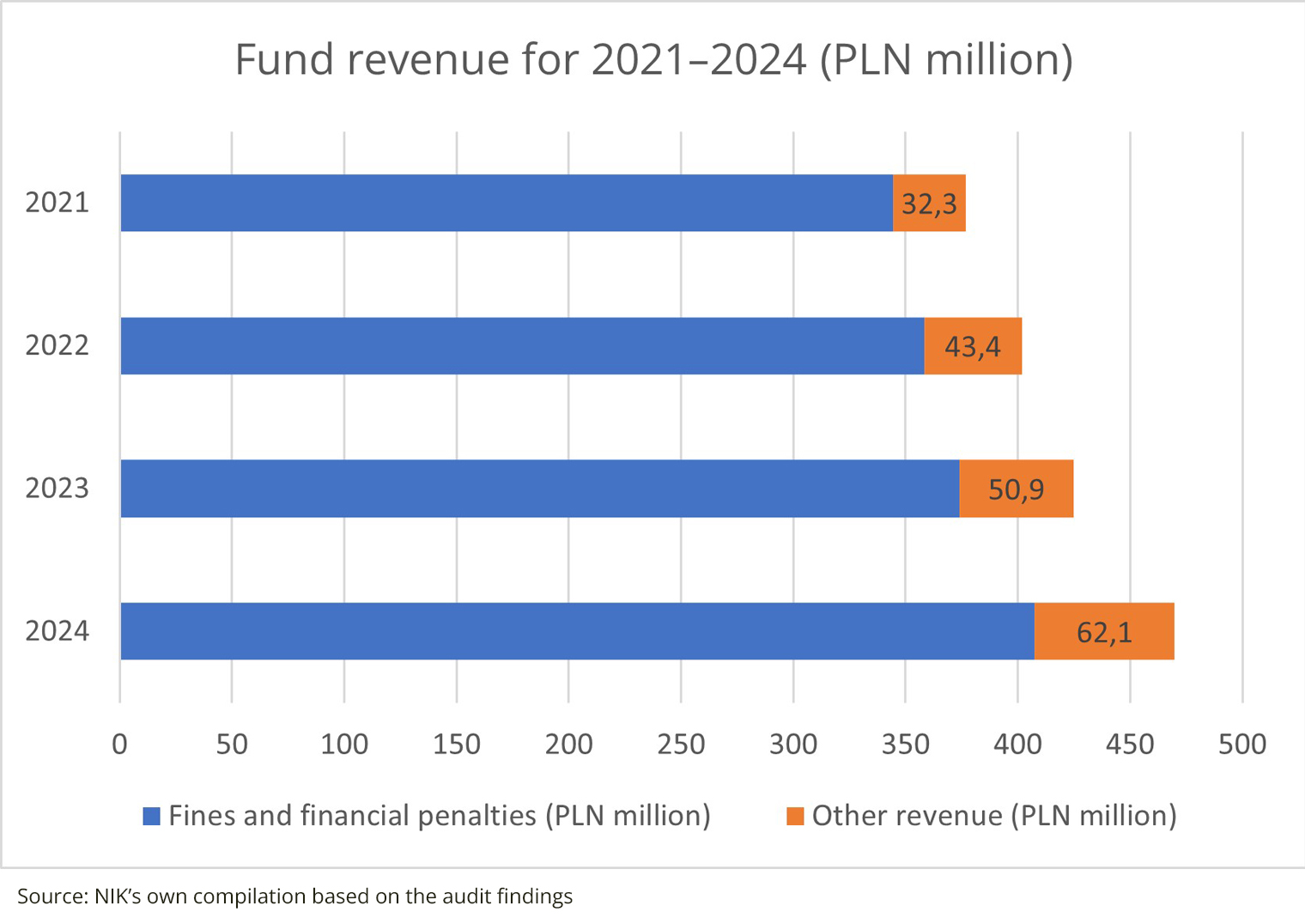
During the period covered by the audit, the Justice Fund revenue showed a steady and significant increase – from nearly PLN 377 million in 2021 to almost PLN 470 million in 2024.
Description of the image
| Year | Fines and financial penalties (PLN million) | Other revenue (PLN million) | Total (PLN million) |
|---|---|---|---|
| 2021 | 344.5 | 32.3 | 376.8 |
| 2022 | 358.3 | 43.4 | 401.7 |
| 2023 | 373.9 | 50.9 | 424.8 |
| 2024 | 407.6 | 62.1 | 469.7 |
Source: NIK’s own compilation based on the audit findings
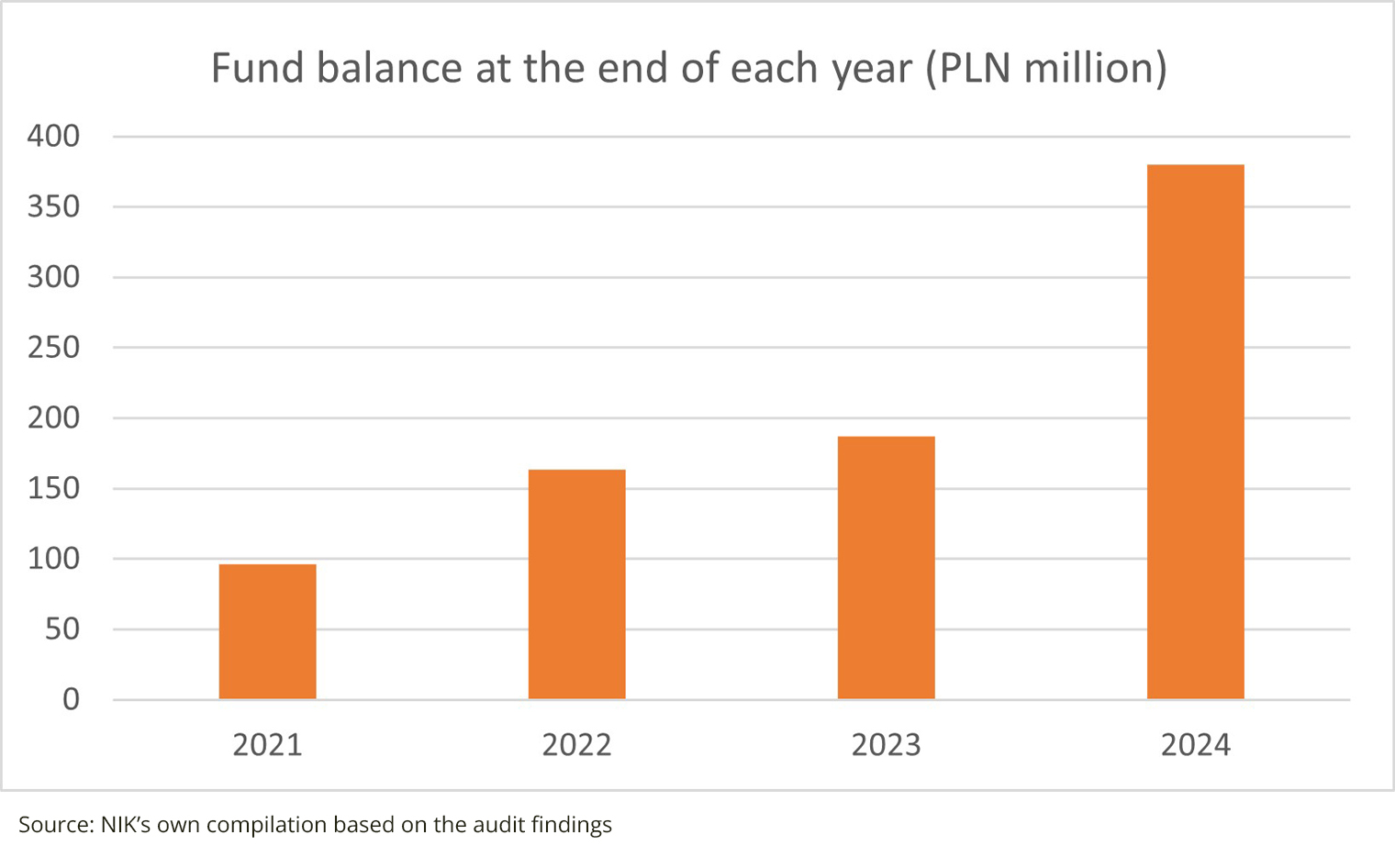
The vast majority of revenue came from payments of fines and financial penalties ordered by the courts. Despite steadily rising revenue, successive Administrators within the Ministry of Justice have failed to build up the human and organisational resources necessary to ensure the effective management of these funds. Furthermore, the Administrator was unable to plan the tasks he assigned to individual entities in a reliable manner, and significant amounts of unused funds remained in the Fund bank account (this situation occurred prior to 2017 and has clearly re-emerged since 2024).
Description of the image
Fund balance at the end of each year (PLN million)
- 2021: 96.1
- 2022: 163.3
- 2023: 186.9
- 2024: 380.1
Source: NIK’s own compilation based on the audit findings
Recommendations
The Supreme Audit Office has concluded that urgent, systemic remedial measures must be taken to prevent the wasteful and inappropriate use of Justice Fund resources in the future. NIK presented recommendations to the Fund Administrator of both a legislative nature (proposals de lege ferenda) and an organisational nature. They refer, in particular, to:
- Implement the organisational changes necessary to ensure the smooth running of the Fund. The Administrator should establish an effective system for managing tasks relating to the operation of the Fund. In particular, this system should include structures designed to: analyse and plan the Fund intended areas of intervention (e.g. identifying the types of crime to be targeted by prevention measures during a given period), organise calls for tenders, oversee and account for the funds allocated, and evaluate the outcomes of projects financed by the Fund.
- Develop reliably the programme content, taking into account mechanisms for identifying the issues they address, as well as indicators for assessing the outcomes of their implementation.
- Draft notices of open calls for tenders (contests) in a manner that clearly sets out the Administrator’s expectations, including, in particular, a precise description of the purpose and method of carrying out the task for which the grant is awarded, together with the expected outcomes and indicators.
- Develop solutions and establish criteria to enable a substantive, comprehensive and objective evaluation of tender submissions, as well as provide selection boards members with the conditions necessary for a fair assessment of bids, including the development of guidelines enabling the independent assessment of individual bid items and tools for verifying the realism of market prices included in the bids.
- Introduce legal and organisational measures to prevent conflicts of interest and the emergence of corruption-inducing mechanisms, both at the level of the Ministry and among grant beneficiaries. The procedures adopted should prevent:
- the recruitment of staff involved in the assessment and processing of applications who, immediately prior to their appointment, were involved in the implementation of projects funded by the Justice Fund;
- the employment, on a commercial basis, by associations or foundations of members of the board of a foundation or association acting as the contractor under a grant contract, their close relatives, or members of the governing bodies of such entities;
- the combining of executive and supervisory roles (e.g. the person carrying out the work and the person approving the expenditure), the roles of those providing support and those verifying their tasks, the provision of support to members of one’s own family, and to individuals sitting on the governing bodies of foundations or associations.
- Strengthening the Administrator’s oversight of the proper implementation of grant contracts by contractors, in particular by verifying the objectives set, the indicators achieved, the outputs produced and the expenditure incurred for this purpose.
In the opinion of the Supreme Audit Office (NIK), the establishment of such mechanisms would ensure the rational use of public funds, inter alia by eliminating the duplication of funding for the same expenditure from different sources and by curbing the discretionary decisions of the Administrator regarding the allocation of funds in areas where he lacks sufficient competence or the capacity to act effectively.