

The Supreme Audit Office (Najwyższa Izba Kontroli, NIK) has uncovered a number of irregularities in the support system for people with disabilities and their carers under personal assistance and respite care schemes. The audit revealed that contracts with non-governmental organisations were being concluded at intervals that did not ensure continuity of funding, which led to interruptions or restrictions in the availability of services. In addition, irregularities were identified in the accounting, including double funding of services and a lack of documentation to support the expenses incurred. NIK highlights the need to speed up the procedures involved in concluding contracts and, consequently, the transfer of funds, in order to ensure the continuity of personal assistance and respite care services. It also recommends introducing stricter rules for the verification and monitoring of public expenditure to ensure the effectiveness and transparency of the support system.
The Supreme Audit Office has carried out an audit of the support provided by non-governmental organisations to people with disabilities and their carers. This support was financed from the Solidarity Fund, which was administered by the Minister responsible for social security (hereinafter: the Minister). The rules governing the provision of support were laid down by the Minister in the programmes adopted thereby (which were in force during the period covered by the NIK audit):
- ‘Personal assistant to a person with disabilities’ and ‘Personal assistant to a disabled person’ in the 2022 and 2023 editions,
- ‘Respite care for family members or carers of people with disabilities’ and ‘Respite care’ in the 2022 and 2023 editions.
Personal assistance programmes were designed to ensure the availability of personal assistance services, i.e. support for people with disabilities in carrying out daily activities and participating in social life. Respite care programmes, on the other hand, were designed to relieve the burden on family members or carers of people with disabilities by assisting them with their daily tasks. The respite care service was intended to provide periodic support in meeting the needs of people with disabilities, in place of family members or carers who provide their day-to-day care.
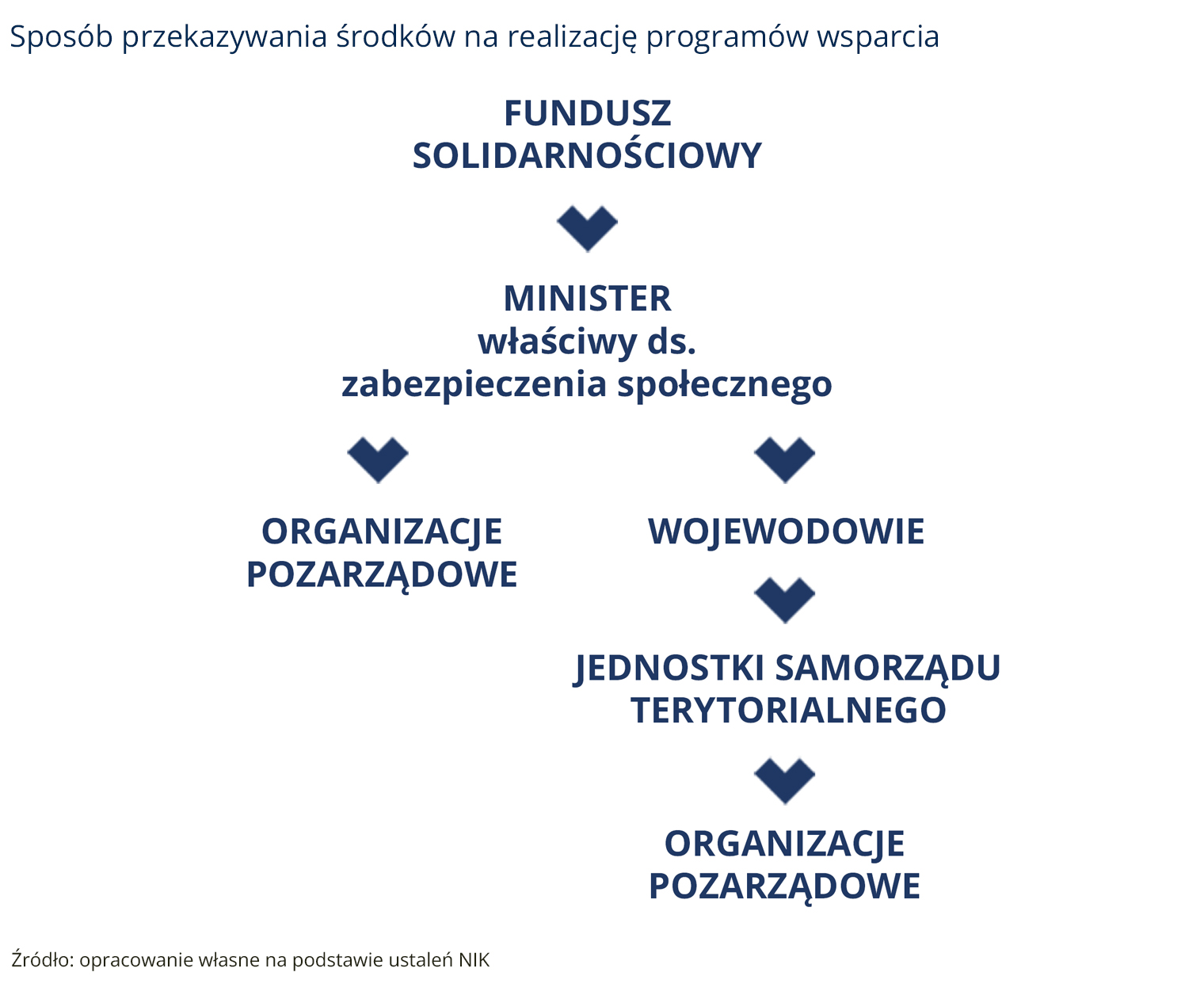
Non-governmental organisations received funding for the provision of these services under contracts concluded directly with the Minister or with local government units.
Description of the image
Method of transferring funds for the implementation of support programmes
- Solidarity Fund
- Minister competent for social security
- Non-governmental organisations
- Voivodes
- Local government units
- Non-governmental organisations
Source: own compilation based on the findings of NIK
Lack of continuity in the services provided by non-governmental organisations
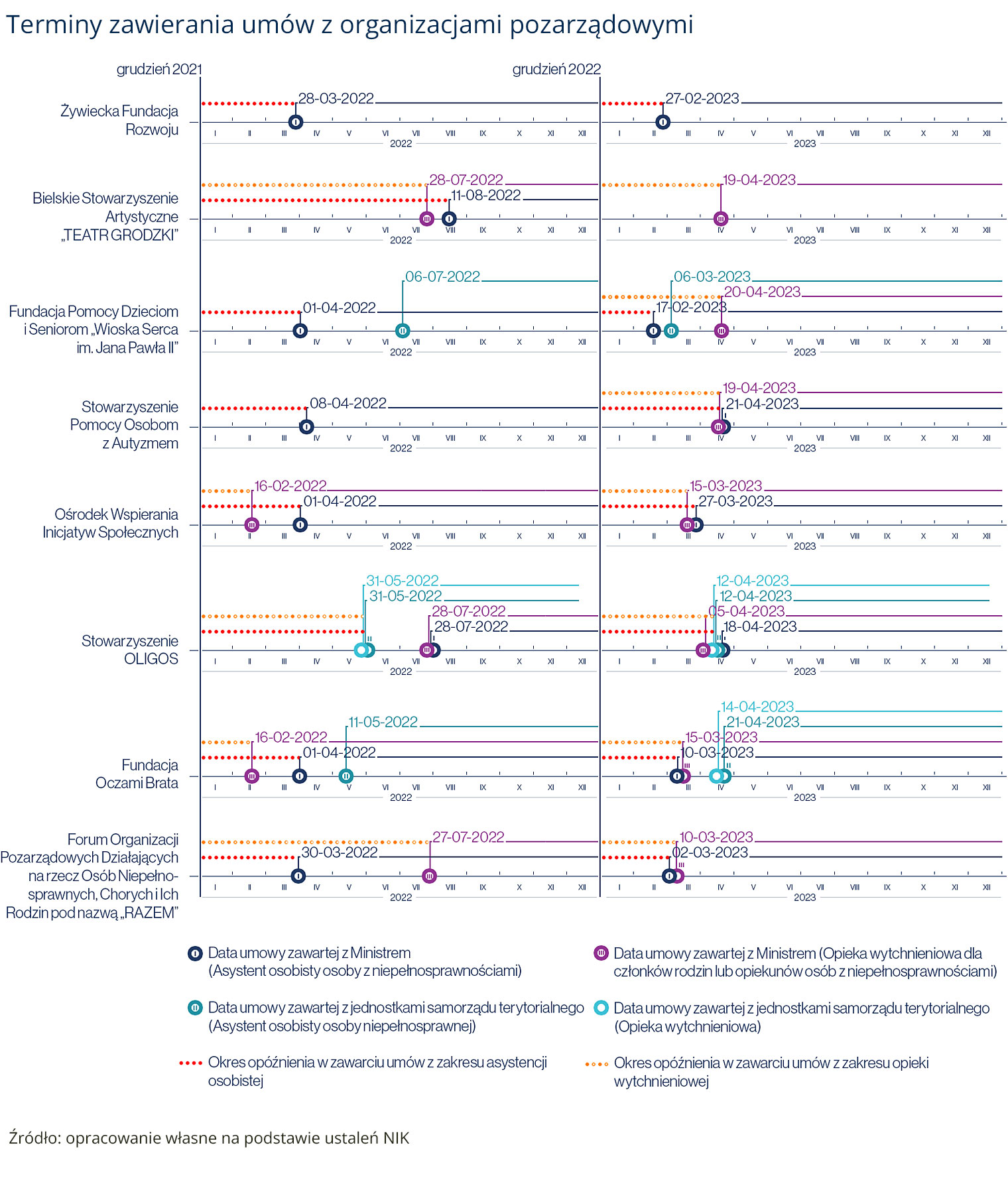
Contracts between the Minister or local government units and non-governmental organisations providing personal assistance and respite care services were concluded at intervals that did not ensure the continuity of these services. This is because these contracts were signed as long as several months after the expiry (in December of the relevant year) of the previous contract concerning the amount and method of transferring funds from the Solidarity Fund. As a result, non-governmental organisations faced difficulties in retaining staff providing services and in securing stable funding; consequently, they were unable to provide optimal care for people with disabilities and their carers during the first few months of the year.
Description of the image
| Non-governmental organisation | Type of contract (Programme and contracting entity) | Date of conclusion of the contract in 2022 | Date of conclusion of the contract in 2023 |
|---|---|---|---|
| Żywiecka Fundacja Rozwoju (Żywiec Development Foundation) | Personal assistant for people with disabilities (Minister) | 28-03-2022 | 27-02-2023 |
| Bielskie Stowarzyszenie Artystyczne “TEATR GRODZKI” (The Bielsko-Biała Artistic Association “TEATR GRODZKI”) | Respite care for family members or carers (Minister) | 28–07–2022 | 19-04-2023 |
| Personal assistant for people with disabilities (Minister) | 11–08–2022 | – | |
| Fundacja Pomocy Dzieciom i Seniorom “Wioska Serca im. Jana Pawła II” (The “Heart Village” Foundation for Children and the Elderly named after Jana Pawła II) | Personal assistant for people with disabilities (Minister) | 01–04–2022 | 17-02-2023 |
| Respite care (local government unit) | 06–07–2022 | 06-03-2023 | |
| Respite care for family members or carers (Minister) | – | 20–04–2023 | |
| Stowarzyszenie Pomocy Osobom z Autyzmem (Association for the Support of People with Autism) | Personal assistant for people with disabilities (Minister) | 08–04–2022 | 21-04-2023 |
| Respite care for family members or carers (Minister) | – | 19–04–2023 | |
| Ośrodek Wspierania Inicjatyw Społecznych (Centre for the Support of Community Initiatives) | Respite care for family members or carers (Minister) | 16–02–2022 | 15-03-2023 |
| Personal assistant for people with disabilities (Minister) | 01–04–2022 | 27-03-2023 | |
| Stowarzyszenie OLIGOS (The OLIGOS Association) | Personal assistant for a person with a disability (Local Authority) | 31-05-2022 | 12-04-2023 |
| Respite care (local government unit) | 31-05-2022 | 12-04-2023 | |
| Respite care for family members or carers (Minister) | 28–07–2022 | 05–04–2023 | |
| Personal assistant for people with disabilities (Minister) | 28–07–2022 | 18-04-2023 | |
| Fundacja Oczami Brata (The Through a Brother’s Eyes Foundation) | Respite care for family members or carers (Minister) | 16–02–2022 | 15-03-2023 |
| Personal assistant for people with disabilities (Minister) | 01–04–2022 | 10-03-2023 | |
| Personal assistant for a person with a disability (local government unit) | 11–05–2022 | 21-04-2023 | |
| Respite care (local government unit) | – | 14–04–2023 | |
| Forum Organizacji Pozarządowych (...) “RAZEM” (Forum of Non-Governmental Organisations (...) “TOGETHER”): | Personal assistant for people with disabilities (Minister) | 30-03-2022 | 02-03-2023 |
| Respite care for family members or carers (Minister) | 27–07–2022 | 10-03-2023 |
It was clear from the programme specifications and the proposals submitted by organisations to the Minister that personal assistance and respite care services were to be provided from 1 January of the relevant year. In reality, however, until funding was secured, the activities of non-governmental organisations were essentially limited to preparatory work, including the selection of programme participants and the recruitment of assistants and respite care providers. Despite the possibility, as provided for in the draft contracts, of reimbursement for funds spent on implementing programmes from 1 January of the relevant year, non-governmental organisations remained uncertain as to whether they would receive the funds. One of the reasons was that the programme provisions stipulated that the Minister’s approval of the list of bids, together with the amount of funding allocated from the Fund, did not in itself give rise to a claim for the conclusion of a contract. To ensure business continuity, one of the NGOs audited had taken out loans (with the interest on these loans being charged to the organisation’s costs, as it could not be covered by the Solidarity Fund). In the case of contracts concluded with local government units, implementation took place once the contract had been signed.
As a result, during the first few months of each calendar year, those in need of support either did not receive it or the scope of that support was significantly limited.
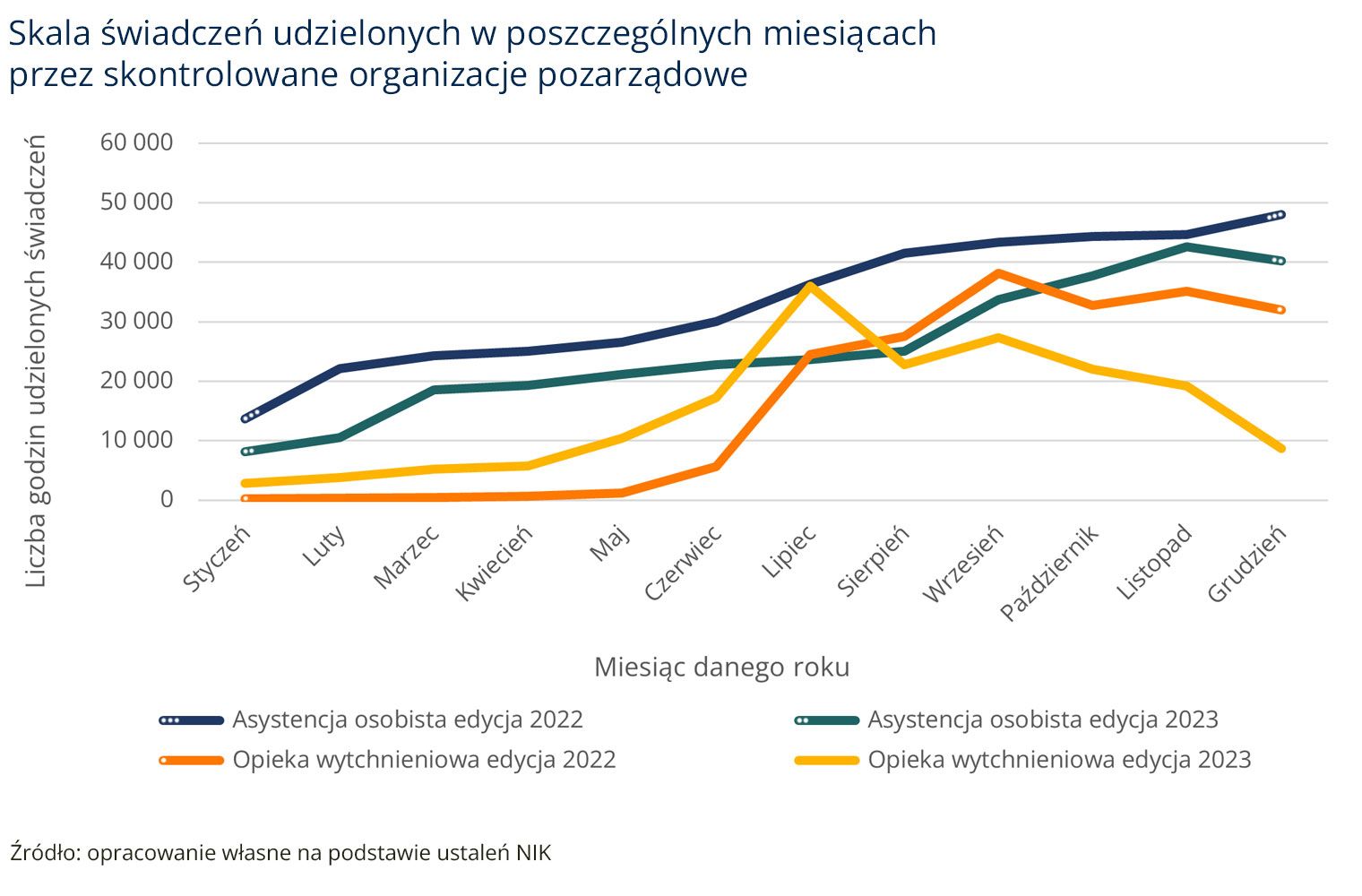
Opis grafiki
| Month of the year | Personal Assistance 2022 Edition | Personal Assistance 2023 Edition | Respite Care 2022 Edition | Respite Care 2023 Edition |
|---|---|---|---|---|
| January | 13,651 | 8,195 | 263 | 2,884 |
| February | 22,069 | 10,510 | 297 | 3,860 |
| March | 24,269 | 18,576 | 497 | 5,173 |
| April | 25,022 | 19,280 | 698 | 5,713 |
| May | 26,571 | 21,109 | 1,247 | 10,418 |
| June | 29,993 | 22,722 | 5,692 | 17,196 |
| July | 36,366 | 23,593 | 24,482 | 35,989 |
| August | 41,484 | 25,034 | 27,486 | 22,812 |
| September | 43,317 | 33,678 | 38,122 | 27,304 |
| October | 44,348 | 37,715 | 32,712 | 22,038 |
| November | 44,708 | 42,577 | 35,130 | 19,146 |
| December | 47,970 | 40,193 | 31,988 | 8,692 |
Source: own compilation based on the findings of NIK
NIK emphasises that the needs of people with disabilities and their carers are not time-bound and do not end with the current year. Practical support should be provided on an ongoing basis. The findings of NIK audit therefore point to the need to speed up the procedures for concluding contracts and, consequently, for the transfer of funds, in order to ensure the continuity of the services provided.
At the same time, NIK notes that the draft Act on personal assistance for people with disabilities was referred to the Sejm Committee on Social Policy and the Family on 21 November 2025. The draft includes, among other things, provisions regarding the granting of assistance for periods longer than one year, which will ensure the continuity of the services provided.
Inadequate provision of personal assistance and respite care
The organisations audited met the criteria for receiving funding from the above-mentioned programmes. They provided support to the number of people specified in the bids attached to the contracts. The support was generally provided to those entitled to it. The support was aimed, amongst others, at people with a significant degree of disability and those with multiple disabilities (the simultaneous presence of at least two types of disability in a single person), as well as at children who absolutely require constant or long-term care or assistance from another person. One organisation provided support worth PLN 35,600 to two people with disabilities as part of respite care, even though the carers did not live with them; furthermore, the carer of one of these persons had not applied for the support.
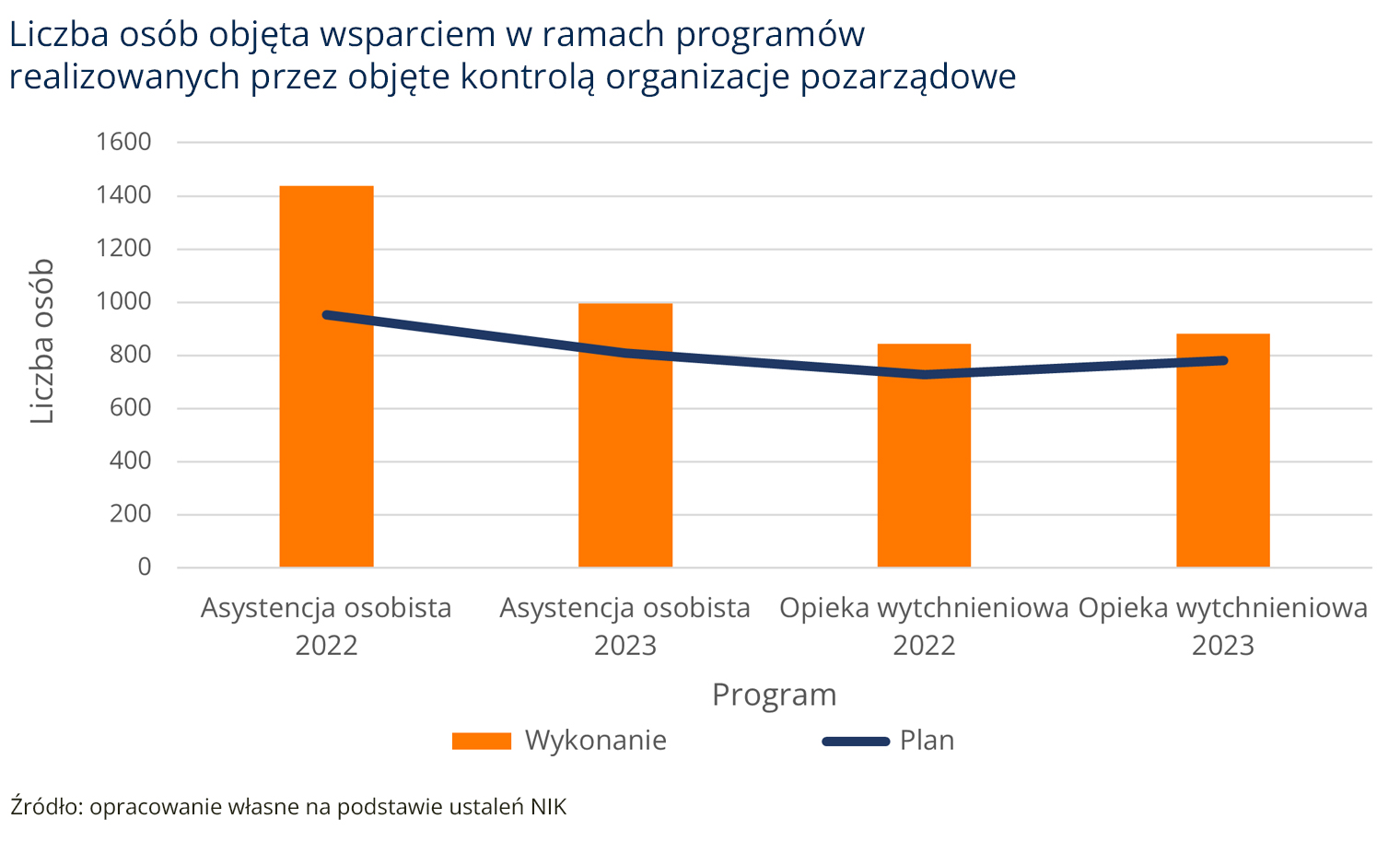
Description of the image
| Programme | Plan (number of people) | Performance (number of people) |
|---|---|---|
| Personal Assistance 2022 | 952 | 1438 |
| Personal Assistance 2023 | 807 | 996 |
| Respite care 2022 | 728 | 843 |
| Respite care 2023 | 781 | 881 |
Source: own compilation based on the findings of NIK
The provision of services by assistants and respite carers was confirmed by signatures on the service records from both the service providers and the persons with disabilities or their carers. However, the audit revealed that some of the services had not been performed or had been billed twice; instances of incorrect billing documentation were also identified. An examination of this documentation revealed that, at the same time:
- one assistant, working in two different locations, provided services to various people with disabilities;
- one assistant, in one place, reported services provided to the same person under different programmes (run by the same or different organisations);
- several assistants were providing services to the same person with a disability at the same location;
- several carers provided services to the same person with a disability in different locations.
During an audit by NIK, one organisation corrected 279 hours of personal assistance services worth PLN 11.2 thousand and repaid the funds that had been wrongly claimed – in this case, according to the service records for a person with a disability, the services were supposed to have been provided at their place of residence. In fact, the person with a disability stayed at a centre providing round-the-clock care as part of the ‘respite care’ programme – both services were funded by the Solidarity Fund.
A total of 79 hours of overlapping service, worth PLN 3.2 thousand, were also identified between various non-governmental organisations. In these cases, the organisations were unable to verify the expense claims submitted by the assistants to another programme implementer. This gave rise to a risk that the programmes in question would not be implemented correctly, as well as the possibility that funds might be spent in breach of the programmes’ rules.
Despite being required to deliver the personal assistance programme itself, one of the organisations audited outsourced the provision of the bulk of the services to other providers. The role of this organisation was limited to administration and acting as a sponsor for the project, whilst the support services were provided by subcontractors. The total value of remuneration paid to third parties amounted to PLN 2.23 million, representing 83.4% of the funding received by the organisation and 92.5% of the funds accounted for as direct costs of the project.
Contrary to the terms of the contracts, one of the organisations did not keep separate accounts for the funds received from the Fund, and in one year it did not keep any accounts at all, despite being required to do so. In its programme implementation reports, the organisation accounted for costs amounting to the sums specified in the individual contracts, even though it did not have documentation confirming that these costs had been incurred in full. In its progress reports, the organisation did not provide any documents evidencing that expenditure had been incurred (receipts, invoices, payslips). The total value of undocumented expenditure amounted to PLN 372.1 thousand. This was also due to the fact that a lower pay rate had been set for assistants, whilst in the project implementation report the organisation stated that it had paid assistants the maximum rate. This indicates that there is insufficient oversight of the correctness of the accounting for funds by both the Minister and local government units (as the entities commissioning the performance of these tasks).
An assistant at one of the organisations failed to confirm that he had provided the services he was allegedly supposed to have carried out for a person with a disability. The organisation paid this person a total of PLN 12.8 thousand.
The total value of the audit findings amounted to nearly PLN 2.9 million. During the NIK’s audit and following the implementation of post-audit recommendations relating to the improper implementation of programmes, the organisations amended their previously submitted reports on the implementation of tasks and returned funds totalling PLN 86.3 thousand.
Recommendations and comments
Based on the findings of the audit, NIK formulated a total of 37 recommendations and post-audit comments. The key recommendations, addressed to non-governmental organisations, concerned the need to:
- ensure that non-governmental organisations carry out ongoing and proper verification of the service claim forms submitted by assistants, and take steps to investigate any irregularities identified;
- make corrections to expenditure reports for items not supported by source documentation, or which were used in breach of the rules of the programmes under review, and to make the corresponding adjustments to indirect costs;
- refund any funds that were unduly collected and misused, together with interest.