

Since the end of the Second World War, the death rate was higher than the birth rate only in the period 2002-2005. At that time, the negative population growth rate ranged from 3.8 thousand to 14.1 thousand. Today it is clear that the year 2013 proved the worst one in this respect. The death rate exceeded the birth rate by over 15 thousand.
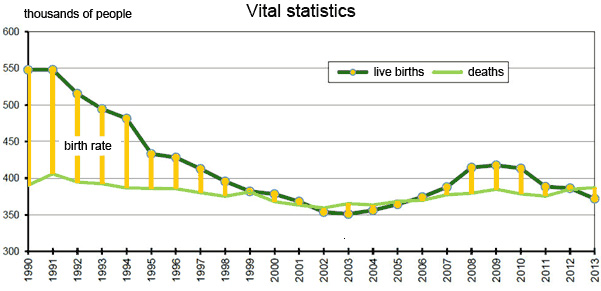
Source: GUS Information on social and economic situation in Poland in 2013
If the current trend continues, in 50 years there will be a bit more than 2 million children in Poland - three times less than in 1960. At the same time, there will be twice as many elderly persons (of 80 years of age or more). According to prof. Okólski, this is a sign of fundamental changes, also in the economy. In 2060, a hundred people at the productive age will have to maintain 70 pensioners.
|
Thousands |
1990 |
1995 |
2000 |
2005 |
2006 |
2007 |
2008 |
2009 |
2010 |
2011 |
2012 |
2013 |
|
Live births |
547,7 |
433,1 |
378,3 |
364,4 |
374,2 |
387,9 |
414,5 |
417,6 |
413,3 |
388,4 |
386,3 |
371,9 |
|
Deaths |
390,3 |
386,1 |
368,0 |
368,3 |
369,7 |
377,2 |
379,4 |
384,9 |
378,5 |
375,5 |
384,8 |
387,2 |
|
Birth rate |
157,4 |
47,0 |
10,3 |
-3,9 |
4,5 |
10,7 |
35,1 |
32,7 |
34,8 |
12,9 |
1,5 |
-15,3 |
Source: GUS Information on social and economic situation in Poland in 2013
Considering the demographic crisis as one of the most serious challenges for Poland, the Supreme Audit Office planned a number of audits in this area for 2014. The key one will be the audit of the family policy coordination in Poland. It started on Tuesday with an experts panel.
Statements of panel participants

Family policy
Representatives of the Parliament, the central government, local governments, non-governmental organisations and external experts discussed the audit programme together with NIK auditors.
NIK wants to look into the following:
- What tools does the state use to develop the family policy?
- Which of them are used properly and which are not?
- Which tools are missing to better help families?
- How is the family policy coordinated? Who is responsible for that and in what scope?
The audit is to give an answer to the question if the solutions used at the moment consistently support processes of setting up and functioning of families. The analyses results will be the basis for a family policy framework in Poland which is to help make possible corrections in effective practices and provisions.
![How to help Polish families? [experts panel]](/plik/big/id,5998.jpg "© Brian Jackson / Fotolia")