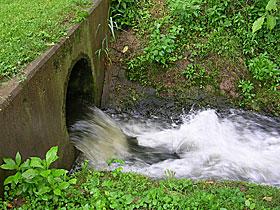


NIK points to a serious threat for the environment on the areas that do not have the sewage system. The auditors verified how the use of holding tanks is supervised in 6 communes of Wielkopolskie Province.
The records of all the audited communes show that the amount of discharged sewage per person is lower than normative values. According to NIK, it may be suspected that a crucial part of sewage from the backyard sewage containers instead of being discharged to the sewage collection station and sewage treatment plants go straight to the environment, causing a sanitary and ecological hazard. None of the audited communes took any measures to precisely diagnose and handle the situation.
The Supreme Audit Institution also indicates many mistakes in discharging wastewater to sewage collection stations. The commune heads gave permits for the receipt and transport of sewage to the companies whose requests had some formal shortcomings and did not guarantee the solutions serving sanitary or environmental protection. In none of 32 permits that were effective in the audited communes was an obligation determined to register and document the frequency of cleaning and disinfecting gully emptiers.
In 9 cases the companies did not provide required information on the fleet of gully emptiers, In 6 of them the sewage collection station where the sewage was to be transported was not determined. Two communes (Nekla and Kramsk) did not specify the requirements for entrepreneurs requesting the permit. The audit also revealed 5 cases of the receipt and transport of wastewater by persons that did not have the required permit and so conducted this activity against the law.
Local governments are trying to expand the water and sewage network. From 2007 to 2011, in 33 communes audited by NIK nearly 152 km of the water supply network, almost 301 km of the sanitary sewage system, 16 sewage treatment plants, 5 water purification stations and one water intake station were opened. As a result, the number of inhabitants using the water delivered via waterworks went up by 20 thousand persons (6.7 percent increase), and subsequent 27 thousand persons may use the sewage system (20 percent growth).
However, during these investments some irregularities occurred, causing delays and the waste of money. They resulted mainly from non-compliance with the Public Procurements Act and planning investments for which the commune had no money.
An extreme example were the actions of Darłowo commune related to the construction of sewage treatment plant in Rusko. The company, which was the only one to tender, offered a price over PLN 4.5 million higher than resulted from the investor’s cost estimate. Instead of cancelling the tender the commune head signed an agreement, which according to NIK, was against the sound management principle. He did it although the commune’s budget had no sum guaranteed for that purpose (it lacked nearly PLN 2 million).
The auditors also identified some cases of the conflict of interest. For instance, Długołęka commune incurred a loss of nearly PLN 260 thousand while commissioning works related to the sewage treatment plant. The reason was that the person appointed as coordinator of investor’s supervision inspectors was at the same time employed by the works contractor. According to NIK, similar cases may justify the suspicion of corruption motives.
The auditors identified a range of situations where public officials did not observe the Construction Law, the discipline of public finance and recording procedures. They resulted mainly from inadvertence and ignorance of the law. That is why, NIK recommends organising training programmes for the local government employees which would expand and update their knowledge of the investment law. It would make it possible to eliminate many shortcomings and irregularities.