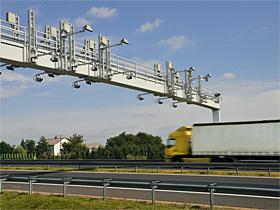


The National Toll System (NTS) started to work on 1 July 2011. The viaToll system that was launched nearly 8 months from signing the contract replaced the ineffective system of vignettes. The system is based on wireless communication technology. It includes gantries built above the toll roads. They are equipped in devices enabling reception and transmission of the signal from viaBOX fitted in a truck to the system operator centre. In that way the toll for driving on public roads is charged electronically. The NTS provided the basis for implementing the European Electronic Toll Service in Poland by introducing a single tool to assess toll fees on payable roads all over the European Union. NIK positively evaluated the tasks performance despite confirmed irregularities.
NIK President Krzysztof Kwiatkowski on irregularities in the viaTOLL system
viaTOLL system
The NIK auditors confirmed the following irregularities:
- about 100 gantries on the roads of Śląskie and Małopolskie Provinces on a stretch of A2 motorway were made of materials that did not meet the norms and were admitted to trade based on false handover certificates . According to NIK, this poses a threat to the life, health and property of drivers. NIK informed the Chief Inspector of Construction Supervision and Director General of National Roads and Motorways of that fact.
- viaTOLL system making up the measurement system has never been subject to any metrological control. Thus, it was not verified if the whole measurement system guaranteed proper charging of tolls and imposing of fines irrespective of the fact that by 2018 the viaTOLL system is to generate PLN 12 billion proceeds from tolls.
- viaTOLL system does not work on concession highways (fees are charged manually there). This is a huge difficulty for drivers which results from the fact that there is no law making sure a single toll system is binding on all roads.
- there were numerous cases of imposing undue fines on drivers because they failed to pay the electronic fee (Article 13k section 1). The level of fines for driving on the same public road without paying depended on the number of gantries passed through by the given vehicle. That practice led to illegal accumulation of penalties for not paying for a single drive on the same national road.
- technical handovers of gantries along with all devices were carried out only after 10-14 months from launching the viaTOLL system. The drivers had to suffer consequences of the system testing while it was being used.
- viaTOLL system was launched despite the lack of road marking required by the law (signs informing drivers that they have to pay for using the given public road). First signs of that type appeared on the roads only in October 2011 (3 months after launching the system).
- viaTOLL system was launched before completing the construction of all planned electronic toll stations (about 100 of 400 gantries were opened). Therefore, until September 2011, there were loopholes in the electronic toll system. However, the General Directorate of National Roads and Motorways (GDDKiA) took care about the public interest and paid the contractor nearly PLN 48 million less due to the delays.
- gantries were improperly qualified as road traffic safety devices (RTS). As a consequence, more than 500 gantries were built on the roads without a construction permit as RTS devices do not need such permits. NIK has noted that works are going on to install road traffic safety devices on the gantries (e.g. weather station sensors). The future and potential use of gantries does not change their fundamental purpose which is not related to the protection of life, health and property of drivers. That is why, qualifying gantries as road traffic safety devices was improper.
Recommendations:
- Supreme Audit Office has asked the Minister of Economy to start works to cover the viaTOLL system with legal metrological control which will enable the state, transport companies and drivers to check if the tolls are calculated and charged correctly.
- NIK has requested that the Minister of Transport change the Public Roads Act to arrive at clear-cut principles of penalising drivers who have not paid the electronic toll to finally eliminate undue fines for drivers.
- NIK has requested the President of the Government Legislation Centre to start drafting the final version of amendments to the Public Roads Act to enable implementation of the European Electronic Toll Service to the domestic law. That will provide drivers with a single device charging tolls on all the EU roads.
- NIK claims that the Minister of Transport should intensify works to develop legal solutions to make sure that the viaTOLL system will also function on concession highways.