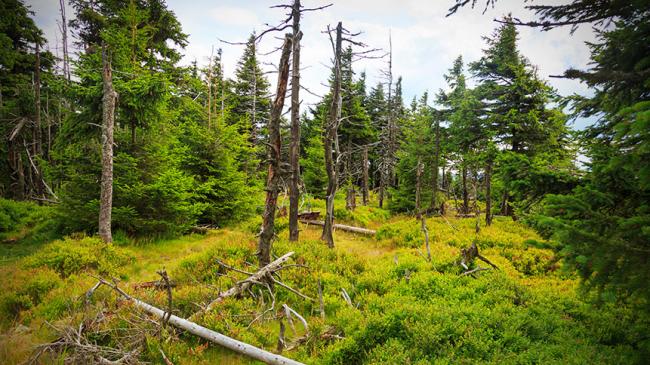


The NIK audit showed that the efforts of the State Forests to adapt forest management to climate change were not very effective in 2019-2024. Those works, especially related to the reconstruction of forest stands and afforestation increase, were started with delay and part of them were carried out improperly and ineffectively.
Audit no. P/24/094/LZG
Currently the so-called monocultures of coniferous trees are most threatened by the decay of tree stands because of climate change in Poland. Statistics point to a significant problem: more than half of Polish forests are pine forests – they represent 63% of the forest area managed by the State Forests (from Polish: Lasy Państwowe, or LP) and 55% of private and municipal forests. On the other hand, firs and beeches are predominant in the mountains. This is a consequence of forest management run by LP for many years and focused chiefly on productive timber harvesting. In case of large-size and medium-size timber, the harvesting almost doubled in 1996-2023 – from 20 thousand m3 to over 38 thousand m3, with simultaneous drastic afforestation decline – from approx. 12 thousand ha to 0.4 thousand ha. In the audited period, without valid forest management plans, i.e. basic documents ensuring sustainable forest management which involves e.g. beneficial impact of forests on the climate, the State Forests harvested the total of approx. 20 million m3 of timber worth nearly PLN 4.6 billion, also from the Nature 2000 areas.
In the audited period, all the analysed plans for 233 forest inspectorates in Poland (over a half) were approved by the minister supervising environmental issues already after the previous documents became outdated –on average after 9 months, or even after 2 years in an extreme case. In addition, the binding plans did not directly cover the issues and tasks related to the forest management adaptation to climate change.
The strategic documents effective at the time specified tasks for the State Forests related to reconstruction and adaptation of forest stands to climate change, e.g. increasing the forest cover. Those tasks, however, were either not carried out or were performed to a little extent. Consequences included, among other things:
- the share of dominant species (pine and larch) went down only from 68.8% of the total forest area in 2019 to 68.4% in 2023 r.;
- the current annual increment of timber resources, or the quantity of wood produced by trees in a year, fell from 4.35% in 2003 to 3.05% in 2023,
- the areas of newly afforested land in Poland were negligible –12.1 thousand ha was afforested in 1996, while in 2023 it was only 400 ha;
- the area of protective forests (that could also alleviate consequences of climate change) declined in 2019-2023 by 25.6 thousand ha;
- in 2022, Polish forests had one of the lowest healthy forest stand indices (14,5%) in Europe and one of the highest forest stand indices (70%) in terms of increased defoliation (defoliation is about plants losing their leaves due to external factors or chemical substances).
Already in 2013, the government obliged the General Directorate of State Forests to develop a full-fledged programme for the forestry adaptation to climate change. The General Directorate adopted the first document of that kind only after nine years, in 2022. Until then the initiatives carried out by the State Forests were fragmentary and of ad hoc nature. A subsequent document covering a comprehensive plan of activities until 2030 included an assessment of their consequences and was adopted in December 2023. It said that the tasks set out in the document were to prevent or minimise negative effects of rapid climate changes, including mainly large-area forest dieback.
However, the plan did not take into account 90% of comments of scientists and environmental communities. Besides, the programme preparation did not involve the measures, deadlines and financing sources of individual tasks, which made it impossible to evaluate their effectiveness and efficiency.
Forests versus climate change
According to scientists forests can play the pivotal role in preventing climate changes and alleviating their consequences. Almost 30% of our country’s area is occupied by forests which cover over 9.2 million ha (of which over 7.3 million ha are the State Treasury forests managed by the State Forests). In terms of afforested area, though, Poland occupies the 18th position in the EU, with the average of 38.6%. The following EU countries have the largest forest areas: Finland, where they occupy 66.2% of that country, Sweden – 62.5% and Slovenia – 58.2%. On the other hand, the least afforested EU countries are: Ireland with approx. 11.6% of forest area, Netherlands – 9.7% and Malta – 1.4%.
The forest area expansion itself is not going to replace the elimination of fossil fuels but it may be one of the tools to compensate CO2 emissions. The National climate and development report Poland 2024 shows that forests managed by the State Forests are losing the CO2 absorption capacity. The decreasing trend of CO2 absorbed by forests managed by the State Forests accompanied by small, permanent increase of absorbed CO2 by other forests shows that the forestry model adopted by the State Forests was not optimal.
Forests also play the key role in stabilising water circulation, reducing the impact of both droughts and floods. In the audited period, the area of protective forests related e.g. to stabilising impact on the environment declined by over 26 thousand ha.
On the other hand, forests can also inflict climate changes as a source of greenhouse gases (mainly CO2), mainly because of deforestation, excessive use, delays of renewal processes, natural and paranatural disasters (e.g. fires).
Above all, forests may fall victim to climate changes, which results among others in:
- dieback of species susceptible to biotopic changes – forest dieback,
- aggravation of the health condition of forests,
- shifts in the occurrence of species of plants, insects and animals,
- increased activity of pests and pathogenic fungi,
- prolonged vegetation and trees growth rate,
- damage related to extreme phenomena – fires, hurricanes.
To minimise the impact of climate changes, preventive measures need to be implemented as soon as possible. In Poland they are delayed by nearly a decade against obligations under the Strategic adaptation plan for sectors and areas sensitive to climate changes until 2020 with the perspective until 2030.
What the State Forests failed to do?
In 2020-2022 (until the end of June), the forest area managed by the State Forests was expanded only by over 22 thousand ha. Also, the adaptation measures involving the forest cover growth were not effected. In 2023, only 0.4 thousand ha of areas owned by the State Treasury were afforested, while in 1996 it was over 12.1 thousand ha.
An important tool to ensure stability of forest stands should be the maximum possible use of natural processes, including promotion of natural renewals (occurring on forest land from self-seeding and suckers). In 2022, the State Forests carried out renewals on the area of 62.3 ha, of which natural renewals made up approx. 11.9 thousand ha, which is less than 20%.
The NIK audit revealed first of all that that the State Forests’ efforts in the audited period related to the reconstruction of forest stands and their adaptation to climate changes were not very effective. The share of dominant species, particularly threatened by dieback went down only a little. In case of pine and larch this share dropped in 2019-2023 from 68.8% of the total area to 68.4% and in case of fir it declined from 4.8% to 4.3%.
The State Forests also did not update – as they were not obliged to by law – the data obtained while taking stock of alien and invasive species in 2019. Then, based on information from 381 forest districts (77% of the total), over 14.3 thousand occurrences of invasive plant species were reported. The most common one – it occurred over 12.3 thousand times – was impatiens parviflora, which spreads fast and displaces domestic species. In case of animals, 395 occurrences of alien species were reported. In most cases (371 occurrences) that was the racoon dog.
The occurrence or spreading of invasive alien species in forests poses a threat to biodiversity and related ecosystem services or impacts them in a undesired way. In the audited period the area occupied by alien and invasive species was significant and increased as compared with the area listed in 2019. Also new threats appeared in that area, yet there were no mechanisms to handle them and no financing, either. The audited forest districts had nature reserves on their areas and had the existence of plant invasive alien species confirmed in the 2019 inventory. Nevertheless, they did not take planned activities in that matter.
Timber harvesting
According to the Central Statistical Office (GUS) the current annual increment of timber resources, i.e. the quantity of wood the trees “produced” in a year went down in 2023 to 3.05%, while in 2003 it was 4.35%. One of the reasons of that situation was increasing timber harvesting which went up in that period from approx. 51% of the annual increment to 75.6%.
The State Forests data on harvesting merchantable timber provided by the State Forests significantly differed from the data presented by the Bureau for Forest Management and Geodesy State Enterprise. As a result, it was impossible to establish if the data provided by the State Forests are correct. For instance, according to the State Forests the volume of net merchantable timber harvested in 2023 was 38.2 million m3 (without bark). On the other hand, in line with the five-year large-area forest inventory prepared by the Bureau for Forest Management and Geodesy State Enterprise (at the State Forests’ request) the average of over 52.2 million m3 of gross merchantable timber (with bark) was harvested annually in 2019–2023.
In the audited period, more and more timber was used for energy purposes. In 2008–2022, the share of timber in the primary energy balance (the amount of energy in power raw materials, such as fossil fuels, atomic energy or renewable energy – sun, wind or geothermal energy) more than doubled – from approx. 16 million m3 to almost 32.7 million m3. The GUS data show that in 2022 the total of over 6.6 million m3 of firewood was harvested, nearly in total from the areas owned by the State Forests – approx. 6.1 million m3.
The pressure on timber harvesting growth resulted from the use of biomass for energy purposes. The timber biomass in Poland is considered as a renewable and emission-free source of energy. The energy producers buying timber biomass were using public financial support under the mechanisms on renewable energy sources which caused an increase in biomass demand. However, according to the National Centre for Emissions Management burning timber emits more carbon dioxide per energy unit than burning fossil fuels. The reason is a much lower calorific value of biomass. CO2 emissions coming from biomass combustion are absorbed by regrowing trees, but it takes a few tens or even over a hundred years to level the net emission generated in the biomass combustion process.
Therefore, this way of using timber in fact contributes to an increased greenhouse effect. The State Forests had information about the sale of timber depending on its species, quality, size and purpose but they had no knowledge about final use of this raw material by national energy companies, heat plants or natural persons. Social organisations have long since pointed to the risk of ineffective protection of high-value timber against its use to produce electricity.
Fire and flood threats
In 2019–2024 (until mid-year), nearly 11.3 thousand fires broke out in the forests managed by the State Forests. The fires covered almost 2.8 thousand ha which caused losses of over PLN 30 million. At the same time, in forest management plans (updated every 10 years) the fire hazard category was lowered for 82 forest districts nationwide. Hence, formal requirements for forest fire protection were loosened. That approach was consistent with the law but in the period of increased weather hazards (long-term droughts, no humidity) fire threats should be categorised taking into account potential adverse changes in the future.
As a consequence of flood in September 2024 (particularly in the southern basin of the Odra River), the State Forests started to estimate damage to the infrastructure and the forests (September/ October 2024). According to the data of the General Directorate of the State Forests (as of 7 October 2024), over 22.4 thousand ha of forests were flooded. On the areas affected by the flood, mainly where the water remained, the risk of dieback of trees or the entire tree stands increased. Also the young forest generation was destroyed or damaged.
In the audited period, the State Forests did not estimate financial losses related to crisis situations (except for fires). According to NIK that knowledge could help expand the base of data needed to take decisions on the adaptation of forest management to climate changes.
Recommendations
In view of the audit results NIK has made the following recommendations:
To the Minister of Climate and Environment
- to initiate legislative work to amend the Act on Forests, directly obliging the State Forests to take action related to the forest management adaptation to climate changes and guaranteeing that the State Forests run forest management based on approved forest management plans;
- to implement solutions covering: improvement in timber recycling, monitoring of the use of timber biomass and elimination of the use of high-value raw material for energy purposes.
To the Director General of State Forests
- to consider isolating a unit as part of the State Forests specialised in implementing and coordinating activities related to the forest management adaptation to climate changes;
- to ensure compliance of the Forest breeding principles with the currently binding Comprehensive programme for the prevention of forest dieback processes in Poland and undertake mitigation measures in the perspective to 2030 in terms of retaining and increasing the intraspecies genetic variability of forests;
- to consider introducing an obligation in forest management plans ensuring:
- a) increased stability of forest ecosystems by species diversification of forest stands, in particular species resistant to climate changes;
- b) support of biodiversity protection to make forest stands more adaptable to climate changes;
- c) water management, e.g. by water retention;
- d) monitoring of climate change consequences and results of activities taken.
- to develop and implement a strategy to combat invasive alien species of plants and animals on the State Forests’ area.