

Audit no. P/24/069 /LKR
The key reason for poor air quality in Poland is “low emission” of pollutants (at the height of up to 40 metres), coming from house furnaces and boiler rooms which do not meet ecological norms. The key pollutants coming from the low emission having adverse impact on health include: particulate matter (PM10 and PM2,5) and Benzo(a)pyrene (BaP). According to WHO the PM2,5 fraction has serious health consequences since such small particles (with the dimension below 2,5 µm) can easily filter in alveoli and the cardiovascular system which may cause ailments of variable intensity, functional disorders of lungs, even lung cancer and increased risk of death. At the same time, B(a)P is a strongly cancerogenic substance. It is generated chiefly by burning solid fuels at low temperatures, older-generation devices or incinerating waste in installations not intended for that purpose.
Since 2017, boilers have been classified under Polish law into classes 3 to 5, where class 5 covers the most eco-friendly boilers. Since July 2018, only boilers meeting class 5 requirements could be sold. Additionally, since 2020 there have been eco-design standards (EU Commission regulation), reducing the emissions of dust particles and nitrogen dioxides. These requirements assume the same emission of dust as for class 5 boilers but they should be met regardless of the boiler load.
Graphic description
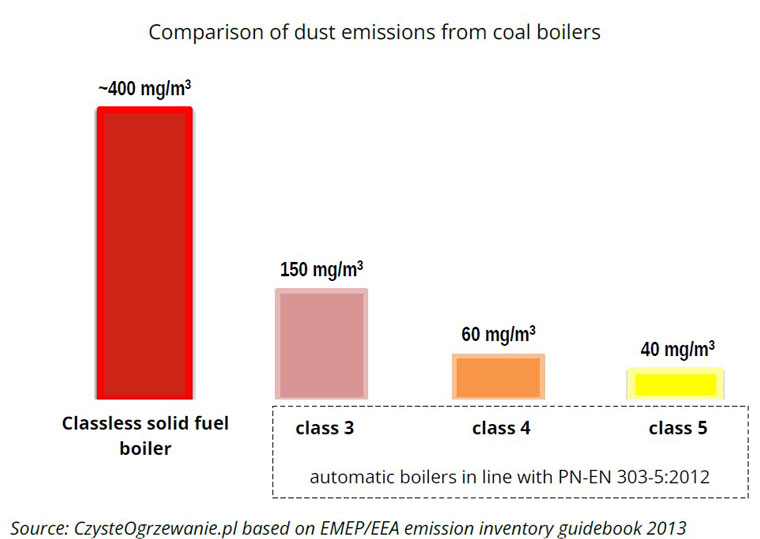
Comparison of dust emissions from coal boilers
- classless solid fuel boiler: ~400 mg/m³
- class 3: 150 mg/m³
- class 4: 60 mg/m³
- class 5: 40 mg/m³
Classes 3,4 and 5 are automatic boilers in line with PN-EN 303-5:2012
Source: CzysteOgrzewanie.pl based on EMEP/EEA emission inventory guidebook 2013
The air protection system in Poland is a complex one. It involves cooperation of numerous participants at various administrative levels. There are four different groups of units accounting for key tasks in this system. Remedy measures are planned by provincial offices and carried out by municipalities. The financing is provided by the national and provincial funds for environmental protection and water management, whereas their implementation is audited by provincial inspectorates for environmental protection.
The provincial governments have taken efforts to improve air quality since 2008. But only in 2016–2017 the provincial assemblies were empowered to pass anti-smog resolutions (currently they are in force in 14 provinces).
Key audit findings
The audit covered four provinces, in which in 2023 acceptable levels of air pollutants, such as PM10 and B(a)P, were exceeded. The entities selected for the audit were key on a regional scale. They were responsible for preparing anti-smog resolutions (marshal’s offices) and performing tasks ensuring their implementation (municipality offices). The NIK audit comprised four municipalities from each of the said province in which the normative values defined for PM10, PM2.5 or B(a)P were exceeded the most in 2022–2023.
Considering poor air quality all the audited provincial offices passed anti-smog resolutions which introduced bans and restrictions on the exploitation of fuel-burning installations. The resolutions specified precisely e.g. fuel quality requirements and elimination of the oldest, classless boilers, aiming at their gradual replacement with boilers complying with class 5 or eco-design requirements.
In each of the audited provinces tasks were set out in the Air Protection Programmes (APPs) involving the replacement of solid fuel boilers and the municipalities’ obligation to audit the compliance with air protection laws, including anti-smog resolutions. Provincial governments supported municipalities in executing anti-smog resolutions, by offering financial, content and training support.
A good practice used in Małopolskie Province, identified by NIK needs to be mentioned. To support activities of municipalities from this region, the Marshal’s Office of Małopolskie Province launched a free application Eco-intervention for mobile and land devices. It enabled anonymous reporting of irregularities concerning e.g. waste incineration or use of devices which were not consistent with the anti-smog resolution. The application helped the municipal services react quickly to emerging reports. It also allowed monitoring the way and the time of responding to the residents’ reports both via the Marshall’s Office and the municipalities. Over 30.2 thousand reports were noted since the application started to operate (March 2020) to the end of November 2024. Over 16.5 thousand audits were carried out following the reports, 71.4% of which were audits related to air protection.
All the audited municipalities reliably identified the air quality issue related to low emission and pointed out measures in strategic documents to lower the emission. In three municipalities the environmental protection programmes were not developed, though, and in three others the reports on their implementation were not prepared, despite the obligation to do so.
Another important aspect is the knowledge of heat sources used in houses and buildings. Poland has a special database called the Central Emission Register of Buildings which contains information about these sources. Since July 2021, all property owners and administrators have been obliged to submit declarations about heat sources. Sadly, many municipalities did not collect complete data – less than 80% of properties were registered in 8 of 18 audited municipalities. Nevertheless, the municipalities did not take effective steps to find the property owners who failed to file the declarations.
In 15 of 16 municipalities covered by the planned audit irregularities were found concerning illegal or unreliable conduct of audits in terms of observing and applying air protection laws.
The residents of one municipality were not held responsible for breaking the waste incineration ban or for violating anti-smog resolutions. In another municipality the air protection audits were discontinued after 2019.
As of 1 July 2024, there were still over 781 thousand classless boilers registered in five audited provinces and over 1.3 million boilers below class 5 which should be replaced with more eco-friendly boilers in three years, that is by the end of June 2028.
However, none of the audited municipalities managed to fully implement anti-smog regulations. In 18 municipalities covered by the audit nearly 29 thousand solid fuel boilers in total were replaced in 2018-2023. However, over 42 thousand boilers are still waiting to be replaced, of which 26 thousand are classless boilers, the least eco-friendly ones. The estimated replacement time for classless boilers, with the average replacement rate in 2018-2023, ranges from 2 to 24 years and for boilers below class 5 it is from 3 to 40 years. The Supreme Audit Office underlines that the emission of pollutants from solid fuel boilers is the main reason of poor air quality in Poland. Therefore, it is particularly important to eliminate classless boilers as they may emit nearly three times more particulate matter than class 3 boilers and ten times more than class 5 boilers. Apart from the nationwide programme “Clean air”, as part of which the replacement of heat sources was subsidised directly from the National Fund for Environmental Protection and Water Management in all 18 municipalities covered by the audit, subsidy programmes were launched to replace old boilers into more eco-friendly ones. The municipalities financed them with their own funds or used financial resources of the National Fund for Environmental Protection and Water Management as part of the nationwide programme “Stop smog”. In the entire audited period, i.e. from 2017, the residents of 16 municipalities covered by the planned audit replaced the total of 19.2 thousand boilers with the municipalities’ financial support.
All the municipalities carried out educational activities to increase the residents’ awareness of the harmfulness of air pollutants. In five municipalities, though, the measures were less intense than they should be. Additionally, in some of them e.g. eco-advisors were hired to help the residents with issues related to non-profitability of heat sources. Also, contact points were set up for the nationwide programme “Clean air”, as part of which the residents could receive subsidies.
NIK points out that the key barriers in effective implementation of anti-smog resolutions include: still insufficient social awareness of the impact of human activities on the environment and health consequences of air pollution, limited financial capabilities of residents and municipalities, limited effectiveness of implemented system solutions related to supervision of municipalities which do not execute provisions of the Air Protection Programmes as well as the lack of full, credible data about the heat sources applied.
On top of that, air pollutants are spread regardless of local governments’ actions but because of the lie of the land or climate conditions which vary across Poland. As a result, in the south of Poland much more intense remedy actions are needed to improve air quality.
Gradual improvement has been noted from the onset of anti-smog measures (limitations were introduced and the replacement of old boilers started). However, the air is still polluted and poses harm to human health. According to estimates the number of premature deaths in Poland in 2022 caused by air pollution with particular matter PM2,5 was nearly 35 thousand.
According to the information of the Chief Inspectorate for Environmental Protection, in 2023 in five provinces the number of premature deaths resulting from long-term exposure to PM2,5 exceeded 11.6 thousand. Hence, in the light of new, more restrictive WHO guidelines and EU law changes (much lower acceptable air pollution levels from 2030), robust efforts are necessary to fully implement bans and limitations set out in the anti-smog resolutions.
Recommendations
To the Minister of Development and Technology (now the Minister of Finance and Economy) to:
take measures to introduce obligation for the municipality head, mayor or city president to verify the data and information in declarations about heat sources or fuel burning sources before entering them in the IT system supporting the Central Emission Register of Buildings.
To the Chief Inspector for Construction Supervision to:
ensure verification and improvement of the credibility of data in the Central Emission Register of Buildings, concerning the number of solid fuel heat sources, also in cooperation with municipalities.
Recommendations for province governments and municipalities:
- to municipality heads, mayors and city presidents – to fully implement and boost remedy measures specified in the Air Protection Programmes, particularly with regard to activities related to implementing anti-smog resolutions;
- to marshals – to use the potential of air protection programmes as broadly as possible to specify tasks supporting the implementation of anti-smog resolutions, including the setting of measures to enable the measurement of boiler replacement outcomes and inspections of individual heating systems.
