

It was no accident that the auditors’ meeting with experts overlapped with the end of a complex audit on public and private partnership. Vice-President of NIK Marian Cichosz stated that the PPP audit was a breakthrough and that it should help remove barriers in using that formula in Poland. ”We are moving with the times and want to be a catalyst of positive changes. Our objective is not only to identify irregularities but also to help auditees” - said Cichosz.
PPP
It is estimated that the share of Poland in the European market of public and private partnership is 1.7 percent, whereas for Spain it is 11 percent and for Great Britain - the leader in that regard - 53 percent. What is the reason of such low popularity of the PPP in Poland? Is it inconsistent provisions of law or the lack of knowledge connected with the negative attitude of officials? Or maybe little social confidence? Opinions of experts invited to the meeting at the Supreme Audit Office varied.
All debaters agreed, however, that the PPP stimulates economic development. The partnership is to the benefit of both public institutions and private investors, therefore its popularisation in Poland is so important. Ewa Swędrowska-Dziankowska from the Ministry of Economy presented various forms of promotion implemented by the Ministry, including among others: set-up of an internet base of PPP projects www.bazappp.gov.pl, organisation of training programmes for public administration staff, conferences and promotion missions.
Irena Herbst from the PPP Centre expressed an opinion that the measures taken by the Ministry are not very effective. She underlined the low interest with the PPP instrument in Poland. She supported her thesis with statistical data. In the years 2009-2011, public entities published 144 calls for tender for private investors, of which only 24 resulted in signing an agreement.
As the main reasons of such low popularity of the PPP model Herbst mentioned: the shortage of knowledge, lack of consistent standards and procedures, conservative and irrational approach of public authorities. ”I mean an attempt of shifting the entire risk to private investors, often without any additional benefits. Most often in the long run nobody declares their interest in a tender” - said the President of the PPP Centre Foundation.
The most negative trend on part of the public administration seems to be the striving for cost containment for any price. It is revealed first of all in the resignation from advisory services. Herbst points out that the PPP issue is extraordinarily complex. ”In many European countries, much more experienced than ours, public institutions normally use advisory services.”
Agnieszka Szymczyk from the European Bank of Reconstruction and Development also emphasised significance of the advisor’s role. The advisor issue is one of the evaluation criteria of a project applying for the EBRD subsidy. The Bank representative provided some examples of unreasonable approach of public entities which either hired no advisors at all or used services of legal advisors only (forgetting about economic specialists). It also happened that some institutions employed advisors but afterwards officials acted at their own discretion anyway.
Many participants of the panel agreed that the public sector thinks in a short-sighted way as it focuses exclusively on finance. According to Kacper Kozłowski (Investment Support), before starting a project public institutions should make an in-depth analysis of the most favourable variant not only in financial terms but also in social and economic aspects. Kozłowski stands in a position that the main problem in implementing the public and private partnership is not a bad law or the shortage of information but people’s mentality and the deficit of trust in the society.
According to Bartosz Korbus from the PPP Institute, a barrier is also the lack of methodology of dividing risks between the public entity and the private partner. Vice-President Cichosz asked if any de lege ferenda proposals (concerning future changes in the law) have been formulated in that matter. Marcin Wawrzyniak from the PPP Institute replied that the Council of Ministers adopted a draft of changes concerning the Eurostat decision. Based on that decision, the obligations under the PPP agreements are not qualified as debt of the public finance sector, if the private partner assumes the ”construction-related risk” and at least one of the following risks: ”demand risk” or ”availability risk” connected with the project.
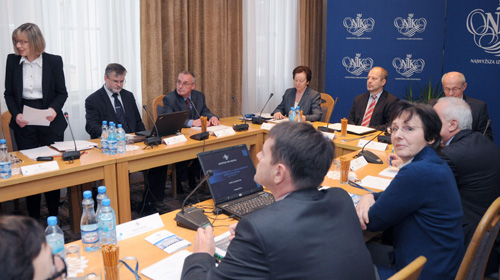
The panel of experts on the execution of initiatives in the public and private partnership in connection with NIK’s audit in that area was held on 7 November 2012 in the headquarters of NIK. Next to the NIK representatives, the meeting was attended by the delegates of the following institutions: Ministry of Economy, Ministry of Regional Development, European Bank of Reconstruction and Development, Polish Agency for Enterprise Development, Association of Polish Districts, Institute of Public and Private Partnership, Centre of Public and Private Partnership, Cieślak & Kordasiewicz Business and Legal Advisory Office and advisory company Investment Support.