

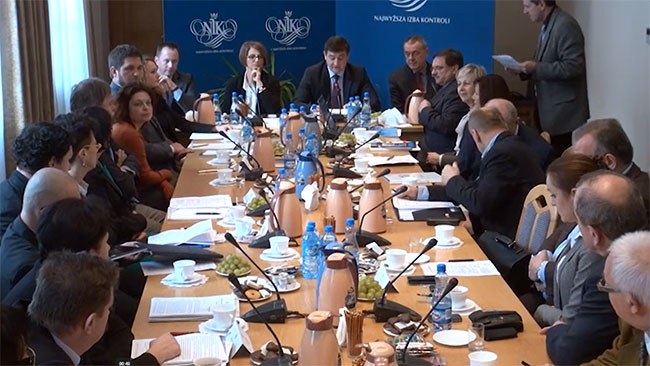
An experts panel on industrial animal farms has taken place in the NIK headquarters. The NIK audits of 2006 and 2011 revealed a lot of irregularities in the farms’ functioning. They were mainly related to non-observance of the environment, construction and veterinary law. A lot of farms operated in illegally used facilities, emitting hazardous substances to the environment. The animal treatment documentation was missing and waste management procedures were not observed.
Participants of the experts panel on breeding animal farms
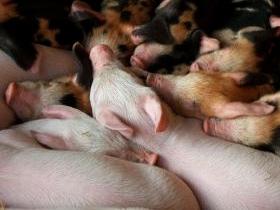
Dispute over animal farms
According to ecologists present at the meeting, the pig farms pose a real threat for the environment. Jakub Skorupski from Green Federation Gaja compared the industrial pig farms to large industrial plants. ”In 2007, Helcom or Secretariat of Helsinki Convention, considered those installations as point sources of agricultural pollution” - he argued. Additionally, the farms are often built in the vicinity of housing estates, recreation areas or nature reserves (e.g. NATURE 2000) and in most cases their location is not consulted with people living nearby.
Grzegorz Brodziak from the Polish Association of Employers - Pig Producers countered the ecologists’ charges. He stands in a position that farm managers are open for public consultations and that they use ecological methods and technologies. Brodziak stressed that the farms are a driver for the Polish economy by providing jobs to Polish farmers. He also underlined that the pig breeding market in other European countries is thriving. In his opinion it confirms the need to intensify measures to boost domestic production in this area. Yet in 2006 the pig population in Poland was 18 million and today it is less than 11 million.
The panel participants agreed that the law changes are essential. Julia Pitera, Member of the Polish Sejm attending the meeting, pointed out that the most important regulations are missing. ”The law on odour nuisance is not in place yet” - she complained. Olga Łukasiewicz from the Provincial Inspectorate for Environment Protection enumerated requirements towards pig breeders which are impossible to comply with in practice. Jakub Skorupski mentioned the issue of Helsinki Convention (concerning the Baltic Sea environment protection) which was ratified by Poland on 8 October 1999 and theoretically came into force on 17 January 2000. Despite the fact that it has been implemented in the Polish legal system, it is still not binding.
Another serious problem related to the functioning of industrial pig farms identified by experts is a poor supervision system. Julia Pitera referred to inspections that were inaccurate or overly supportive for breeders. On the other hand, the breeders complained about too burdensome inspections which focus on the farms managing perfectly and leave out the ones that operate on the verge of the law.
”The Polish state will not accept pathologies” - ensured Arkadiusz Litwiński, Vice-Chair of the Sejm Committee for Environment Protection, Natural Resources and Forestry. But at the same time, changes in the law and the supervision system in case of animal farms seem indispensable, he added.