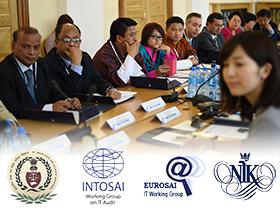


Two IT Working Groups - of EUROSAI, chaired by NIK President Krzysztof Kwiatkowski and of INTOSAI (WGITA), chaired by the Comptroller and Auditor General of India Shashi Kant Sharma met in the Polish Supreme Audit Office to present the progress of their projects, initiate new activities and also exchange their experience and ideas in the area of IT audit and IT tools.
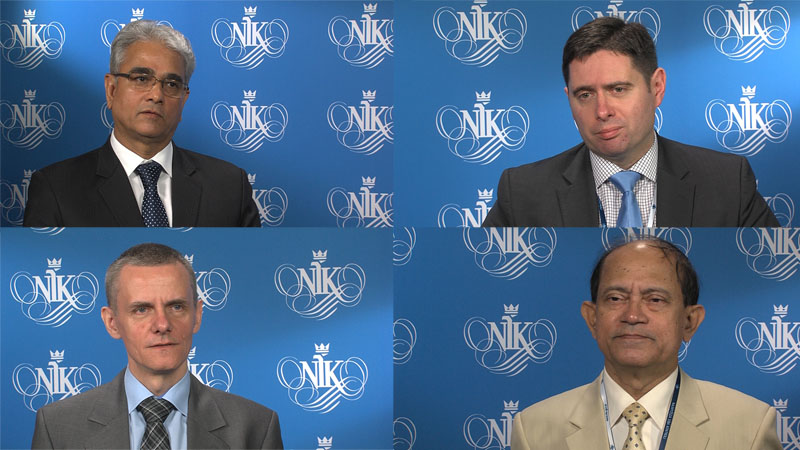
INTOSAI and EUROSAI in Supreme Audit Office
During the meetings a lot of attention was paid to ISSAI 5300 on IT audit (one of International Standards of Supreme Audit Institutions). ”Works on this ISSAI will be finalised next year and thereafter it will be available for use for all public auditors throughout the world ” - said Shashi Kant Sharma. Advisor to NIK President Paweł Banaś confirms that works on the standard are half way through. The standard should be concise and cover only basic issues - definitions, areas and requirements for IT audit. In the coming years more specific guidelines related to ISSAI 5300 will be defined - IT risks, IT investment audit, IT audit as part of financial audit and other types of audit. In that way it will be easier to manage this group of standards and guidelines. The EUROSAI IT Working Group is also interested in developing guidelines on the ISSAI 5300. Joint efforts to work out recommendations for that document have strengthened cooperation of the two working groups: within INTOSAI and EUROSAI.
European Organisation of Supreme Audit Institutions (EUROSAI) is a regional working group of the International Organisation of Supreme Audit Institutions (INTOSAI). Both organisations gather respectively 36 and 50 members, mainly Supreme Audit Institutions (SAIs) and the European Court of Auditors. There are working groups operating in several thematic areas within both organisations. In the IT area they are: INTOSAI Working Group on IT Audit and EUROSAI IT Working Group. The Polish Supreme Audit Office is currently the Chair of the EUROSAI IT Working Group. At the same time NIK has been an active member of the INTOSAI Working Group on IT Audit for many years now.
Key activities of the Working Groups are:
- improvement of knowledge and skills in applying IT audit in public entities;
- self-assessment of IT systems used for auditing;
- internet communication security;
- e-administration;
- cooperative IT audits conducted at least by two member states.
The conference participants showed their special interest in the IT Audit Handbook presented by the American SAI representative. The Handbook was developed as part of a joint project of the INTOSAI Working Group on IT Audit and the INTOSAI Development Initiative (IDI). It shows technicalities of audit to auditors from all around the globe, specialising in different areas. It also highlights advantages of combining different experiences. ”There’s a wide variance in the level of IT capacity across the different SAIs. So whatever we do it has to be able to be used by everybody. We have to make sure it is not too technical or not too simple so everyone can use it adequately for audit” - said Madhav Panwar from the USA, member of the project as part of which the Handbook was developed.
The presentation delivered by the representative of the SAI of Iran also sparked great interest of the conference participants. It concerned the so-called SANA, which is the Electronic Audit System. The system is to increase the speed and precision of the monitoring and audit process, and also automate the audit. The SAI of Iran promised to deliver essential documentation for the WGITA project on audit management software.
IT Governance, data mining as a tool in fraud investigation or standardisation of big IT projects - were other issues discussed by representatives of Supreme Audit Institutions from all around the world during the conference in NIK headquarters.
The auditors from the EUROSAI Group got familiar with the progress of the project chaired by NIK involving presentation of IT audit results (Control Space of e-Government), also called THE CUBE . ”Projects related to workshops verifying IT maturity of individual SAIs (ITSA), as well as the progress of implementing IT audit proved very interesting as well” - said Piotr Prokopczyk, Head of Department of Science, Education and National Heritage of NIK. ”In the course of our discussion on the results of the biometric passports audit we managed to define joint subjects for cooperative audits.”
At the Electronic Monitoring Centre representatives of INTOSAI and EUROSAI got familiar with the IT system implemented by the Minister of Justice. In the institution’s headquarters the guests were welcomed by NIK President Krzysztof Kwiatkowski, Minister of Justice Borys Budka and Head of the Electronic Monitoring Centre, Gen. Paweł Nasiłowski.
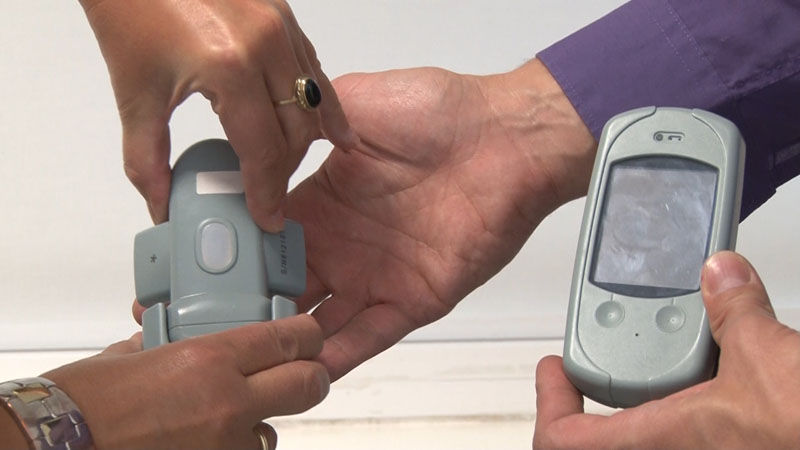
Electronic Monitoring System
”This place shows how modern technology can be used for monitoring, here taking the form of the Electronic Monitoring System” - said the Minister and emphasised at the same time that the system was positively evaluated by the Supreme Audit Office. ”I am very glad that over eighty persons from all around the globe may see something which is a great success of the Polish system of justice, the penitentiary system in particular” - he added.
Also in the opinion of Krzysztof Kwiatkowski the Electronic Monitoring System proved successful in all dimensions: rehabilitation of convicts, finance and IT. The conference participants guided by the Head of the Electronic Monitoring Centre, Gen. Nasiłowski were most interested in practical application of the system. They were also impressed by high effectiveness of the system - in Poland it is about 90 percent.
The Electronic Monitoring System (EMS) is a state-of-the-art, non-custodial system for executing the deprivation of liberty punishment outside the penitentiary facility. Electronic devices being part of the system make it possible to monitor the convict to see how he or she meets the obligations imposed by the court. In line with new law, as of 1 July 2015 electronic monitoring has been incorporated in the permanent catalogue of the restriction of liberty punishments. It covers sentences from one month up to two years. The EMS cost of one convict is less than PLN 11 per man-day, whereas the maintenance cost of one prisoner is PLN 2.7 thousand per month. The electronic monitoring systems allows the state budget to save about PLN 11 million per month.