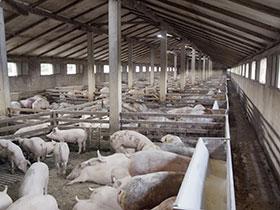


There are 864 industrial animal farms operating in Poland. Since 2010, their number has increased by 112. They have a huge impact on the quality of life of the people living nearby. The farms produce unpleasant odours. Besides, improper storage, removal and utilisation of huge quantities of waste (e.g. manure) poses serious threats to the natural environment and human health (e.g. over-fertilisation of the soil with animal faeces contaminates groundwaters).
Evading the law
In view of the effective Environmental Protection Act, the owners of industrial farms may evade its provisions without any problem. Theoretically, the so-called integrated permit is needed, which imposes a lot of requirements in the field of environment protection. For instance, such farms have to meet specific conditions of water intake and noise emission, they have to use energy properly and observe the rules of using animal faeces produced on the farm as a natural fertiliser. Industrial farms are audited regularly (once a year or once in two years) by the Province Inspectorate of Environmental Protection. In practice, all these requirements could be evaded by dividing farms. The reason is that smaller farms are not obliged to have the integrated permit. Depending on the size they are only required to provide the so-called sector permits, which are much less strict. Medium farms only have to report their activity to the Province Inspectorate of Environmental Protection. Smaller farms do not even have that obligation.
NIK points out that some of the industrial farm owners use that legal gap and formally (in the official documentation) divide their farms into smaller ones (although they do nothing in reality). Small entities established as a result of that formal division still function as part of one industrial farm but without the need to apply for and comply with the integrated permit.
In the period 2011-2013, the audits conducted by only one Province Inspectorate of Environmental Protection (in Warsaw) revealed the division of 13 poultry and pig farms. At the end of the day 31 smaller farms were established which did not need the integrated permit anymore.
NIK recommended changes of legal provisions in that matter already in the previous audit of industrial pig farms in 2006. According to NIK’s recommendation, changes in the law were planned to make the integrated permit obligatory regardless of formal divisions of an industrial farm (as part of the amended Environmental Protection Act). However, the plans were abandoned after public consultations. The results of the present NIK audit confirmed that many industrial animal farms are still divided for the purposes mentioned above.
Offensive odour issue - still unsolved
The complaints about industrial animal farms received by local authorities and inspectorates concern mainly the odour and noise they produce. The NIK audit revealed there is still no solution to the odour issue, despite the fact that the Ministry of Environment worked on the relevant act for five years. The draft project assumptions were changed many a time and due to significant objections of local government officials, citizens and business representatives, the Ministry of Environment decided to give up works on the Offensive Odour Control Act but rather cooperate with other ministries to change the law. NIK recommends speeding up these works as due to the absence of relevant provisions the farms may be a burden for local inhabitants without being held responsible for that.
NIK has also emphasised that the Minister of Environment did not issue any ordinance on the point of reference or cut-off values of odoriferous substances in the air and the methods of evaluating odours, although he was entitled to do so under the Act. The Ministry representatives believe that an ordinance would bring about strict penalties and would pose a threat of closing farms because of the odour issue but would not solve all the problems, anyway.
The study methodology is the most questionable because it uses human smell as the only tool to measure the odour nuisance. According to the Ministry officials, it does not guarantee objectivity of study results.
Better audit of farms needed
According to NIK, none of the inspectorates responsible for auditing industrial farms (Veterinary Inspectorate, Inspectorate of Environmental Protection and State Sanitary Inspectorate) performed its task properly. Depending on the nuisance posed to people and the environment, the farms are qualified into appropriate risk categories and should be audited in line with them every one or two years. However, in the period 2011-2013, the Inspectorate of Environmental Protection did not audit all industrial pig farms qualified into the first, most rigorous risk category.
The frequency of audits of industrial poultry farms is also questionable to NIK. Theoretically, they are qualified into the 2nd risk category so they should be audited every two years. But the Chief Inspectorate of Environmental Protection allowed even less frequent audits (without specifying precisely how frequent they should be). For instance, from 2011 to 2013, the Inspectorate of Environmental Protection audited 34-42 percent of poultry farms.
Animal farms were not audited frequently enough by the State Sanitary Inspectorate. None of the eight Regional Sanitary Inspectorates audited by NIK had valid data about all farms under their supervision. According to NIK, the lack of valid data (e.g. on the number of animal farms) made it impossible to effectively supervise health and safety at work in those farms.
No cooperation between vets and inspectorate of environment protection
NIK also revealed significant discrepancies in the data kept by various inspectorates. For instance, there were 180 pig farms covered by the supervision of the Veterinary Inspectorate in 2013, whereas the Inspectorate of Environmental Protection supervised only 145 pig farms in that year. The data concerning poultry farms varied even more (954 poultry farms were supervised by the Veterinary Inspectorate and only 686 ones by the Inspectorate of Environmental Protection).
Cooperation between the two inspectorates was not effective, either, particularly in terms of information exchange.
Audits ordered by NIK
At the request of NIK, the Inspectorate of Environmental Protection, the Veterinary Inspectorate, the State Sanitary Inspectorate and the Inspectorate of Construction Supervision conducted audits in four provinces which covered industrial pig farms, poultry farms and fur-bearing animal farms.
Of 61 animal farms audited by the Veterinary Inspectorate, irregularities were identified in 22 ones. They concerned mainly the lack of required cleanness of facilities as well as improper sanitary and hygienic condition of their surroundings. The inspectors also noted that animal corpses were sometimes stored in inappropriately marked containers, not secured against animal access.
The animal care was not adequate in some cases. Animals were kept in harmful conditions, e.g. pigs did not have enough space or light, their faeces and feed remnants were not removed. At the same time, hens in poultry farms were kept in crowded cages. Also in fur-bearing animal farms the cages were too small which made the animals suffer bodily injuries.
The Inspectorate of Environmental Protection audited 62 industrial farms - 18 of them did not observe the terms of integrated permits, e.g. noise level was not monitored, water examination was carried out improperly (or not at all).
Irregularities were detected in 15 of 20 audited fur-bearing animal farms. In 5 cases their owners stored manure under mink cages which may have caused sewage containing nitrogen to get to the ground. In one farm wastewater was discharged to the ground.
NIK’s recommendations to the Minister of Environment concerned:
- developing draft amendment to the Environmental Protection Act that would impose an obligation on all technologically related animal farms, located in neighbouring plants to have the integrated permit. The Supreme Audit Office considers changing the law a priority to make sure the environment protection law is not evaded by formal division of industrial farms;
- speeding up actions in cooperation with relevant ministers to adopt the laws that will effectively solve the odour issue.
NIK also addressed recommendations to the Chief Veterinary Doctor and Chief Inspector of Environmental Protection:
- to improve supervision over the Inspectorate activity to ensure full control over animal farms;
- to improve cooperation between the inspectorates in terms of supervision over animal farms.