

Audit no. P/23/013/KGP
The transition to circular economy (CE) in Poland was not fully effective. The circularity rate in 2018-2023 went down. Also, the EU-required level of recycling and preparation of communal waste for reuse was not achieved. It needs to be underlined, though, that in 2021-2024 Poland paid about PLN 9 billion due to the so-called plastic packaging tax, related to untreated plastic waste. NIK also pointed out that delays in implementing the EU laws in the Polish legal order did not help the circular economy transition. According to NIK the state’s activities fostering the circular economy, as part of the CE Roadmap in particular require further coordination and evaluation, as well as combining efforts to support the CE and shaping them into a consistent process.
Efforts supporting implementation of circular economy
Circular economy is an economic model in which products are used as long as possible and then repaired, renewed or recycled. This model aims at minimising the volume of waste and using resources in an efficient and sustainable way. The European Union and Poland have been pursuing circular economy due to continuous depletion of non-renewable resources, their growing prices and dependence on supplies from abroad, challenges related to environmental protection as well as unstable geopolitical situation. Transition of the Polish economy to CE was scheduled in the Circular Economy Roadmap, adopted by the Polish government in September 2019 as one of the projects being part of the Strategy for Sustainable Development until 2020 (with a perspective until 2030). It was to be implemented in 2021-2023.
In July 2022, the government adopted the Productivity Strategy 2030 which was to implement a deep, modernising change in the Polish economy, including an increased use of recyclable materials, reduction of industrial waste production and state’s support in CE transition.

Graphic description
The circular economy model
The graphic shows a pie chart illustrating the product life cycle in circular economy. In the centre of the diagram is the inscription "CIRCULAR ECONOMY".
Around the central point there are segments with arrows illustrating successive stages of the cycle:
- Raw materials
- Sustainable design
- Production
- Distribution
- Consumption, Reuse, Repair
- Collection
- Recycling
From this stage, the arrow leads back to the "Resources" stage, closing the main circuit. From the "Recycling" stage, an additional arrow goes outside the cycle, pointing to the item marked as "Residual waste". This illustrates the material waste that falls out of the closed loop.
Source: European Parliament: www.europarl.europa.eu
Municipalities play a significant role in implementing circular economy, although currently it mainly comes down to communal waste management. Big cities have more organisational and financial capacities in implementing CE. For instance, the cities audited by NIK: Gdańsk, Kraków and Lublin – took part in the project Circular Cities Programme Poland, which resulted in developing the CE strategy for each city.
A special report of the European Court of Auditors (ECA) of July 2023 showed that - despite the EU activities - the CE transition in EU Member States is proceeding slowly. In 2015-2021, the average rate of closed-loop recycling for all 27 European Union countries went up only by 0.4 percentage point and in seven EU Member States - in Poland, Sweden, Romania, Denmark, Luxembourg, Finland and Lithuania – the CE rate even went down. According to ECA the strategies related to implementing circular economy in the EU Member States are too much focused on waste management and too little on waste prevention.
This audit examined adequacy and effectiveness of implementing circular economy by the national government and local administration in 2018-2022. That was the first audit of NIK on circular economy as such.
Incomplete implementation of CE Roadmap and delayed legislative process
In principle, measures under the CE Roadmap fostered the circular economy implementation, yet they were not fully effective, timely or impactful.
The government failed to transpose provisions of the EU law key for the circular economy, in particular directives (EU) of the European Parliament and of the Council: 2018/851 (amending the directive on waste), 2018/852 (amending the directive on packaging and packaging waste), as well as Directive 2019/904 on the reduction of the impact of certain plastic products on the environment. Since Poland failed to meet the deadline to transpose the said directives in the domestic law, the European Commission initiated proceedings concerning Poland’s failure to deliver its commitments under the said directives. After Poland responded to formal charges, the proceedings were terminated.
Communal waste recycling in Poland below the EU-required level
Poland declared that in 2020 the level of recycling and preparation of paper, metal, plastic and glass for reuse made up 41% of the waste weight. The waste directive 2008/98/EC obliged Poland to reach 50% in 2020. In subsequent years, the level of recycling and preparation for reuse in Poland was calculated using a new method and amounted to 26% in 2021 and 27% in 2022. According to NIK there is a high risk that Poland will not meet the EU-required level of communal waste preparation for reuse and recycling, i.e. 55% minimum by 2025. Also, there is a significant risk of not achieving the required waste storage level. As a consequence, the EU Tribunal of Justice may impose fines on Poland.
Since 2021, EU countries have been obliged to pay the so-called plastic packaging tax, or PPT, the level of which depends on the weight of plastic packaging not subject to recycling. In 2021-2024, Poland paid about PLN 9 billion to the EU budget due to that fee.
Circular economy in municipalities comes down mainly to communal waste management
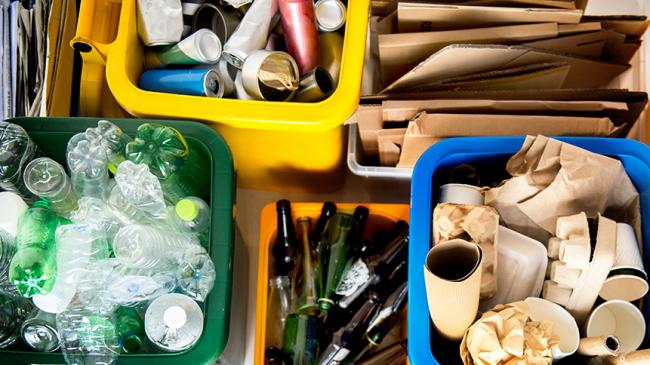
The audited municipalities ensured selective collection of communal waste. Most of them used other, less desired methods of communal waste management – as compared with recycling and preparation for reuse, e.g. disposal by storage and combustion.
Nationwide, the weight of communal waste collected selectively has grown. In 2018, over 3.6 million tons were selected in that way (29% of total communal waste generated), whereas in 2022 it was 5.4 million tons (which makes 40%). According to the GUS data the percentage of recovered communal waste in Polish municipalities went up from 57% in 2018 to 61% in 2022. That resulted mainly from a higher level of composting and fermentation (increase from 8% in 2018 to 14% in 2022), as recycling remained at a similar level (26% in 2018 against 27% in 2022).
Still low circularity rate in the Polish economy
The efforts supporting CE did not help improve circular use of materials in the Polish economy. In line with Eurostat data, in the audited period the use of recycled materials in the Polish industry plummeted from 76 million tons in 2018 to 46 million tons in 2023. That translated into a decrease in the circularity rate from 10.5% in 2018 (10th place among EU countries) to 7.5% in 2023 (16th place among EU countries). For comparison, the circularity rate for the EU was 11.6% in 2018 and 11.8% in 2023.
This means that more than 90% of the materials used in our economy came from virgin raw materials. One of the reasons why the circularity rate has declined is an increasing accumulation of materials in infrastructure (buildings, roads and machinery) and in products that were used for a long time, as well as a significant share of fossil fuel combustion. This indicator can be improved, for example, by: increasing the level of waste recycling, developing the market for recyclables or introducing new technologies that enable more efficient use of materials (eco-design).
Decoupling and increased resource productivity
NIK has positively evaluated decoupling, i.e. breaking the link between the real economic growth and the total weight of material resources used and waste generated, which reduces the economy’s negative impact on the environment. In 2018-2022, despite about 15% of Poland's real GDP growth, the total weight of waste generated increased only by about 0.5% (from 127.8 million tons in 2018 to 128.4 million tons in 2022), whereas the weight of industrial waste went down slightly (from 115.3 million tons in 2018 to 115 million tons in 2022).
The weight of all waste generated in Poland (industrial and municipal) per capita was 4.6 tons in 2018 and 4.7 tons in 2022. Poland still produces less waste per capita than the EU (5.2 tons in 2018, 5 tons in 2022), but this gap has narrowed. This is largely due to an increase in disposable income, economic growth and growing consumption in Poland.
As a result of improved resource productivity, each kilogram of good produced in Poland is actually gaining in value. From 2018 to 2023, resource productivity in Poland increased by 23% in real terms, while in the EU by 9%. Despite this improvement, material resources are still used by the Polish economy less efficiently than the EU average. A kilogram of materials allowed generating a GDP in 2022 worth EUR 0.80 (EUR 1.5 according to the purchasing power standard - PPS) compared to EUR 0.70 in 2018 (EUR 1.2 according to PPS), placing our country on the 22nd position in the EU in terms of material use efficiency (21st position according to PPS).
Recommendations
To the Minister of Development and Technology, among others. to prepare reports on the implementation of government programmes, in particular the Circular Economy Road Map, taking into account the status of individual activities along with an indication of the reasons for failures in implementation and remedial actions.
To the municipalities e.g. to:
- ensure that waste management is carried out in a way that allows the required levels of preparation for reuse and recycling of communal waste to be achieved;
- ensure all required information in the analyses of the state of communal waste management, as well as compliance of information on the level of preparation for reuse and recycling of communal waste with reports on the implementation of communal waste management tasks submitted in the BDO system;
- carry out inspections of entities collecting communal waste at least once every two years;
- take action to support the reuse of products and prepare the products that had already become waste for reuse, in particular to set up and support reuse and repair networks as well as economic incentives.