

According to NIK the construction of wind farms was often accompanied by the conflict of interests, intransparency and corruption threats. Unclear provisions of law as well as inconsistent doctrine and jurisdiction did not provide sufficient guarantee that wind farms would be erected in in an environment—friendly manner, limiting inconvenience to the people living nearby.
The Supreme Audit Office identified the following issues and irregularities:
- none of the audited municipalities, despite numerous protests concerning the location of wind farms, did not organise a referendum in that matter, although that solution was provided for in the law. Decisions on behalf of local communities in that respect were taken exclusively by city council members without taking into account the arguments of local communities;
- in nearly one third of municipalities wind power stations were located on the land owned by city council members, local government employees or municipality heads, i.e. decision-makers or persons who on behalf of the municipality participated in the decision-making process concerning the investment location. According to NIK that situation could give rise to a conflict of interests which posed a threat of corruption or lobbying, which was unacceptable;
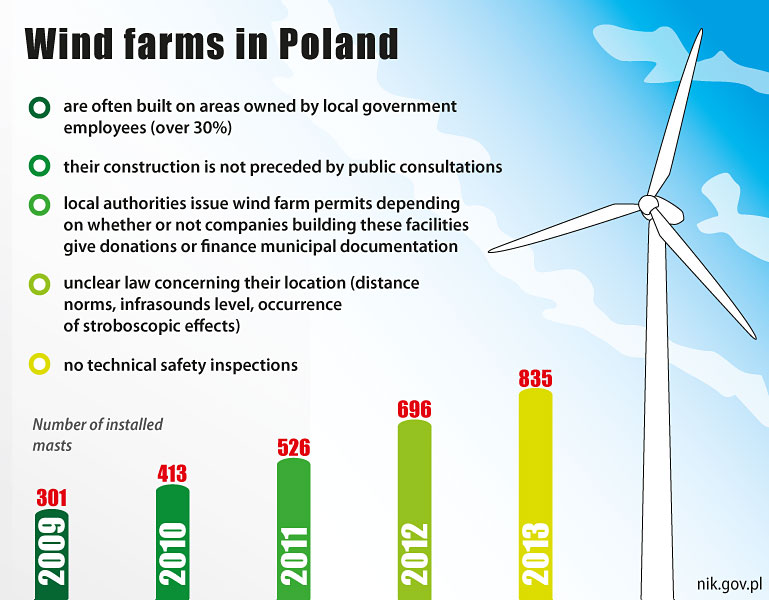
- in an absolute majority of cases (80 percent of municipalities), the wind farm permits issued by local authorities depended on whether or not the investors financed the planning documentation or gave donations to the municipality. According to NIK such relations on the verge of the public and private interests represented a corruption-prone mechanism;
- the Polish law did not specify the safe distance between wind farms and a developed land, especially the one inhabited by people;
- the law also did not define acceptable norms concerning other potential threats, such as infrasounds or stroboscopic effects. That was the reason why eligible public institutions did not examine - in the said scope - the wind farms’ impact on the environment;
- technical inspection services did not care about safety related to the functioning of technical devices in wind power stations. Effective regulations concerning technical inspection did not specify which mechanical elements should be screened by public inspection bodies;
- in the construction law, wind power stations have not been allocated to any category of construction facilities. As a consequence the use permit was required for the same wind farms at one point and at another their use was allowed only after the construction closeout. According to NIK the construction of a wind farm should always require the facility use permit;
- unclear law, inconsistent jurisdiction and doctrine resulted in discrepancies in interpretation and application of legal provisions concerning the location of wind farms on environmentally protected areas despite controversies and protests of local communities. As a consequence, wind turbines will be erected in environmentally protected areas in the North-East Poland.
Final comments and recommendations
Considering the audit results, the Supreme Audit Office recommends the following measures should be taken:
- define ways of financing the municipalities’ planning documentation related to the construction of wind power stations which would require specific law changes,
- develop a consistent methodology to measure the emissions of noise generated by wind farms,
- effectively limit possibilities of locating wind farms in environmentally protected areas,
- establish the legal basis for permitting the use of wind farms,
- cover the use of wind turbines with technical inspection.
The Supreme Audit Office has addressed the President of the Council of Ministers and the Minister of Environment with relevant proposals to change the law in the matters arising from the audit findings.