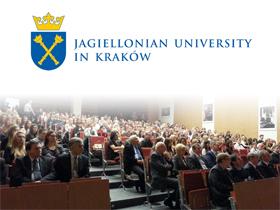


”I am happy to be here, at the Faculty of Management and Social Communication of the Jagiellonian University in Cracow which received a distinction in human sciences and which educates a few thousands of students every year in the field of management, social politics, economics, journalism, social communication, psychology and others” - in these words NIK President Krzysztof Kwiatkowski greeted the students. The President started the opening lecture by referring to the jubilee of the Jagiellonian University which celebrates its 650th anniversary. At the same time he mentioned that the Supreme Audit Office has its 95th anniversary this year.
A big part of the lecture was dedicated to management and work in the Supreme Audit Institution. "NIK verifies and evaluates the adequacy of the process of planning public tasks” - the President said. ”We are checking among others if proper data was used to draft the plan, if the objectives were corrected in line with the requirements defined by changing internal and external circumstances” - he explained while proceeding to the issue of NIK’s role in improving the state functioning from the perspective of management sciences. ”It is justified” - the President argued - ”since the control itself is the object of this science as one of classical management functions (according to Henri Fayol). Control is a stage of the organised activity cycle. It was noted not only by Henri Louis Le Chatelier but also by the Polish scholar Karol Adamiecki.
The students attending the meeting had a chance to see the broad thematic scope of audits conducted by NIK. The President mentioned that last year NIK completed 206 planned audits and 108 ad hoc ones. Key areas for the state functioning and matters important for citizens were analysed as part of these audits. The President also said that NIK has audited 1639 entities since the beginning of the year, where the key audits dealt with the budget act execution, ensuring power safety of the state, environment protection and healthcare.
A large part of the lecture concerned the so-called de lege ferenda proposals where NIK postulated changes in the law. Last year NIK submitted 78 proposals of this kind. 61 of them were related to statutory provisions and 17 dealt with changes in ordinances.
The students were shocked by the popularity of the NIK website. ”We have over 2 million page views per year” - the President said. You can find us also in other Internet services, such as Facebook, Twitter, Google+, YouTube. In 2013 there were 14 256 materials in total about NIK in the media, that is 6 percent more than in 2012” - the President added.
Other points of the lecture which the students found the most interesting included: methods of selecting audit subjects, experts panels attended by scientists and extensive cooperation with the prosecutor’s office. The Head of NIK also presented recent achievements of NIK in the international arena: appointment of NIK as a member of the INTOSAI Governing Board and as external auditor of the Council of Europe and European Organisation for Nuclear Research (CERN). Krzysztof Kwiatkowski emphasised that there were many more examples of our international activity. ”We take continuous efforts to effectively eliminate corruption from public life - also in the international arena. After all, this is a pathology in various public organisations.”
President Kwiatkowski summed up the lecture by raising the issue of citizens’ trust in public institutions. ”Public trust in Poland is much lower than in other countries. I think in comparison to other public institutions we enjoy quite a high public confidence level. We are perceived better than the Sejm or the Senate. ”Our work is evaluated similarly as efforts taken by the Constitutional Tribunal (46 percent)” - he said and quoted the results of the study conducted by CBOS (Public Opinion Research Centre) in 2013 which revealed a 9 percent growth of NIK ratings against 2010. According to Krzysztof Kwiatkowski, NIK owes such a high confidence level to cooperation and professionalism of all NIK employees.