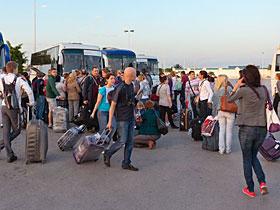


This year’s bankruptcies of tourist agencies have directly hit several thousands of Polish people. Some of them went through a real drama abroad. ”We were in a hurry with our audit to make it before the following travel season” - said President of NIK, Jacek Jezierski, during the experts’ panel. ”We hope that the audit results will contribute to improved situation of persons using the services of travel agencies”.
Travel agencies
Grzegorz Buczyński, directly responsible for the audit, pointed to the gaps in the effective law. ”Bankruptcies are a natural element of the market play. The problem is that the customers of travels agencies lost their money but no one really knows today who would have to give it back to them, although the law guarantees them full return of expenses.
Katarzyna Sobierajska from the Ministry of Sport and Tourism ensured that works on standardising regulations were already pending. ”There is an issue, though, because the tourist market is now one of the most regulated markets in Poland. Fast implementation of changes without thorough analysis of what happened could harm instead of helping us all” - said the undersecretary of state.
Monika Stec from the Office of Competition and Consumer Protection spoke in a similar spirit. ”The following regulations may entail pushing some entrepreneurs out of the market which will reduce competition and harm customers in the long run” - argued the Director of the Department of Consumer Policy.
Changes in the law appear to be essential, though. One reason was the situation of the Province Marshals who were obliged to bring back to Poland the tourists abandoned abroad by travel agencies. Izabela Stelmańska from the Marshal’s Office of Mazowieckie Province talked about some problems related to that task. ”The Marshal had to transform in one day into a tourism organiser whom he is not. He had to fight for free seats on the planes where succeeding was close to a miracle in the tourist season. Besides, he had to finance most of the operations from his own budget.
In these circumstances the law orders the marshal only to perform the task commissioned by the government administration. Therefore, the Regional Chamber of Auditors soon questioned the way provincial money was used. ”I’m only wondering who would have helped the tourists if we had acted legally and waited with bringing the people back to Poland until we got sufficient funds for that” - Ms. Stelmańska wondered at the meeting. And she added that until then the Marshal had not been given his money back.
The issue of dishonesty of some travel agencies was also addressed during the debate. Representatives of the Polish Association of Tourist Agents emphasised that only 10 percent of offers of the agencies who later went bust or appeared insolvent had been sold by agents. The rest were bought directly by customers, mainly via internet. ”We could say then that sales representatives themselves excluded unreliable entrepreneurs” - said Marek Kamieński. But why did they offer their customers offers of the travel agencies they were not sure of themselves? ”If we shared our doubts with people, we could be brought to trial. Some companies, seeing our hesitation, threatened us with court proceedings for damaging their interests and image”.
”But customers come to agents because they see and know more” - replied Vice-President of NIK, Wojciech Misiąg. ”People trust you and expect reliable information from you. If they do not get it, even because of the reasons you’ve mentioned, there is something deeply alarming about that”.
During the panel, the experts a few times addressed the issue of an additional guarantee fund. ”This may be the direction we should set” - said Katarzyna Przewalska from the Ministry of Finance. ”This solution is used all around the world and maybe it’s worth considering also in Poland”.
”How about the grey market of the Polish tourism?” - inquired Marek Traczyk, editor-in-chief of TTG Polska. He explained that he meant e.g. school trips organised without the help of specialised organisations, part of pilgrimages which take place without participation of a travel agency or the Church (the Church may act as tourist organiser), and finally a range of business trips for whole groups. ”This phenomenon intensifies year after year and remains out of the state’s control. And what if a tragedy happens there? People will remain without any help at all.”
The Supreme Audit Office organises experts’ panels before and after its audits. During such debates, outstanding specialists confront one another, which helps to streamline the audit programmes and interpret the audit results in a better way.