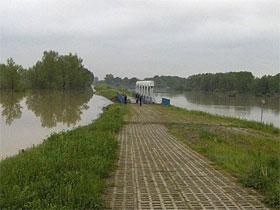


Poland has no national plan for flood protection, nor are there any such plans for water regions. Neither the president of the National Water Management Authority nor the directors of the Regional Water Management Authorities have produced such plans, although since 2002 they have been obliged to do so under the Water Law Act. The president and the directors excused themselves with the EU Directive which entered into force in 2007 and which requires that other documents and analyses be developed. However, the Directive provisions were included in the Polish legislative system only in 2011. Therefore, these excuses do not influence NIK’s evaluation that the lack of flood protection plans at the national and regional level could prevent proper organisation and actions in case of a flood.
The situation is even worse due the fact that the technical condition of hydrotechnical structures is deteriorating and the number of new ones is insufficient. In 2008, 30 water-retaining structures audited by the regional authorities were in a safety-threatening condition. In 2010, the number of such structures was already 41. According to the data of the Central Construction Supervision Office, 70 percent of water water-retaining structures are above 25 years old (of which more than 30 percent are 50), some structures are more than 100 years old (the shipping sluices, in particular). The problem is not the age, though, but the lack of maintenance and renovation which leads to the structures’ degradation. Within the two years covered by the audit, the Regional Water Management Authorities did not carry out the 84 scheduled renovations of water-retaining structures and flood banks, although 50 of them were qualified as the 1st urgency level, which stands for a real danger in case of a potential flood. Besides, there are nearly 2 thousand damages on the rivers, brooks and water engineering structures waiting for renovation - of which more than a half is at the 1st urgency level.
In the audited period (from 2008 to the first half of 2011), 14 water investments were accomplished, another 12 was in construction. PLN 376 million was spent on them. The needs were greater but some investments were not included in the construction plans due to the lack of funds. That was the reason why e.g. three water power plants were not built in the Lower Silesia. The same thing happened to the water thresholds in the Wielkopolska region and to the wing dams on the Warta river.
The main reason of that state of affairs is the chronic lack of finance for water management. From 2008 to 2010, PLN 333.7 million was spent on the maintenance of waters and water structures. Depending on the year, it is from 13.4 to 20.9 percent of needs estimated at PLN 690 million per year. The structures’ administrators report that they usually receive one third of essential funds for the maintenance, although at times it is only 10 percent. As a result, only the most urgent tasks can be undertaken, as e.g. removing the flood consequences. Year by year, the deficits are growing and the structures are getting damaged. In case of a flood they break down more often or even fail to operate at all.
Considering the permanent lack of money, NIK finds it essential to work out a system solution to ensure financing and quick performance of tasks which are material and urgent from the viewpoint of water safety. At the same time, the Supreme Audit Office appreciates the efforts of the President of the National Water Management Authority, who via the Minister of Environment, addresses the Minister of Finance every year with a request to increase the pool of funds for the maintenance of waters and water structures.
NIK is alarmed by ineffective auditing on part of the Regional Water Management Authorities, which results in their incomplete knowledge of the condition of water structures. The audits are too rare and they do not comprise all structures administered by the authorities. For instance, the compulsory controls of the technical condition (at least once a year) covered only 30 percent of the length of flood banks. Only 6 percent of flood banks and less than 40 percent of water-retaining structures (in 575 audited ones) were covered by an important (mandatory!) control of the structures’ technical condition and usability. The implementation of post-audit recommendations was also poor. It resulted among others from the already mentioned lack of money.
NIK on the execution of the Flood Protection Project
NIK negatively evaluates the execution of the Odra River Basin Flood Protection Project. As a result of several years’ delays due to prolonging preparations for investments, ineffective cooperation with external companies and uneconomical and ineffective management of the Project budget, the deadline for performing the key tasks is in question. The safety of the Odra river basin has not improved significantly since the time of the flood in 1997.
During the flood in July 1997 the water covered more than 2.5 thousand villages, towns and cities in the South-West Poland (including Wrocław, Opole, Racibórz). The natural disaster also did not spare the Czech Republic, Eastern Germany, Austria and the South-West Slovakia. In Poland itself more than 50 people lost their lives. The material losses were estimated at nearly PLN 14 billion.
To prevent disastrous consequences of floods in the future, in 2001 the Polish government developed the Programme for the Odra River 2006, the implementation of which was assumed for the years 2002-2016. The Polish side took out a credit facility and a cash loan for the Programme implementation in the amount of EUR 345 million (2/3 of funds needed for that purpose) with the World Bank and the Council of Europe Development Bank. Six percent of funds came directly from the state budget and 25.7 percent from the European Union. These funds were supposed to be allocated to the two key undertakings within the Odra River Basin Flood Protection Project (being part of the Programme for the Odra River 2006), i.e. construction of Racibórz Polder - which in case of flood could contain 170 million m³ of water, that is nearly twice as much as the volume of Zegrzyńskie Lake near Warsaw - and Modernisation of Wroclaw City Floodway System (being a group of rivers, channels and hydrotechnical structures, a unique one in Poland).
The institutions responsible for the Project implementation used the funds uneconomically and inefficiently. As at the end of 2011, the use of funds was only PLN 119.2 million, that is 4.6 percent of planned total Project costs (PLN 2.6 billion), because the money was spent not on construction works but on financing of the services of Technical Support Consultants, purchase of real properties or preparation and update of the project and technical documentation. In 2011, the Regional Water Management Authority [RZGW: Regionalny Zarząd Gospodarki Wodnej] in Gliwice wasted PLN 264.2 thousand by commissioning the same works twice. The works were related to the client’s preparation of the construction permit request for Racibórz Polder. RZGW also acted uneconomically by paying PLN 1.9 million for the real properties of persons resettled from the construction site a few weeks before the transaction conclusion and by paying PLN 406 thousand to a natural person for the purchased property 53 days before signing notarised deeds. In the latter case the action of RZGW was also illegal.
The irregularities on part of the Regional Water Management Authority in Gliwice led to considerable delays in the Project execution. In line with the assumptions of the Programme for the Odra River 2006 the Racibórz Polder was supposed to be handed over by the end of 2011. However, by that time only PLN 75.4 million was spent, i.e. about 6 percent of the amount allocated to that purpose and RZGW did not even start the Polder construction. It failed to develop full and updated project documentation, obtain the construction permit or select the contractor. The delays partly derived from some objective reasons, such as the amendments to the provisions of law, but to a large extent they were dependent on RZGW. Lengthy preparations for the Polder construction, poor problem solving skills, ineffective cooperation with the Technical Support Consultant, failure to obtain copyrights for the project documentation - these are only some causes of the delays.
NIK indicated some delays also on part of the Regional Water Management Authority (RZGW) and the Lower Silesia Board of Amelioration and Water Structures [Dolnośląski Zarząd Melioracji i Urządzeń Wodnych (DZMiUW)] in Wrocław which were responsible for the Modernisation of Wroclaw City Floodway System. Originally, this investment task was to be accomplished in 2008. However, by the end of 2011, no works in that area were even started. The delays resulted among others from lengthy procedures for preparing documentation and obtaining environmental decisions or ineffective supervision of the work of the Technical Support Consultant that did not discharge its obligations.
At the end of 2011, the delays as part of the Project reached 3 years. In practice it means that the assumed works completion date - 31 May 2014 - has become unrealistic. It may lead to the loss of the EU funds. Additionally, the Project costs are growing. In the middle of 2011, they were estimated at EUR 826 million, being EUR 321 million more than originally assumed. The sources of the difference financing have not been defined yet, which may result in subsequent delays in executing key flood protection investments.