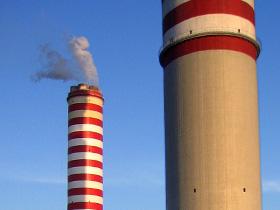


In the Kyoto Protocol[1] Poland committed itself to 6-percent reduction of greenhouse gas emissions in the period 2008-2012 (against base year 1988). However in 2010, according to the data of the National Centre for Emissions Balancing and Management (KOBIZE), Poland reduced the emissions by as much as 28.9 percent. That commitment could be met among others thanks to the efficiently operating emissions management system.
KOBIZE plays a pivotal role in the emissions management system, providing the Polish side with organisational and expert support. The NIK audit revealed that KOBIZE performed its tasks properly. It conscientiously monitored greenhouse gas emissions produced by the operators of industrial installations. It issued emission allowances on a timely basis. It drafted opinions based on which the Minister of Environment gave the green light to the so-called Joint Implementation Projects[2]. Besides, KOBIZE accurately ran the National Registry, an electronic database containing Kyoto units and emission allowances. That Registry was properly secured which was later confirmed in practice by numerous unsuccessful phishing attacks.
The audit carried out by NIK, covering the period from 1 January 2008 to 13 June 2012, is a result of the agreement signed in January 2012 by the Supreme Audit Institutions of Denmark, Finland, Latvia, Lithuania, Norway and Poland. It was related to a parallel audit of allowance trade systems in each of these countries. The final outcome of the audit is the joint report in which individual SAIs assessed effectiveness of the European Union Emissions Trading System (EU ETS). The main task of the system is to fight against climate change by supporting the participating countries in observing the provisions of the Kyoto Protocol and also to help them limit the costs related to the emissions reduction.
The audit findings show that the emissions management system in Europe is exposed to the activity of fraudsters who embezzle VAT on the occasion of trade in CO2 emissions allowances. The trade in allowances is related to large cross-border money transfers. It creates favourable conditions for tax frauds. In Denmark and Norway considerable amounts were swindled out of both countries’ budgets when settling VAT tax on allowance trading transactions. To protect the state against severe losses, a solution called reverse VAT was applied in four Scandinavian countries being partners to the cooperative audit. According to that principle, it is the buyer, not the seller that is responsible for settling the tax.
[1] International agreement being part of the United Nations Framework Convention on Climate Change on the prevention of global warming. Poland entered the Protocol on 16 February 2005.
[2] Initiatives undertaken in cooperation with other countries aimed at reducing greenhouse gas emissions.