

Despite favourable natural conditions, the Polish inland shipping is not an economically attractive area and its popularity has decreased in decades. Declining significance of the inland shipping industry is mainly due to progressing degradation of inland waterways which makes investments in the construction of a new fleet unprofitable for freighters. As a consequence, most of the fleet gets old, the use of decapitalised ships generates high costs and additionally decreases competitiveness of that branch of transport. About PLN 14 billion is needed to return appropriate parameters to the waterways, whereas expenditures for that purpose in 2012 were only PLN 160 million. Investments in inland shipping are given much lower priority in Poland than for instance construction of motorways or railway modernisation. Irregularities identified by NIK with public administration bodies confirm that this sector is neglected in our country. It is different in many other EU countries which promote inland shipping industry. It is the case because water transport is much more efficient and environment-friendly than e.g. road transport. It does not cost much at the same time.
In the audit on inland shipping in Poland NIK made the following findings:
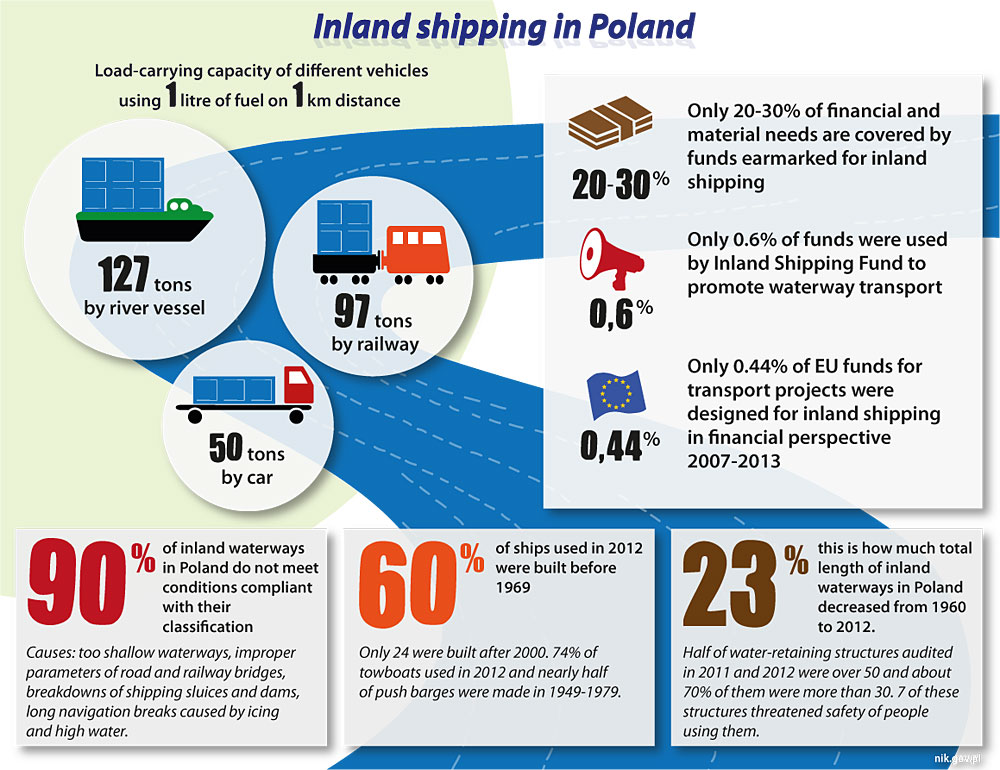
- as much as 90 percent of inland waterways in Poland does not meet the conditions of use defined by the law. The main cause of progressing degradation of waterways is insufficient funds covering only 20-30 percent of needs. The most significant impediments for ships include too shallow waterways (e.g. in 2011-2012 in Odra channel, the minimum waterway depth for safe navigation of 1.8 m was provided for a period not longer than 90 days, whereas it should have been at least 240 days), improper parameters of road and railway bridges, breakdowns of shipping sluices and dams and long-term navigation breaks caused by icing and then high water. NIK inspectors stated that poor technical condition of waterways posed difficulties for the shipping traffic, making the regular transport of goods impossible for freighters.
NIK underlines that the National Water Management Authority (NWMA) and the Ministry of Transport, Construction and Maritime Economy (MTCME) did not take efforts to change the ordinance in a way making sure the norms set out there reflect the actual state of affairs. According to NIK, it is unacceptable when the legislative system defines provisions which may not be complied with. - A lot of hydraulic structures audited by NIK were obsolete and neglected. For instance in Poznań the technical condition of 28 in 64 of them was defined by NIK inspectors as insufficient. The water control facility on the Odra River was in a very bad condition - 30 groynes (dams built near the river bank to slow down the water current) needed a major overhaul. The NIK audit showed that some RWMA did not carry out regular audits of hydraulic structures, required by law or did not eliminate defects identified during audits. In both cases the reasons were financial deficits;
- In most cases RWMA had delays in executing major infrastructural investments in the inland shipping industry. It was the case mainly with the Programme for the Odra River - 2006. The Programme assumed modernisation of that waterway in the period 2002‑2016. Until 2013, despite the lapse of about 80 percent of the time, only a half of funds were used as part of the whole Programme. Particularly long delays (11 years) occurred in case of the construction of Malczyce barrage;
- The Inland Shipping Fund (ISF), established before the accession of Poland to the EU did not pursue its primary goal being the inland shipping promotion. In the audited period and before that, the Fund used only a small part of the money at its disposal. In 2011, payments for freighters made up 2.9 percent of available funds, whereas in 2012 it was only 0.6 percent. NIK auditors pointed out that in 2012 the costs of the Fund’s banking service were higher than the aid provided to the freighters. At the end of 2012, the Fund’s unused amounts were PLN 41 million. According to NIK this is incomprehensible considering the slowdown of the inland shipping. This situation resulted largely from the fact that the domestic law was not adjusted to the EU legislative system.
- No funds were acquired for the development of the inland water transport infrastructure as part of the EU support programmes for 2004-2006, whereas in the financial perspective 2007-2013 the EU funds acquired for that purpose represented only 0.44 percent of the total allocation of funds for transport projects. According to NIK, the approach of MTCME and NWMA shows that the public administration neglects the inland shipping sector. On the other hand, NIK positively evaluates actions taken by MTCME in cooperation with NWMA to increase additional financing for the inland shipping industry (that share would be 1.38 of the total amount of aid for transport projects, which would stand for a two-fold increase of funds for that purpose);
- Until the audit ending, MTCME and NWMA did not develop any long-term programme defining the deadlines or financing of investment tasks in the area of inland shipping. NIK emphasises that a clear and implemented state policy supporting the inland shipping industry will make it much easier for shipping companies to plan their transports, make long-term investments in modernisation and purchase of a new fleet as well as to conclude long-term transport agreements.
Post-audit recommendations addressed to the former Minister of Transport, Construction and Maritime Economy concerned among others:
- speeding up works to develop a long-term programme for infrastructural investments in the inland water transport;
- taking efforts to guarantee financing for selected projects for infrastructural investments in the inland water transport;
- speeding up works to develop a draft amendment or develop a new act on Inland Shipping Fund or Reserve Fund.
NIK has also addressed the President of the National Water Management Authority with the following recommendations:
- better use of funds earmarked for the financing of inland waterways;
- streamlining the investment activity of Regional Water Management Authorities;
- strengthening supervision over timely execution of infrastructural investments in the inland shipping sector;
- speeding up works to develop a long-term programme to restore parameters of the inland waterways’ use.