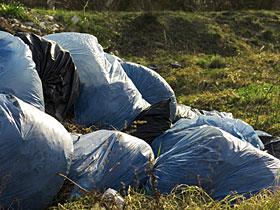


The number of wild landfills is alarming. In Gdynia and Kielce the auditors identified a few hundreds of such waste dumps, in Poznań there were more than five hundred of them. The communes paid PLN 5.1 million for their liquidation during which about 5.3 thousand tons of waste were removed. The NIK findings show that in 15 communes the place of removed garbage was quickly filled with new waste which can be qualified as hazardous. Besides, not all communes liquidated the wild landfills for which they blamed the lack of funds (e.g. Koniecpol, Łazy, Myszków, Szczyrk, Węgorzewo).
The majority of commune heads cannot enforce lawful management of communal waste. First of all, they lack some information on agreements between land owners and entrepreneurs dealing with garbage removal. The officials should run thorough records of such agreements. However, 12 communes did not keep such records at all (or they started to do it too late) and 16 had some gaps or mistakes in the records which made it impossible to check if the owner had a valid agreement. The commune heads who lacked such information did not intervene when the property owners had no agreements with the waste removal companies. In such circumstances, only three cities (Żywiec, Olecko, Poznań) organised a substitute waste collection, although the NIK audit showed that the property owners without agreements were present in nearly all communes.
Nearly a half of playgrounds for children and almost all sandpits are exposed to contamination caused by animals - alarms NIK. Nearly all of the reviewed sandpits (93 percent) and the majority of playgrounds (more than 52 percent) have no fences or other forms of protection against animals. It means that the children playing there are exposed to contact with animal impurities. Only in three of 35 communes (Bodzentyn, Gdynia, Gniezno) playgrounds and sandpits were properly protected.
NIK points out that not all communes provide proper conditions for its inhabitants and visitors to observe the principles of cleanliness and tidiness. In 17 audited towns or cities there were too few dustbins, in some communes they were placed only in representative locations, neglecting peripheral areas (e.g. that was the case in Kielce and Ogrodzieniec). Also some pet owners may not count on any support in fulfilling their statutory obligation of impurities removal. The heads of 12 communes excused themselves mainly by the lack of money. In the remaining 13 communes they distributed pet poop bags. In 10 communes special dustbins were installed, though not always in sufficient numbers. Only four communes organised special paddocks (functioning as toilets) for dogs.
Another big problem of the communes is the limited access to public toilets. There are too few of them almost everywhere. In 2011, in the audited communes, there was one public toilet per 11.9 thousand inhabitants on average, whereas e.g. in Great Britain it was 600. Only 11 of the audited communes have built new restrooms in the past years, and their total number did not exceed 21. In many towns or cities it is a norm when public toilets are closed in a given season or on bank holidays, when they are open only in specific hours and are not adapted to the needs of the disabled. Very often there is no notice for inhabitants or tourists on the location of such facilities. In two audited communes (Knurów and Myszków) no restrooms were open.
In the majority of the audited communes (71 percent) the commune heads did not order mandatory deratisation although it is required by the cleanliness regulations. Only single operations were carried out in those communes. However, the experts point out that the only way to effectively get rid of the rodents and limit their population is to do deratisation on a complex basis.