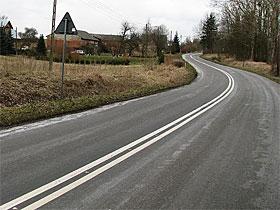


The local road network in Poland is poorly developed. Additionally, its surface is in bad condition which gives Poland a poor rating in comparison with other EU countries. County roads are over 127 km long and municipality roads exceed 237 thousand km which makes up 88 percent of all public roads (412 thousand km in total). The bad condition of road infrastructure is a crucial barrier in regional development - it hinders economic activity of individual regions, decreases their attractiveness and competitiveness in the field of investments. It also has an adverse impact on the safety level of road users. According to the Police statistics, the three fourths of all accidents take place on local roads every year.
Effects of implementation of National Programme for Reconstruction of Local Roads
The local roads reconstruction programme was to improve the state of local infrastructure. In the first edition of the Programme (2009-2011), the local road network totalling 8.2 thousand km (4.7 thousand km of county roads and 3.5 thousand km of municipality roads) was modernised and expanded. The investment value was PLN 6.1 billion, of which PLN 2.9 billion came from specific purpose subsidies of the state budget. In the second edition of the Programme (until the end of the Programme), the modernisation and development covered 827 km of the road network.
The Programme implementation to date contributed considerably to the improvement of the technical condition of local roads and road traffic safety (pavements, bike paths, bus lay-by were built, as well as traffic and street lights were installed as part of the investment). Considering positive effects of the Programme, NIK critically evaluates the decrease of the state budget subsidy, especially that local governments alone cannot afford to finance the repairs or construction of local roads.
Key irregularities identified by NIK
For many years local governments neglected the planning of the local road network development. More than a half of them - 20 in 35 of audited administrators (57 percent) - did not devise such plans, despite the statutory obligation. The absence of plans makes it difficult for local governments to solve transport or communication issues in their regions. As a consequence, officials selected roads for repair or reconstruction at their own discretion.
Numerous cases were identified of improper supervision exercised by road administrators over investments carried out as part of the Programme. The irregularities occurred both at the stage of works (improperly made road foundations, road sides and bus lay-bys), and at the stage of final handovers. The former were approved without any verification or confirmation of work execution in compliance with the terms and conditions set out in agreements with contractors (that was the case with 15 of 35 road administrators). The contractors did not submit required documentation: the results of laboratory tests, certificates and attestations, being the basis of correct handover and settlement of tasks. Long-term negligence in this respect may contribute to the occurrence of damages of the whole structure of some parts of the roads and hence require complex and costly repairs.
The great majority of road administrators (83 percent of all auditees) did not properly discharge their obligation to conduct periodical technical inspections of their road network. They either did not make any inspections required by the law or carried them out in a limited scope. In some cases the inspection boiled down to running on a given part of the road. The officials explained that they knew local roads perfectly because they used them on everyday basis. However, the lack of proper assessment of the road condition may be dangerous for drivers.
91 percent of audited road administrators committed gross negligence in terms of proper road marking and development of permanent traffic arrangement projects. Only 3 of 35 road administrators (9 percent) had approved traffic arrangements for all the roads administered by them (28 units had approved traffic arrangements for parts of the network under their management, and in four cases there were no such arrangements at all). On the roads of all administrators, cases were identified where road signs were installed against the approved traffic arrangements. Additionally, the signs were often illegible - dirty, corroded, devastated. Frequently, their visibility was limited as well.
Significant irregularities concerning the condition of road records were detected. As much as 63 percent of administrators (22 percent auditees) did not run any road logs at all. In other cases the records were incomplete or outdated. These records document all repairs and renovations as well as audits and technical inspections of the given road. The absence of up-to-date records makes it difficult to maintain the road properly or plan its repairs.
Key recommendations
To the Minister of Administration and Digitalisation:
- to continue implementation of the National Programme for Reconstruction of Local Roads and ensure yearly subsidy from the state budget of at least PLN 1 billion as was assumed in the Programme.
To the Minister of Infrastructure and Development:
- to amend the ordinance on specific terms and conditions of the traffic management on public roads and supervision of implementing that ordinance.
To the owners of infrastructure of municipality and county roads:
- to increase supervision of the following: drawing up of road network development plans, running of up-to-date road records as well as conducting and proper recording of technical inspections of the roads;
- to intensify audits of permanent traffic arrangement projects and proper road marking;
- to exercise effective investment supervision in the course of works and at the stage of their handover.