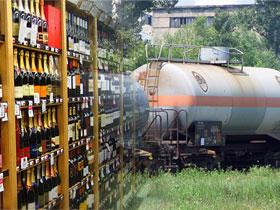


In the years 2004-2007, over 41,000 tonnes of a product containing ethyl alcohol (usually 94-96%), a contaminant (denatonium benzoate), a surface-active agent and water were imported to Poland through the border crossing in Przemyśl. According to importers, the substance was a windscreen washer fluid, while the Ukrainian producer described it as a methylated spirit. The contamination was, however, easily removable, and after that the ethyl alcohol could have been used for spirits production. The laboratory of the Customs Office in Przemyśl examined the product at the Polish border, and every time it was considered consistent with the importer’s declaration. Then the product was authorised for sale on the EU market as an anti-freeze windscreen washer fluid, and classified as an “unspecified product”, instead of as ethyl alcohol.
Such classification allowed for application of a zero excise rate. In the opinion of the NIK, such classification was incorrect. It permitted importers not to pay the excise duty and, consequently, a product that contained over 95% of ethyl alcohol, denatured with an easily removable substance, reached the market.
Under the Polish law, excise duty is not charged on ethyl alcohol unfit for human consumption only if it is exempt from the excise duty (and not if a zero excise duty rate is applied when it is classified as an “unspecified product”). When an excise exemption is applied, the product is monitored. Then, the importer must fulfil a number of conditions, such as, for example, to track the destination of the imported product and to check whether it is not used for human consumption. During this time, the excise is suspended and only after complying with all the conditions stipulated by the law, the importer of the denatured alcohol is finally exempt from the excise duty payment.
By not applying the tax exemption procedure, the Polish state was not able to monitor ethyl alcohol denatured with an easy removable substance. Since the concentration of alcohol in the imported product was high, and the contaminant was easy to remove (with the use of an activated carbon filter, sodium hypochlorite and vinegar), and since the product was not monitored, the alcohol it contained could have been used for illegal spirits production.
Irregularities stemmed from the position taken by the Minister of Finance that allowed for applying a zero excise duty rate for products containing ethyl alcohol. Interestingly, the EU law does not permit a zero excise duty rate for ethyl alcohol.
The NIK stated that, despite signals from representatives of customs services and several entities from the spirits market, the stance of the Ministry of Finance remained unchanged.