


More and more money is spent on medical rehabilitation but its availability is still decreasing. The number of waiting patients is going up, the waiting time is getting longer and the list of places providing rehabilitation services without queues is shrinking. The rehabilitation financing model is complicated and does not include final treatment effects: the costs of good- and poor-quality services are the same. Legislative works on defining the profession of physiotherapist are prolonging and without clear provisions rehabilitation services may be performed by persons without adequate preparation. At the same time, the absence of standards in medical rehabilitation makes it difficult to maintain proper quality and effectiveness of treatment.
In the audited period (2011 - May 2013), the National Health Fund (NFZ) systematically increased outlays for medical rehabilitation. The funds planned for 2013 were 15 percent higher than the ones planned for 2010. Nearly PLN 267 million more was earmarked for rehabilitation in 2010 than for 2013. At that time, also the number of specialists in medical rehabilitation, balneology and physical medicine as well as speech therapists and physiotherapists increased.
Problems with rehabilitation availability
Regardless of potentially favourable circumstances to boost availability of medical rehabilitation, it went down in the audited period. At the same time the number of people waiting for rehabilitation increased: at the end of 2011, there were over 400 thousand people registered for physiotherapy and at the end of 2013 the number of them went up to nearly 613. At rehabilitation units there were 114 thousand and more than 150 thousand persons waiting for their procedures in 2011 and 2013 respectively.
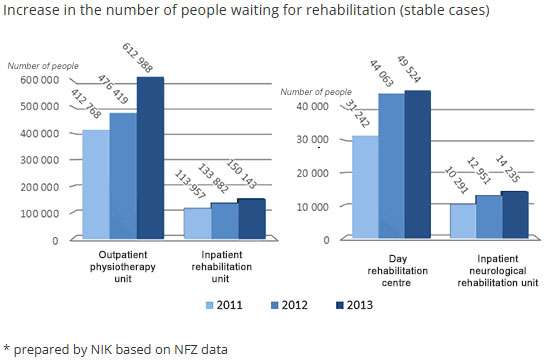
Opis grafiki
| Type of rehabilitation unit | 2011 | 2012 | 2013 |
|---|---|---|---|
| Outpatient physiotherapy unit | 412768 | 476419 | 612988 |
| Inpatient rehabilitation unit | 113957 | 133882 | 150143 |
| Day rehabilitation centre | 31242 | 44063 | 49524 |
| Inpatient neurological rehabilitation unit | 10291 | 12951 | 14235 |
* prepared by NIK based on NFZ data
The time of waiting for rehabilitation procedures in four key rehabilitation units: at the end of 2011 in outpatient physiotherapy units patients waited for their procedures 41 days on average, whereas in 2013 it was already 61 days. At rehabilitation units it was 174 and 251 days correspondingly.
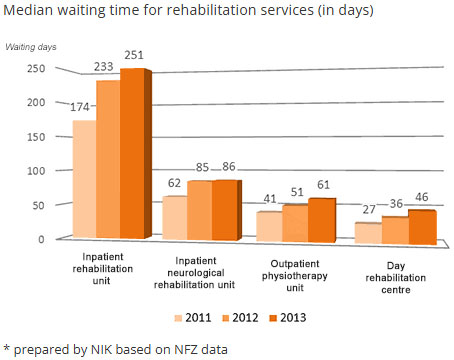
Opis grafiki
| Rehabilitation unit | 2011 | 2012 | 2013 |
|---|---|---|---|
| Inpatient rehabilitation unit | 174 | 233 | 251 |
| Inpatient neurological rehabilitation unit | 62 | 85 | 86 |
| Outpatient physiotherapy unit | 41 | 51 | 61 |
| Day rehabilitation centre | 27 | 36 | 46 |
* prepared by NIK based on NFZ data
At the same time the number of placesA offering rehabilitation services without the need to wait was falling. For instance, at the end of 2011 every fifth outpatient physiotherapy unit provided its services without queues, whereas at the end of 2013 it was every tenth one. However, according to NFZ data, despite longer and longer queues - there are still some medical centres where you can sign up for rehabilitation without waiting. For instance according to NFZ, in one fifth of day rehabilitation centres the waiting time was zero days.
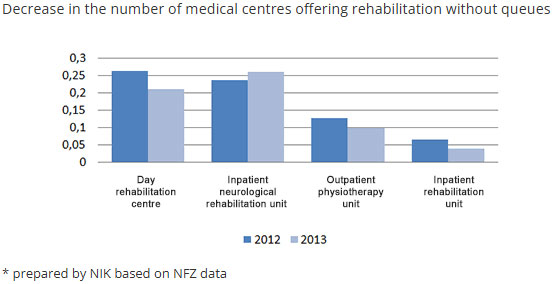
Opis grafiki
| Rehabilitation unit | 2012 | 2013 |
|---|---|---|
| Day rehabilitation centre | approximately 0.26 | approximately 0.21 |
| Inpatient neurological rehabilitation unit | approximately 0.24 | approximately 0.26 |
| Outpatient physiotherapy unit | approximately 0.13 | approximately 0.10 |
| Inpatient rehabilitation unit | approximately 0.07 | approximately 0.04 |
* prepared by NIK based on NFZ data
No standards
Despite numerous requests of medical authorities, the Minister of Health has not yet defined standards of conduct in medical rehabilitation. According to NIK this hinders development of modern and effective rehabilitation, assessed by measurable ratios, scales and tests. Besides, without clear criteria it is more difficult to state precisely which procedures are really needed for which patients.
The Ministry of Health did not make regular assessment of rehabilitation availability. It did not even specify ratios concerning the number of professionally active medical specialists, e.g. in rehabilitation, in relation to the number of inhabitants. Hence, the Minister could not reliably assess if the number of specialists in a given area was correlated with the number of patients and their needs. At the same time, the NIK audit revealed considerable differences in rehabilitation availability in various regions. Differences per inhabitant reached even 90 percent. Regional differentiation was also noticeable in terms of the number of rehabilitation doctors. In the period 2011 - 2012 in some provinces there were nearly twice as many medical rehabilitation specialists per 100 thousand inhabitants as in others. According to NIK the on-going monitoring of rehabilitation availability would be a valuable source of information for the Minister of Health, especially in the context of taking vital decisions concerning healthcare policy of the state.
Non-regulated profession of physiotherapist
NIK has pointed out that Poland is one of the EU member states which have not yet developed their own standards regulating the profession of physiotherapist. Legislative works on relevant provisions were started four years ago - in February 2010. The law is still not in place, though. As a consequence, almost everyone may become a physiotherapist, also a person without proper medical preparation. Moreover, the Ministry of Health lacks reliable data on the number of people working as physiotherapists or on their qualifications. Considering the relatively big number of persons performing that job in Poland (approx. 40 thousand according to estimates) and their significant role in the rehabilitation process, it seems essential to adopt a proper act defining the scope of physiotherapists’ duties, the methods of educating them or the responsibility they have before patients. The more so because rehabilitation in some cases (if performed incorrectly) may do more harm than good.
Other irregularities
The ordinance of the President of the National Health Fund imposes quite a questionable obligation on outpatient physiotherapists to perform some procedures at home (not less than 3 percent of their monthly contract). Theoretically, this provision is unjustified because home care physiotherapy and inpatient physiotherapy are related to two different kinds of treatment. However, it was not formally questioned by the Minister. Additionally, the NIK audit revealed that none of the service providers obliged to provide home care physiotherapy services discharged that obligation.
And physiotherapists say they do not offer home care physiotherapy services because doctors do not refer patients for such procedures. Most auditees did not even inform patients of possibilities and principles of signing up for home visits.
In nearly half of audited medical centres (45 percent) irregularities were identified in running lists of patients waiting for rehabilitation. Those procedures had impact on the credibility of data gathered and published by NFZ.
Despite the statutory provisions, most of the audited service providers did not give patients the possibility of arranging visits by electronic means from 1 January 2013. No doubt, that approach hindered access to rehabilitation services even more.
The key issue directly related to demographic changes going on in Poland is how to increase effectiveness and how to optimise costs of the current rehabilitation model. According to NIK the funds intended for rehabilitation should be used more effectively. NIK stands in a position that changes should comprise the scale and distribution of the rehabilitation infrastructure as well as the very organisation and financing of rehabilitation services.
The model of medical rehabilitation in Poland should be oriented on improving the treatment effectiveness. And this one is to be measured by universal and objective ratios (evaluation of medical services or patient satisfaction survey to be considered) enabling comparison of treatment results in various places. Patients should know for instance how long their treatment is going to take and if that period is not longer than the one proposed by another medical care unit.
According to NIK these solutions can be implemented with the help of the following measures:
- ensuring access to medical rehabilitation to all patients in need regardless of where they live;
- using the two concepts: pay-for-performance and value-based purchasing to make sure remuneration is correlated with performance results.
NIK’s recommendations addressed to the Minister of Health concerned first of all:
- taking actions in close cooperation with medical environment to develop and implement standards of conduct in medical rehabilitation;
- ensuring quick completion of works on the draft act on the profession of physiotherapist to define the principles underlying that job;
- taking actions in cooperation with institutions performing tasks related to various forms of rehabilitation in order to improve effectiveness of functioning and coordination of the rehabilitation system in Poland comprising medical, vocational and social rehabilitation.