


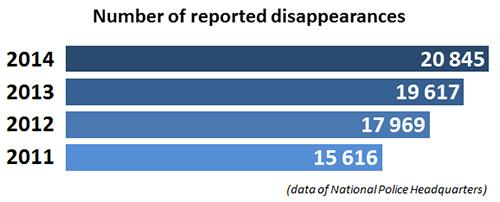
The police statistics show that about 17-20 thousand people in Poland go missing every year, of which about 2 thousand are never found. It is particularly alarming that the number of disappearances increases by another 2 thousand every year.
Poland has a missing persons system in place. Since 2013, in the National Police Headquarters there has been the Missing Persons Centre, responsible for coordination, analysis and direct search of missing persons nationwide. The Police has developed special procedures, e.g. by defining three separate disappearance categories. Separate, properly profiled groups of activities have been assigned to each category. Also the data catalogue has been precisely defined. Now it should include the data to be established by the police officer who accepts the missing person report. Additionally, when the Act on the Police was amended in 2014, some provisions were added to make the police officers’ work easier. For instance, now they can create and process databases including DNA codes of missing persons. The absence of such database in the past made it difficult to establish, for example, that the body of a missing person was found. Until then only the database of unidentified bodies had been in place. Each time after establishing the DNA code of a missing person, police officers had to file requests to search the database of unidentified bodies. When the data did not match they had to repeat the procedure from time to time. Now, when the data on a missing person’s DNA code can be processed, the procedure has become automatic. The NIK audit showed, however, that despite implementing system solutions and clear procedures, some irregularities in the search for missing persons occurred.