


In the audited period tax proceedings were conducted in a timely manner, guaranteeing taxpayers active participation in them. While taking decisions concerning refusal or granting of reliefs with regard to the settlement of tax liabilities officials operated legally and with respect for entrepreneurs’ interests. Organisational changes were implemented and training programmes for employees were organised in tax offices with the intention of providing a better quality of the taxpayers’ service.
The Ministry of Finance (MF) and tax bodies covered by the NIK audit conducted information and education activities to make tax settlements easier for citizens and also to increase their confidence in the state tax system. In 2013, the MF Tax Administration Department took efforts to change the organisation and functioning of the Polish Tax Information (from Polish: KIP) to guarantee optimum support to taxpayers. In January 2015, the Ministry of Finance is planning to implement changes in KIP organisation, including easier access to tax law knowledge resources (so-called Knowledge Base). Changes in the organisational structure of tax chambers and tax offices are also planned. The efforts on part of the Finance Minister helped make the electronic way of filing documents more popular. In less than 3 years the number of documents submitted electronically went up twice: from 6.6 million in 2011 to 14.7 in the middle of September 2013.
At the same time the NIK audit revealed the following areas for improvement:
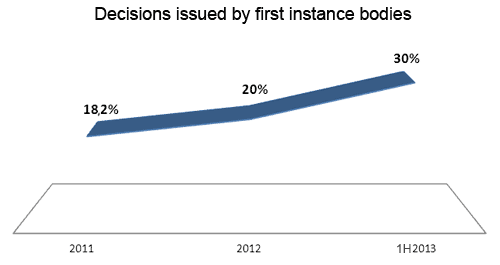
- low quality of tax bodies’ decisions confirmed by a growing number of taxpayers’ appeals against those decisions. In 2011, taxpayers appealed with tax chambers’ directors against 18.2 percent of decisions issued by the first instance bodies, in 2012 against 22 percent. In the first half of 2013, as much as 30 percent of decisions were contested;
- high percentage of annulled decisions taken by the first instance bodies. Although this number has fallen slightly since 2011, it is still significant. The percentage of annulled decisions taken by tax offices was 34.4 percent (in 2012 it was 35.5 percent). The percentage of decisions taken by tax chamber directors and annulled by provincial administrative courts was 17.9 percent in 2011, in 2012 it went down to 14.7 percent but in the first half of 2013 it spiked to 19.7 percent;
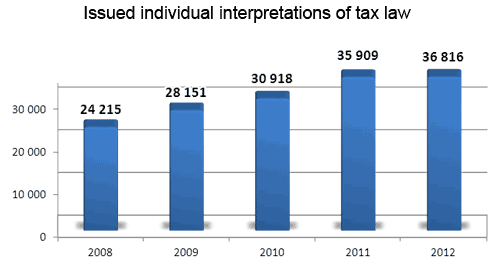
- growing demand for tax law interpretations which confirms ambiguity and complexity of law. The diagram below presents an increase in tax law interpretations in the period 2008-2012;
- growing number of annulled tax law interpretations confirming their low quality. In the audited period the number of tax law interpretations contested in administrative courts went up by 21 percent (from 2 109 in 2011 to 2 552 in 2012). Every fourteenth issued decision was contested. In 2012 and in the first half of 2013, administrative courts - having reviewed 3 887 taxpayers’ complaints - annulled 56.2 percent of interpretations issued by tax chambers;
- lengthy appeal proceedings. In three of six tax chambers part of appeal proceedings were conducted sluggishly. In line with binding provisions they should not last longer than 2 months. In practice, in extreme cases taxpayers had to wait 4 or even 5 years for the proceedings’ outcome;
- the Minister of Finance responded to tax chambers’ queries in an untimely manner. In nearly 55 percent the Minister gave responses after 3 months and in extreme cases even after several years which shows that the MF officials had doubts how a given issue should be solved;
- tax office employees abused their rights in carrying out control activities. In a half of audited tax offices their employees urged taxpayers to submit statements on their sales turnover in the period 2010-2012. In two tax offices covered by the audit citizens were warned that ignoring that call would result in penal sanctions set out in the penal tax code. Demanding such information from taxpayers goes beyond the officials’ rights defined in the law.
According to NIK the growing demand for tax law interpretations is an outcome of changeable and imprecise law. Ambiguity of the law and non-compliance of domestic tax provisions with the EU regulations and the Constitution of the Republic of Poland are also the reasons why the quality of tax decisions and interpretations is so low. Other reasons include staff shortage and work overload.
NIK underlines that a big number of annulled decisions and disputes with taxpayers contributes to a decline in public confidence in tax bodies. NIK stands in a position that the tax law should be tightened up and the system of issuing individual tax interpretations needs to be strengthened.
In its post-audit statement NIK recommended that the Minister of Finance should:
1) develop clear, consistent and stable tax law provisions, compliant with the EU directives and jurisdiction;
2) take efforts to:
- enhance consistency and adequacy of individual interpretations,
- verify incorrect tax interpretations on an on-going basis,
- shorten deadlines for taking a stand on tax law interpretation issues addressed by tax bodies;
3) work out and implement measures to evaluate task execution by tax chambers’ directors and tax offices’ heads.