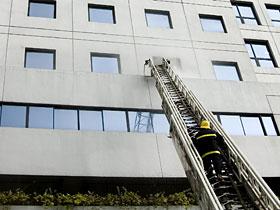


There are nearly 11 thousand skyscrapers in Poland (including 557 office buildings, 204 hotels and more than 10 thousand residential buildings). In 2010, the State Fire Service checked fire safety in more than 2 thousand of them. The audit revealed 6 thousand irregularities, some of them very serious. The obstacles on fire ways in 568 buildings could pose a threat to people’s lives, in 329 facilities the fire ways were impassable and in over 1000 buildings the water supply and fire protection systems did not comply with the norms.
NIK has checked if the Fire Service is prepared and equipped to rescue people in case of fire (or other hazards - chemical, biological or ecological) at heights. 13 units of the State Fire Service (SFS) were covered by NIK’s direct audit, whereas necessary information was obtained from 100 Voluntary Fire Service (VFS) units. The audit comprised the period 2008-2010 (first half).
510 units of the State Fire Service and 3795 units of the Voluntary Fire Service deal with the rescue at heights as part of the fire and rescue system in Poland. Extra support is provided by 24 height rescue groups using alpinist techniques, helicopters and specialist equipment. According to NIK, firefighters properly conduct rescue operations, despite e.g. incomplete specialist equipment. Firefighters complain most about the lack of command and communication vehicles, jumping cushions, light foam generators, rescue tents and height rescue vehicles. The deficit of helicopters is also an issue. The need to rent machines from the Police or Border Guard does not guarantee that actions will be taken urgently. In large city centres there are too few landing sites for rescue helicopters and the effective law does not specify what technical requirements they should meet or where they are to be located. This is a huge difficulty when a rescue needs to be carried out in a high rise building. For some time already the National Headquarters of the Fire Service has taken initiatives which are to draw attention to the absence of its own helicopters or landing sites.
The NIK audit reveals an issue related to the qualifications of firefighters, especially volunteers. 36 percent of firefighters from the SFS and as many as 82 percent from the VFS are waiting for a rescue at heights training. Only professional firefighters underwent a full training programme at the basic level, whereas 27 percent of volunteers did not have it yet. Local governments put it down to budget limitations.
NIK points out that special procedures for rescue actions in skyscrapers are needed. They have to consider specific architectural solutions along with a significant number of people staying inside them. Each Fire Service unit should work them out individually so that they take account of a specific nature of risks and threats in a given area.