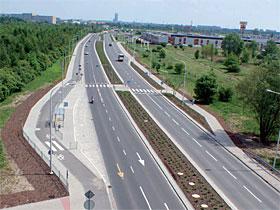


In the audited period the construction of 110 km of roads was finished as well as the modernisation of subsequent 346 kilometres. All in all, it was 25.8 percent more than in 2004-2007. The majority of new and modernised roads appeared in Warsaw - 128.9 km. The expenditures for road investments from 2008 to 2011 (first half) totalled PLN 6.5 billion, i.e. approx. 30 percent more than in 2004-2007. Warsaw and Cracow acquired the most funds for road investments: PLN 354.5 million and PLN 133.2 million respectively.
The investments were well prepared in most cases. The cities guaranteed funds to cover all of 24 audited undertakings. For 14 tasks they obtained EU subsidies (up to approx. 930 million in total) and for 5 engagements -the state budget funds (in the total of PLN 48 million).
Some cities lost a chance to receive additional funds because of inappropriately prepared investments or erroneous EU grant requests. An example is Cracow where 2 of 13 requests were rejected because the city had neither prepared the construction projects nor obtained the construction permits. At the same time, Warsaw, Lublin and Poznań lost the EU funds of approx. PLN 25 million in total. The reason were irregularities in awarding public procurement and delivering work performance or investment grant agreements.
In Gdańsk, Szczecin, Warszawa and Wrocław the investment planning was poor - the principles of developing long-term investment plans were non-transparent there. The expenditure plans were changed many a time there, often without being fully implemented. In some cases the cities withdrew from the planned investments. Most often the reason was the lack of funds or undertaking some new investment tasks. That was the case in Wrocław which had to plan 19 new initiatives because of Euro 2012.
In almost all of the audited investments the project documentation was prepared with delay, in some case of even up to several years. The investors frequently agreed to postpone the documentation delivery deadlines, in numerous cases without analysing the request or charging due contractual penalties. For instance, in Warsaw, during the construction of the traffic junction Łopuszańska-Kleszczowa, the documentation delivery deadline was put off 15 times. Simultaneously, the investor being the Board Of Urban Road Investments [Zarząd Miejskich Inwestycji Drogowych: ZMiD] proved to be inconsistent and unreliable. First, it set the documentation delivery deadline at 30 November 2008. Then, in January 2009, ZMiD calculated the default penalty to the designer as more than PLN 280 thousand. In subsequent annexes to the agreement it repeatedly postponed the deadline. In the long run, the designer avoided the default penalty.
Apart from delays in drafting the project documentation, there were also some drawbacks in terms of inhabitants’ transport needs. For instance, that was the case in Gdańsk where a roundabout was designed without ensuring its proper capacity, or in Lublin where a design did not include an important crossroads. The shortcomings were eliminated in the course of the investments.
On the one hand, the reason to be pleased is the progress in constructing and modernising the Polish roads. On the other hand, the reason to be worried are the irregularities at all investments stages - planning, preparation, performance and hand-over of works. There were no clear principles or transparent solutions and the existing ones were not always observed. According to NIK, it points to faulty management control and defective monitoring of investment tasks. Without these tools efficient performance of investments will not be possible. Precise planning of expenditures is essential, especially with limited funds for investment financing. NIK indicates that it is a good practice to carry out a socioeconomic analysis and estimate risks at the investment planning stage. It will help avoiding unpleasant surprises at later stages of the tasks performance.