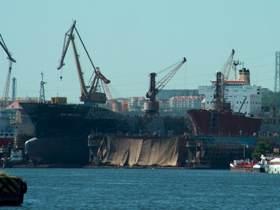


The draft Compensation Act was developed at the request of the Ministry of Treasury by a private law firm. The knowledge and experience of employees of the department supervising the shipyards were used to a limited extent in these works, which NIK considered impracticable. As a consequence of these limitations as well as the pressure of time, some provisions of the Compensation Act did not comply with the EC’s decision, were imprecise or incompatible with other provisions.
The temporary supervisor and then manager of compensation (the same ones for both shipyards) formally were appointed in line with the Compensation Act. However, they were elected based on an arbitrary decision of ARP SA. In both cases they lacked experience in conducting the liquidation or bankruptcy. Relatively high pays were provided for them, without enforcing establishment of a real security for potential claims due to non-performance or improper performance of the contract. Those activities were unreliable, impracticable and uneconomical. From January 2009 to 31 March 2011, remuneration of the compensation manager of the New Szczecin Shipyard and the Gdynia Shipyard totalled PLN 15 million gross. By the end of the compensation process it may be PLN 17.2 million. The money was used to cover the costs of renting the law firm and salaries for BBL plenipotentiaries in the shipyards. The compensation manager administered the property of both shipyards rationally and in line with the Compensation Act. It was an economical decision to continue the construction of three ships in the Gdynia Shipyard and another three in the New Szczecin Shipyard. Actions were taken in both shipyards to maximise proceeds from assets management before selling them. The assets of both shipyards were protected by external companies and any attempts to steal them were reported to the law enforcement bodies.
Financial obligations towards shipyard employees were met in line with the agreement between the government and the employees’ representatives of November 2008. The following actions were performed properly: transfer of employees to the shipyards from their subsidiaries (1 359 persons in total), payment of damages as part of the voluntary exit scheme (PLN 41 thousand per person on average) and payment of benefits to participants of the monitored layoff programme. Total costs of the employee right protection reached PLN 761 million, of which about PLN 638 million was paid to the employees. Considering the scale of funds used for that purpose, the support for employees in their work search did not prove effective enough, according to NIK. Only less than 3 thousand of more than 9 thousand dismissed shipyard employees have found a new job.
The shipyards’ asset valuation was made in line with the Compensation Act. In most cases, though, the compensation manager established the assets’ asking price based on their value estimation under the so-called forced sale conditions, assuming that it made up 50 percent of the market price. According to NIK, selling the assets for a higher price would be more economical. The shipyards’ assets, though, were sold in reliable tender procedures.
The transaction with Qatar investors represented by Stichting Particulier Fonds GREENRIGHTS (SPFG) was not finalised although they won most assets of both shipyards in the first tender procedure. The guarantee of PLN 36.1 million paid on behalf of SPFG was retained (PLN 26.5 million in the Gdańsk Shipyard and PLN 9.6 million in the New Szczecin Shipyard). The compensation manager repeatedly informed SPFG that it would pursue damages for aborting the transaction. Those actions were inconsistent, though, since until the audit completion date SPFG did not receive a precise calculation of amounts subject to claims.
The Minister of Treasury took intense efforts to persuade SPFG to finalise the transaction. Some of them were not transparent, though. The investors withdrew from buying the assets that they won in the tender, saying they had some legal defects. SPFG also charged the Minister of Treasury with unjustified withdrawal from the assurance that SPFG could abort the transaction without any negative consequences. The Minister denied to have given any guarantees of that kind. Nevertheless, the then-Vice-President of ARP SA confirmed that the letter with the guarantee was in place. NIK did not establish the real picture in that matter due to contradictory explanations and impaired access to some documents quoted by SPFG.
SPFG committed itself with the Ministry of Treasury to incurring the maintenance costs of the shipyards’ assets it won in the tender starting 22 July 2009 until the transaction completion date, on the condition of providing the estimation of their total maintenance costs. It was improper to deliver the relevant letter of the Ministry of Treasury to the compensation manager only on 29 July 2009, that is past the deadline set by the investor. In that way the chance for PLN 6.7 million was lost (the costs of maintenance of the shipyards’ assets from 22 July to 17 August 2009).
Deliveries of liquefied natural gas (LNG) from Qatar through the terminal which is being built in Świnoujście, assumed from the middle of 2014, will be a real diversification of the earth gas sources. NIK positively evaluates PGNiG’s actions, as a result of which the contract of 29 June 2009 was signed. Its terms, including the price parameters, do not differ from the ones commonly used in the LNG trade. NIK did not identify any credible arguments confirming the relation between the gas delivery contract and the compensation procedure.