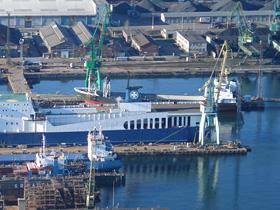


In the Polish seaports an increasing number of containers is trans-shipped (in 2010, their number grew by 56 percent against 2009), the cargo traffic is growing, whereas companies managing four ports of fundamental significance for the national economy (Szczecin, Świnoujście, Gdańsk and Gdynia) achieve positive financial results.
The companies administering the seaports of key importance for the national economy led to modernisation of the port infrastructure, especially in terms of its adjustment to the needs of the container cargo handling. It meant construction and modernisation of the container terminals, since in past years those ports were focused mainly on handling mass cargos. However, the NIK auditors point to considerable wear and tear of the port infrastructure, which is often too old. Its reconstruction will require large outlays. Even with significant contribution of grants from the European Union it may be difficult to obtain funds for that purpose.
Increased competitiveness of the Polish seaports was also driven by the government’s actions which were positively evaluated by NIK. They included e.g. reaching agreement with Russia on restoring sailing on the Vistula Lagoon, successful negotiations with Germany (due to the construction of Nord Stream pipeline) on the way of minimising sailing problems before Świnoujście port (by sinking the gas pipeline) and bringing back the zero VAT rate for cargo handling services provided in seaports.
Improvement of access to seaports both from the hinterland (roads and rail lines) and from the sea (the depth and width of approach fairways) was of key significance for the increased competitiveness of the Polish ports. On the other hand, NIK stated that the investments in infrastructure having impact on access to ports were made with delays.
The ports’ management boards were too slow in removing shallowings on approach fairways, which resulted from the lack of funds from the state budget and binding construction procedures, which enormously slowed down the works. As a consequence, the works that were considered necessary in spring could be performed only in autumn or even a year later.
Basic problems in seaports handling by the rail transport include e.g. worsening technical condition of the rails and the need for trains to go through urban areas. The ports incurred losses due to hindered rail transport. The latter is difficult to estimate, though, as there is no data on which freights did not reach the port due to prolonged handling time arising from low quality of that transport. Besides, as a result of higher fees for using the rail infrastructure, this part of ”the transport puzzle” got even worse.
Activities of the General Directorate for National Roads and Motorways were positively evaluated. The percentage of surfaces in a good technical condition on the roads being connections with seaports went up by nearly 11 percent, whereas the percentage of surfaces in a poor technical condition dropped by 20 percent. However, NIK points to prolonged time of execution of road investments, such as construction of A1, S3 and S7 motorways.
A barrier for the seaports’ competitiveness was bureaucracy at the cargo clearance, higher than in other European cities. The Supreme Audit Office draws special attention to bureaucracy identified in the investment process, which limits the ports’ development. It includes among others complicated and long-lasting procedures for obtaining project documentation, acquiring relevant administrative decisions, selecting contractors. Also the activity of the government administration in terms of facilitations for maritime entrepreneurship proved ineffective.