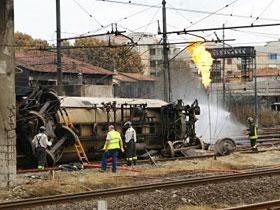


There are more than 800 accidents on the railway every year. Responsibility for removing their consequences rests with railway line managers. The biggest one is the Polish Railway Lines company [PKP Polskie Linie Kolejowe S.A.: PLK] which controls 96 percent of rail network in Poland. Therefore, technical rescue teams operating as part of that company are of key significance for the railway technical rescue service. According to NIK, these teams are poorly organised and improperly deployed around Poland. Only every third rescue team (of 24 units operating in our country) had complete staff. Not a single employee was hired in the teams in Rybnik, Białogard and Ostrów Wielkopolski. Only one in three employees completed compulsory training programmes. Nevertheless, in as many as seven units no rescue worker accomplished mandatory courses in transportation of dangerous goods or first aid in emergencies. Trial alarms were not carried out in 8 of 13 Railway Lines Plants [Zakłady Linii Kolejowych (ZLK)]. The heads of those entities did not know how the teams were prepared to attend to emergency calls. Nearly 60 percent of departures to accident sites were delayed.
Basic equipment of railway rescue teams comes from the 60’s of the past century. Although it is obsolete and worn out, PLK has not bought new equipment for six years now. 11 of 102 carriages used for technical and utility purposes by all rescue units were broken. Every fifth track and road vehicle departing for rescue actions did not have valid technical certificates. The NIK audit showed that four rescue teams: in Białogard, Czerwieńsk, Ostrów Wielkopolski and Rybnik - did not have functional equipment at all and could not attend to emergencies. In most Railway Lines Plants, rescue workers had no protective wear, not to mention radiophones or fuel in power generators.
According to NIK, supervision exercised by the Office of Rail Transportation (UTK) over railway line managers was insufficient. For instance, UTK did not control if the rescue personnel was trained or prepared for emergencies. They also did not take care of whether railway line managers provided information on accidents to the State Commission for Investigation of Railway Accidents. Only from 2010 to 2012 (first half), PLK did not inform the Commission of 124 incidents on rail tracks, whereas 835 incidents were reported with delay.
In March 2011, PLK stopped to maintain fire lanes near the railway lines managed by the company. According to NIK, that was the outcome of an erroneous interpretation of regulations on rail transportation. However, the minister responsible for transport accepted the decision of the company management. He also told the manager of rail infrastructure to appeal against decisions of chief commanders of the State Fire Service with administrative courts which ordered PLK to maintain fire lanes (the courts dismiss these appeals). Following that turmoil, the number of forest fires set near rail tracks increased significantly (e.g. in the area of ZLK in Sosnowiec it went up from 57 in 2010 to 111 a year later).
NIK takes note of the fact that the railway technical rescue service lacks statutory regulations governing its organisation, training programmes, equipment or operational readiness (and it should since this is a specialist rescue service, like mountain-, water- or mining rescue services). The activity of the railway rescue service is stipulated only by internal provisions of railway line managers. And efficiency of that formation depends only on their good will and financial opportunities. NIK stands in a position that the minister responsible for transport should take a proper legislative action in this matter.
The Supreme Audit Office claims that due to inefficiency of the railway technical rescue service, in case of an accident, modern sections of rail tracks will remain impassable for a longer period of time. The carriers will demand high compensation payments for their losses which may make the financial condition of line managers even worse.