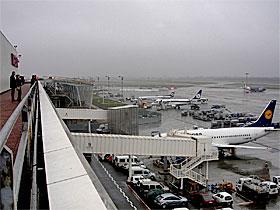


NIK verified how the Polish airports are protected. Poland had some problems in adapting the domestic law to the EU regulations issued in April 2010. The consequential dualism of legal norms made it difficult to produce transparent safety and security procedures. The number of executive acts being critical to develop the national programme for the civil aviation protection is still too small.
The airport administrators as well as the carriers and other entities conducting their activity on the airports area did not update their protection schemes. Out of 72 schemes that should have been updated, 24 remained unchanged and 27 were updated with delays of even up to 15 months.
The entities that obtained the status of registered postal agents at the airports were not prepared to control cargo and mail. As a consequence, the controls of cargo and mail, against the EU legislation, were made by the Airport Security Service and Border Guard. The entities that should have done it did not incur the costs of control carried out by the Airport Security Service and Border Guard.
As a result of untimely preparation and conduct of training programmes, there were 259 employees working at the Polish airports in different periods without required courses in civil aviation protection. They were e.g. security check operators and their supervisors. Some of the security check employees performed their duties without certificates required by the law. It was the case e.g. in Szczecin, where 25 of 48 security check employees did not have the relevant certificates. The number of hand luggage control operators was smaller than required by the law.
During the inspection of the security restricted areas at the airports in Poznań and Szczecin the NIK auditors confirmed the presence of unauthorised persons. The security restricted area in Poznań was accessed by two cars without the security check via a temporary gate leading to the construction site located in that area. The cars’ drivers were not subject to the security check, either. The vehicles and their drivers did not have required passes authorising them to stay in the restricted area. The NIK auditors confirmed the presence of one unauthorised person in the luggage sorting room during the inspection of the security restricted area. That person was employed in the aircraft cleaning company. She entered the security restricted area without a pass in order to get the airplane cleaning equipment from the luggage sorting room.
A negligence posing a threat to safety and security was identified by the auditors at the Wrocław airport. The airport security guards did not document the receipts of airplanes for protection and their returns to the carrier. Other airport protection officers kept the aircraft receipt log. However, they did not record there the seal numbers put on the aircraft transported to the apron area and their compliance with the original status. It was inconsistent with effective procedures and could enable unauthorised persons to board the planes.
At the airports in Szczecin, Bydgoszcz, Poznań and Wrocław irregularities were identified in terms of proper maintenance of the fence and adjacent areas.
There were also some problems with identifying and removing aviation obstacles. For instance, the removal of trees that posed a threat to the safety of flights in the vicinity of the Szczecin airport took more than 9 months. Just after the Smoleńsk air crash, the Szczecin airport administrator approached the Forestry Management Goleniów with a request to remove another bunch of trees. In the justification the administrator referred to the disaster in Smoleńsk and requested that proper actions be taken: ”…not wanting to wait for a moment when our airport becomes the negative hero of a similar incident”. To illustrate the actual status, the administrator enclosed with his request the satellite photos of the same areas of both airports, pointing to their ”striking similarity”. The Forestry Management Goleniów, quoting among others the Forests Act, informed the administrator that the removal of trees is impossible under the provisions of law. According to NIK, the procedure for removing air obstacles needs to be simplified significantly. The safety of passengers and aircrafts should be treated as an obviously higher-order good.