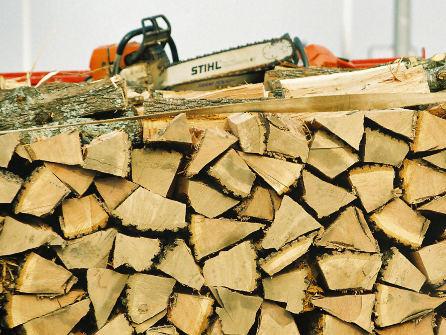


Authorities of the audited towns and cities do not use the economic potential of trees removed on the occasion of various investments. Only four of 22 of them had an organised wood selling system. In the audited period (2.5 years) these local governments earned more than PLN 171 thousand. However, most towns and cities (12 in 22 audited ones) do not even try to estimate the wood value. Others do it sporadically. Local government officials are positive that the value of wood is very low as compared with the costs of its valuation. Nevertheless, according to the calculation made by NIK inspectors, the value of estimated wood in the audited cities exceeded PLN 310 thousand, whereas the value of non-estimated wood was at least PLN 115 thousand. NIK has stated that the failure to use that potential translates into real losses for the local governments’ budgets.
In most of them (18 in 22 audited ones) wood is treated as worthless waste. It is used as fuel (4 towns or cities) or left to be discarded by specialised companies (14 towns or cities). In eight of them the authorities made a reservation that the companies should deduct the wood value from the service cost but they did not check if they at least included them in cost estimates. The NIK audit also revealed a mess in accounting books. The city officials do not properly run records of wood - they fail to include its value or issue invoices.
Following the audit, NIK submitted six reports of wastage and suspicion of a crime. One of them is related to unexplained disappearance of wood, others with the lack of its valuation.
The irregularities identified by NIK were also related to the requests for tree removal permits. It was a widespread practice in cities with poviat rights that their presidents sent such requests to themselves. In seven of eleven audited ones they acted as poviat heads at the same time. Such behaviour is inconsistent with the Environment Protection Act as it stands for reviewing one’s own cases. Therefore, NIK claims it is essential to exclude presidents from that procedure. This recommendation is supported by numerous cases where the presidents showed excessive favour for their own requests - the permits were issued without an inspection beforehand, based on incomplete requests or even despite their absence. There were also unjustified cases of exemption from logging fees or absence of administrative penalty for removing a tree without permit.
The audit also revealed that the city officials could not correctly fill in the logging requests. From 247 requests audited by NIK, 38 percent had formal gaps. They needed to be completed and therefore the whole procedure was prolonged. In four towns or cities the officials did not know the law as they launched procedures for granting permits to remove the trees that did not need it (as they were covered by road investment permits). In two other towns or cities the trees were removed without required permit, which exposed them to administrative penalties. In some cases they were really high, e.g. in Zabrze it was about half a million zloty.
NIK points out that some towns or cities delivered incorrect data to the Central Statistical Office. In part it results from negligence and incompetence, but also from different interpretations of certain provisions of the Environment Protection Act. That is the reason why there are no credible data on the condition of urban greenery in Poland.