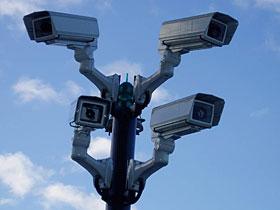


The Supreme Audit Office has checked the way the video surveillance system works. An important aspect of the audit was to say if the cities can keep balance between the care for public security and the citizens’ constitutional right to protect their freedom and privacy.
In the period 2010 – 2013, NIK inspectors observed more than 152 thousand incidents, mostly road offences in the cities covered by the audit. Serious offences (robberies, burglaries, thefts and property damages) recorded thanks to the CCTV made up only 5 percent of all observed incidents.
In 1/3 of audited cities, the video surveillance system revealed mainly instances of incorrect car parking (51 to 99 percent of all observed incidents). The CCTV data were transferred mainly to municipality or city guards. Only 25 percent of that information (mostly concerning road offences) went to the Police.
Warsaw stands out from other cities covered by the audit. Cooperation between the unit servicing the video surveillance system and the Warsaw Police Headquarters was very well organised. The Police received information on nearly half of observed incidents. They mainly had to do burglaries, batteries, robberies and thefts. It shows that cameras were installed in proper places, the number of employees was adequate to the number of cameras and the video surveillance was conducted conscientiously, 24 hours a day.
It was similar in Radom. The CCTV equipment was designed and serviced properly there which made it possible to detect various misdemeanours, of which incorrect parking made up only 6 percent of all identified incidents.
The surveillance cameras were installed in the places indicated by the Police. However, most cities could not assess effectiveness of the installed video surveillance system. In those cities no criteria or ratios were defined to say if the safety level improved in the monitored places.
In the cities having a developed system checking the CCTV effectiveness, the Police could precisely evaluate individual locations. For instance in Warsaw, considering the sample of 15 cameras, violence decreased in as many as 15 places. In Poznań the Police identified an increase of detectability of crimes in selected camera locations.
NIK identified the following irregularities:
- in 20 percent of audited cities the personal data of monitored persons were not properly protected. They were stored on computers disks not secured with any password or in rooms available to third parties. In some cities unauthorised persons could process data. NIK has noted that such practices could lead to the infringement of personal interests of persons whose image and behaviours were recorded by the CCTV,
- half of the cities that conducted video surveillance processed personal data illegally. Some data were not passed on to the Inspector General for the Protection of Personal Data. Nine cities complied with that obligation (of which five after the audit of NIK),
- in more than half of audited cities the camera images were not monitored 24 hours a day. In practice it meant that in case of a dangerous incident – although recorded on the disk – the Police or City Guard failed to react properly and without delay,
- in some cities the results of threat analysis and the Police recommendations were ignored, leaving cameras without service at the time of the highest probability of danger (for instance in the night, also at the time specified by the Police as the most dangerous: on Friday and Saturday nights),
- in half of audited cities surveillance operators were forced to monitor images from too many cameras at the same time. The worst situation was in Zamość where one operator was responsible for 40 to 80 surveillance cameras (depending on the number of employees on one shift) and in Poznań (8 to 69 cameras per one employee). It is worth noting that according to experts human perception allows observation of images from 16 cameras maximum. This condition was met by the cities where there were fewer than 16 cameras. As for larger cities, only Warsaw and Radom were compliant.
- in most cities operators were not presented with any requirements to do this kind of work. Only in five cities at the stage of recruitment potential employees had to have good sight, concentration skills and attention divisibility,
- half of the cities did not agree upon any cooperation principles with the Police to regulate the use of data from the CCTV system to improve the security level.
NIK has noted there are no provisions of law clearly defining the body to oversee the video surveillance system. Governors are obliged to supervise activities of city guards related to monitoring and recording of incidents by technical means. Three of six governors, though, did not conduct any audits in that respect and two of them audited only one city guard each. Only the Governor of Wielkopolska exercised real supervision. Most governors claimed the law did not impose such an obligation on them.
The surveillance systems may also be run by entities other than city guards (as security companies for example). NIK has pointed out that CCTV activities carried out by them are not governed by any provisions of law and are not subject to the governor’s supervision in that regard.
That is why, NIK stands in a position that solutions should be introduced to make sure an independent state body exercises real supervision over the surveillance system in public places.
NIK has emphasised that a well-designed and properly functioning video surveillance system, may increase the citizens’ sense of security, fulfil preventive function and facilitate the search of perpetrators of crimes, accidents or vandalism acts. The monitoring and recording of images, though, may not infringe fundamental citizen’s rights, including the right to respect for and protection of private and family life. Any interference of public authorities is acceptable only in cases which are essential (for instance owing to the state or public security) and strictly defined by the law.
NIK has addressed the Council of Ministers to take legislative initiative to define the terms and conditions of monitoring and recording incidents in public places and precisely define the following:
- circumstances justifying the use of video surveillance,
- principles concerning installation of cameras considering the right to respect for and protection of private and family life,
- entities authorised to conduct video surveillance and conditions they have to meet before using CCTV,
- entities obliged to exercise supervision over the entities conducting and using the video surveillance system,
- obligations of entities conducting video surveillance in terms of ensuring protection of personal data and other rights related to the respect for and protection of private and family life,
- principles of verifying effectiveness of the CCTV system,
- operation standards of the video surveillance system, including norms related to the number of images that may be monitored by one employee,
- principles of using the video surveillance system by bodies responsible for ensuring public order and citizens’ security (Police, City Guard) as well as principles of cooperation between surveillance operators and these bodies.