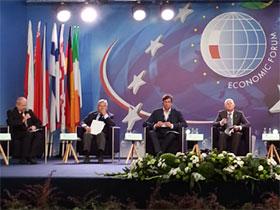


The forum in Krynica is one of the most important business and economic events in this part of Europe. Sometimes it is referred to as the Polish Davos. This year it is called ”Post-crisis world - time for new leaders”. The programme comprises nearly 180 meetings attended by over 2.5 thousand people - politicians, business people, economists and intellectualists. The forum is a place for key debates on issues critical for Poland and our neighbours. This year’s anniversaries, e.g. of the first free elections in Poland and 10th anniversary of our country’s presence in the EU were a point of departure for discussions on the most significant social phenomena and economic trends after the transformation. One of guests invited to the Krynica Forum was President of the Polish Supreme Audit Office Krzysztof Kwiatkowski.
Waste management reform a year after
NIK President participated among others in the debate on the waste management reform. The first effective year of the new system brought a lot of new experience, not always positive. Already in 2013, NIK checked how local governments are prepared to implement new provisions. But inspectors also mentioned positive aspects of the reform - mainly that the number of people sorting waste is growing. NIK also pointed to necessary changes in the law to improve the new system functioning. The point was among others to further specify the term property owner, that is to indicate the person responsible for submitting the declaration and pay the waste management fee (real property administrator, housing cooperative or flat owner). NIK’s proposals are now the subject of works of the Sejm Committee and the Ministry of Environment.
During the debate President Kwiatkowski announced that another complex audit of waste management would start in September. Pre-audit analyses reveal that the biggest problem is the absence of effective monitoring of what is happening to waste after it is collected by entrepreneurs. The lack of reliable information along with unstable provisions and the absence of waste sorting standards makes it difficult to answer basic questions: Has the waste recycling ratio increased in Poland? Does waste go to Regional Plants for Municipal Waste Management? Or maybe it gets lost somewhere on the way and is not processed at all? NIK audit along with the survey should help answer the question how the municipal waste management system works after a year.
In search of social approval
Public purpose investments give rise to objections of local communities not only in Poland. Although infrastructural initiatives are critical for the state, they happen to be a real burden for some inhabitants. President Krzysztof Kwiatkowski together with other participants of the panel on infrastructural investments considered how to have effective dialogue in the course of investments and how to make public administration involved in that. Besides, a question appeared if the law may replace social approval in special cases.
NIK Head presented characteristic examples of irregularities that lead to misunderstandings and conflicts between public investors and local communities. They include the lack of referenda while conducting key investments; lack of reliable information on investments; lack of analyses on social effects of administrative decisions.
These errors are reflected in many audit findings. In 2011 the Ministry of Environment limited the acquisition of wood from Białowieża Forest to 48,5 thousand m3 without prior analysis of social and environmental consequences of that decision. NIK’s criticism concerned particularly the lack of evaluation of the impact of reduced acquisition of wood on the local labour market and on the condition of trees. In the audit of the Polish Nuclear Power Programme NIK established that the information campaign on nuclear power started with delay and without any coordination. As a consequence, such initiatives as ”Get to know the atom” or ”Consciously about atom” had very limited impact. Finally, in the recent audit of wind farms NIK found out that the local governments decided about the location of wind farms ignoring social objections. They did not organise any referenda, and the very process of locating power stations proceeded in the circumstances of threatening conflict of interests, non-transparency and corruption threat. Consequentially, in many places the level of social acceptance for this kind of investments went down to zero.
Lights and shadows of local governments in Poland
In Krynica Krzysztof Kwiatkowski gave a lecture on the functioning of local government units and analyses conducted at NIK in that matter. Audits carried out from 2011 to 2013 helped identify typical irregularities and also list good practices. Both were gathered in a special report and presented in April to local government representatives during a special conference at NIK. ”We want to make sure our audit findings are used in practice” - emphasised NIK Head. And he added that he wanted to focus particularly on popularising good solutions identified by inspectors in their audit practice. There are plenty of them in the report - the ones related to malnutrition in children, protection of the labour market and the ones that let local governments buy energy at lower prices (it is possible if several municipalities join the so-called purchase group which strengthens their position in price negotiations and reduces activities related to public procurements).
NIK President also communicated that NIK’s work plan for 2014 included the work of regional accounting chambers in terms of prevention of threats related to excessive debts of local government units. The audit results should be useful both for local governments and the regional accounting chambers.
This year’s forum was dominated by subjects related to power industry, environment protection and healthcare. Widely discussed topics included the role of nuclear power in the future, search for new sources of economic growth, regional cooperation and development of relations with new economic powers. Other issues were among others tensions in international relations and possible scenarios concerning development of the situation in Ukraine. The forum participants also talked about how the conflict influenced economic situation in the region.