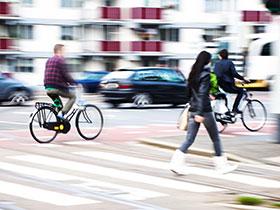


Polish roads pose a huge threat to pedestrians and cyclists. These traffic participants, who move about the roads without any protection (by the car body, safety belts or air bags), represent about 50 percent of the injured and 40 percent of fatalities in all road accidents. Poland is the highest-risk country in Europe in that respect. Pedestrians in Poland are at risk of losing their life in a road accident nearly three times as much as in Germany, Spain, France or Great Britain. In those countries the death toll among pedestrians per year is about 400, whereas in Poland it is more than 1100 (about ⅓ of all fatalities - in 2013, the total of 3357 died on Polish roads, of which 1140 were pedestrians).
The majority of pedestrians in Poland die on pedestrian crossings (232 fatalities) and at intersections (182 fatalities). Over 9000 pedestrians get injured every year. Accidents with pedestrians make up over 26 percent of all accidents. In 2013, there were 9489 accidents of this type. The most frequent cause was that drivers did not observe the ”pedestrian first” rule. This is how 142 people died. Incorrect driving over pedestrian crossings ended in killing 80 people. Speeding drivers caused the death of 96 persons.
304 cyclists died on Polish roads and 4144 were injured in 2013. Most accidents took place in built-up areas (more than 4000 of 4723 accidents in total). The main reason was that the driver did not comply with the cyclist priority rule.
The accident cause analyses (with pedestrians and cyclists as victims) shed light on essential actions that should be taken to significantly improve safety of these traffic participants. They include:
- improvement of road infrastructure - construction and modernisation of roads considering the interests of pedestrians and cyclists;
- making urban and non-urban space safer for pedestrians and cyclists (building pavements, especially in villages and towns intersected with roads of different classes, building catwalks, underground passages, squares and pedestrian streets closed for traffic, traffic lights near passages in high-traffic places);
- introducing solutions to protect cyclists, e.g. separated cycling lanes, legal and infrastructural setup of conflict-free space in the triangle: cyclist - pedestrian - driver;
- increasing social awareness in that respect, especially with children and youth;
- better enforcement of traffic rules with pedestrians and cyclists.
During the audit NIK will check if efforts taken by state authorities help improve safety of pedestrians and cyclists.
The following issues will be of NIK’s particular interest:
- Have the educational and preventive measures improved the safety of pedestrians and cyclists?
- Does the road infrastructure guarantee required safety of pedestrians and cyclists?
- Have the traffic control initiatives taken by the Police, Inspectorate of Road Transport and municipal (city) guards helped improve the safety of pedestrians and cyclists on Polish roads?
- Do effective regulations provide sufficient protection to pedestrians and cyclists?
- Do the urban and non-urban development schemes take account of the interests of pedestrians and cyclists? What measures have been taken to make this space safer for pedestrians and cyclists?
The Supreme Audit Office will conduct its audit in the following institutions:
- Ministry of Infrastructure and Development,
- branches of General Directorate for National Roads and Motorways,
- Marshall Offices,
- Boards of Provincial Roads,
- local governments at the county level,
- city councils (boards of city roads), municipality offices,
- Ministry of the Interior,
- National/ County Police Headquarters,
- Chief Inspectorate of Road Transport,
- municipal/ city guards,
- Ministry of National Education,
- selected primary and secondary schools (upper- and lower).