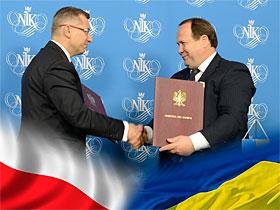


This year some seminars are planned to be held in NIK’s training centre near Warsaw. The areas to be tackled include the audit of public debt, financial audit as well as prevention and fighting of corruption.
Poland will also share with Ukraine its experience in the EU funds’ auditing. The agreement between NIK and the Accounting Chamber of Ukraine covers as well: exchanging experience in the methodology of audit, carrying out joint analyses, organising conferences, seminars and working meetings, conducting cooperative audits, exchanging data on domestic regulations, information materials and implementing methodology related to the audit of public finance and the use of international standards of public sector auditing.
Agreement between Polish and Ukrainian auditors. Extract from press conference.

A NIK delegation stayed in Kyiv before. It was chaired by Vice-President Wojciech Kutyła. It was agreed then that Poland would host a meeting of the EUROSAI Task Force on the Audit of Funds Allocated to Disasters and Catastrophes. The meeting was initially supposed to be held at the beginning of April in Lviv.
The Task Force which is just having a meeting in Warsaw was established at the Congress of the European Organisation of Supreme Audit Institutions (EUROSAI) in 2008. At the same time the Accounting Chamber of Ukraine was appointed the Task Force Chair. The group meets once a year and now comprises 13 members. These are the Supreme Audit Institutions from Azerbaijan, Armenia, Belarus, Bulgaria, Kazakhstan, Lithuania, Moldova, Poland, Russia, Ukraine and Hungary. The Task Force also includes auditors from the European Court of Auditors (ECA).
The Task Force has initiated and now coordinates audits on the use of budget funds earmarked for the prevention of natural disasters and catastrophes and elimination of their consequences. Subsequent meetings of the group took place among others in Wrocław (2012) where the common position on the international audit of funds for disasters and catastrophes was signed. It set out mainly the principles of joint audit methodology. Last year the group met in Sofia where NIK presented the results of the national audit concerning the use of public funds for the flood protection facilities and liquidation of flood consequences. That audit has become part of the international audit on the protection against natural disasters.
At the EUROSAI Congress in June 2014, a report on the Task Force activity will be presented as well as a proposal to transform the existing Task Force into a regular working group of that organisation. Additionally, it has been planned that during the Congress the final report will be signed from the audit of state activities related to the prevention of natural disasters and catastrophes and elimination of their consequences.
For a dozen or so years NIK has developed reports on issues related to flood risk almost every year.
What are the tangible results of NIK audits, works of subsequent governments, local governments and Parliament members?
- areas between flood banks and riverbeds have been ordered to a large extent
- management methods have improved considerably during the crisis; we positively evaluate actions taken by the Police and Fire Service
- effective aid is provided to flood victims
- monitoring scheme and hydrological and meteorological protection system have been developed
- investments started in river basins, mainly in the Odra River, among others using funds from the EU and the World Bank (the key investment in Racibórz is still proceeding too slowly, though).
What needs to be done considering to-date NIK audits?
- clearly define tasks of individual institutions in terms of flood prevention;
- continue investments to modernise flood banks and purify rivers, brooks, streams and roadside ditches by making check-ups imposed by the law and repairs indicated as necessary by those check-ups;
- invest in the systems of hydrotechnical facilities and structures in the basins of the Odra and Vistula Rivers - water reservoirs and polders. NIK has noted that the construction of the Racibórz Polder, which is key to the project, has finally started. However, the Flood Protection Project in the Odra River is still delayed against the project assumptions.
Only the system including water reservoirs, polders and flood banks can effectively minimise flood consequences.
What else needs to be done?
- not allow development of floodplains - precisely define the law in that matter and try to move floodplains’ residents to safe places to live in.
Last audit - published in April 2014 showed that the local land use plans cover only 12 percent of flood risk areas and only in 1/3 of this 12 percent investment bans and limitations have been introduced.
30 percent of municipalities (without the land use plan) did not define any provisions in the land use studies prohibiting or limiting investments in flood risk areas.
In most audited municipalities in the construction permits investors were not informed of any consequences or threats related to the location of their investments in flood risk areas.