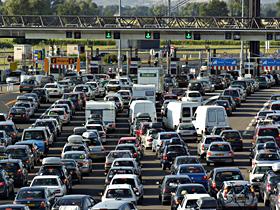


According to numerous drivers traffic jams at toll gateways question the point in using motorways. ”Motorways get jammed because this is a complicated network of road stretches broken by bottlenecks and barriers.” - explains Tomasz Emiljan, Head of NIK Department of Infrastructure. And he gives an example of A2 motorway. Drivers going from Warsaw to the West first pass by incomplete gateways near Pruszków, then they enter a payable motorway stretch operated by the General Directorate of National Roads and Motorways Stryków Konin, then they run on a payable Wielkopolska motorway, a free-of-charge Poznań ring road and then again enter a private stretch Tomyśl-Świecko. In the periods of intensified traffic these conditions cause traffic jams, which was for instance the case during holiday weekends when drivers were going to the sea or to the mountains using A1 and A4. motorways.
Tomasz Emiljan on problems with Polish motorways
motorways
How to solve this issue? There are several possibilities. First, to steer the capacity of toll gateways manually, on an ad hoc basis. The point is to increase the number of toll gateways both at the entrances and exits by the time the traffic jam is relieved. ”Unfortunately, only one stretch of the Polish motorway is adjusted to that solution” - explains Emiljan.
A solution to the problem could be an agreement between motorway operators and the Minister of Infrastructure and Development on joint settlements for driving on payable road stretches. Joint settlements would translate into fewer toll gateways and greater traffic capacity. This solution would be beneficial for drivers who would not have to pay each time when they enter another motorway stretch.
In some countries the so-called vignettes are applied (e.g. Austria and Switzerland). Drivers buy subscription and use motorways without limits. ”With that system toll gateways and traffic jams no longer exist. But there is another issue - drivers avoiding payments.” - explains Emiljan. For a short time vignettes functioned also in Poland but experts say reintroducing them is not a good idea.
Most specialists point to the so-called viaTOLL system which is already used in trucks. Introducing it with motorcars would shorten the drivers’ waiting time at toll gateways. Cars equipped with electronic fee charging devices would only have to slow down in a given place, whereas the system would make fast verification and raise the barrier, enabling the car to leave the motorway easily.
”Digitalisation of toll gateways is a proven solution” emphasises Emiljan. Experiences with the viaTOLL system, confirmed also by recent NIK audits show that this could be an effective way to get rid of traffic jams on motorways, although not the easiest one for drivers.
Road operators would definitely benefit from that solution. Digitalisation of toll gateways would certainly bring about more profits because traffic jams lower the motorways’ capacity and in the long run, also income. On the other hand, drivers would have to settle plenty of formalities which in case of a single drive on a motorway may be considered problematic by some of them. Nevertheless, it seems better than standing in a traffic jam for an hour or two.