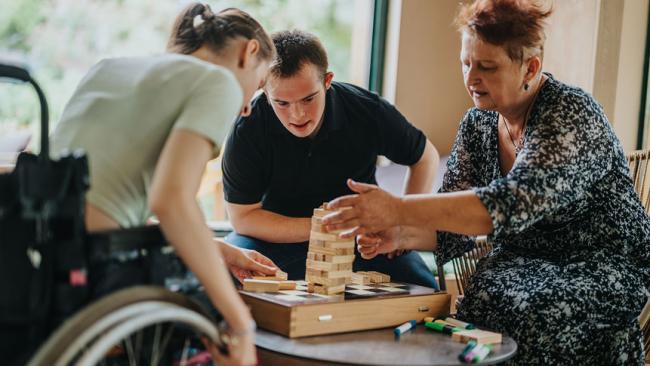


The Programme was implemented from July 2019 to June 2024 and covered two modules:
- Module I – founding of the facility – in all the Programme editions 44 care and residential homes were opened with 807 places, of which 271 were 24/7 care places.
- Module II – operation of the facility – 1 287 persons with disabilities took advantage of places in 44 facilities, of whom 418 used 24/7 care and 869 benefited from day care (data as of the end of June 2024).
The decision to financially support the founding of care and residential homes was a response to postulates of the persons with disabilities’ community that underlined the absence of day care facilities and 24/7 care facilities (apartments) but could not find a place in the existing network of social welfare facilities.
There was no facility of this type in nearly 8.5% of all districts and approx. 20% of all facilities did not meet required standards. In most local governments covered by the audit the demand for support offered by the facilities exceeded the demand specified in the request filed with the governor. That was the case in 83% of municipalities and districts.
In 2020-2023, the total of over PLN 270 million was spent to implement the Programme “Care and residential homes”. The funds not used for tasks laid out in agreements signed with the governors in 2020-2023 totalled PLN 49.5 million.
Key audit findings
The Minister of Family, Labour and Social Policy prepared and implemented the Programme “Care and residential homes” improperly and without due diligence. Before defining the Programme principles the scale of needs was not analysed, also the number of facilities needed to satisfy those needs was not specified. The improperly developed Programme principles were changed many times in subsequent editions. That made the Programme implementation difficult and resulted in unequal treatment of municipalities and districts. The changes resulted in a drop in the Programme popularity: to implement Module I in the 2023 edition local governments placed 90% requests less than in the 2019 edition and 87% requests less than in the 2021 edition.
The facilities’ functioning was impaired by huge delays in signing agreements between the Ministry and the governors. That disturbed financial liquidity of the facilities and forced the local governments to secure their own funds necessary to maintain the facilities. The Minister failed to verify 83% of the requests in due time so he could not meet his obligations related to transferring funds. Besides, the Minister lacked basic data concerning the Programme, i.e. related to the number of facilities, places and charges and even amounts spent on individual tasks.
In first editions of the Programme, PLN 20 was earmarked for one hour of day care per charge and not more than PLN 5 thousand for 24/7 care per month. Due to an increase in prices of goods and services and growing employee costs, the amount appropriated for day care in the 2023 and 2024 editions was up to PLN 22 per hour. The level of financial support in case of 24/7 care was not changed, though. According to NIK this does not encourage local governments to join the Programme. Besides, the municipalities and districts already implementing it are forced to financially support the facilities’ activity with their own funds. As a consequence, the local governments which decided to participate in the Programme earlier, are not treated equally.
The issue of additional financing for the facilities after a specified period of their existence was not addressed in any edition of the Programme. According to the Ministry after the end of 5-year period of the facilities’ activity, most local governments will run them at their own cost. NIK has found, though, that none of the municipality or district heads agreed to continue running the facilities without additional financing. NIK has noted that without financial support most facilities will cease to exist and persons with disabilities will have to look for other places and forms of assistance.
In the majority of cases charges were admitted to care and residential homes based on administrative decisions issued after conducting family background surveys. In some cases, though, charges were admitted before the decision was issued, which was inconsistent with the Programme assumptions. Those procedures were justified as emergencies. That is why, NIK emphasises the need for implementing an emergency admission procedure as an exception from obligatory administrative procedure, by amending the Social Welfare Act.
The local governments applying for funds to establish care and residential homes did not have complete data about the number of persons with disabilities in their area. Nevertheless, they were trying to identify those persons’ needs. They could not provide them with sufficient access to the Programme as the demand for this form of assistance largely exceeded the number of places offered there. In principle, though, the local governments properly performed their Programme-related tasks and achieved effects set out in the funding requests. They established such facilities in their areas and also hired qualified and experienced specialists.
Recommendations
In view of the audit results NIK recommends the following:
- making care and residential homes part of the social welfare system, e.g. by including them in the Social Welfare Act;
- taking steps aimed at amending the Social Welfare Act to enable urgent assistance to the persons in need in social welfare facilities;
- ensuring financial support for the facilities after the deadline specified in the Programme;
- levelling off an additional financing amount for one hour of day care;
- concluding agreements with governors in a time enabling local governments to guarantee the financing continuity of the facilities’ operations;
- strengthening supervision over the Programme;
- providing access to database including number of persons with disabilities to local government units.
As for governors NIK recommends performing tasks in line with the agreements concluded with the Ministry and principles specified in the Programme documents as well as auditing local governments which implement the Programme.
At the same time, authorities of the municipalities and districts should provide assistance to persons with disabilities, tailored to their needs.