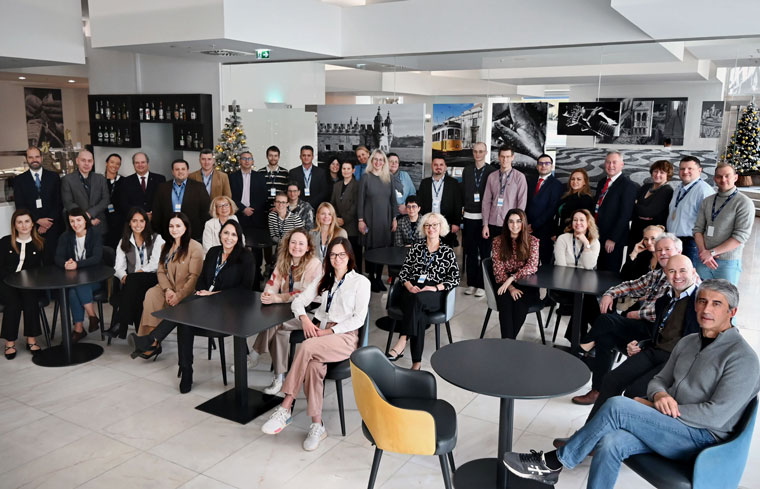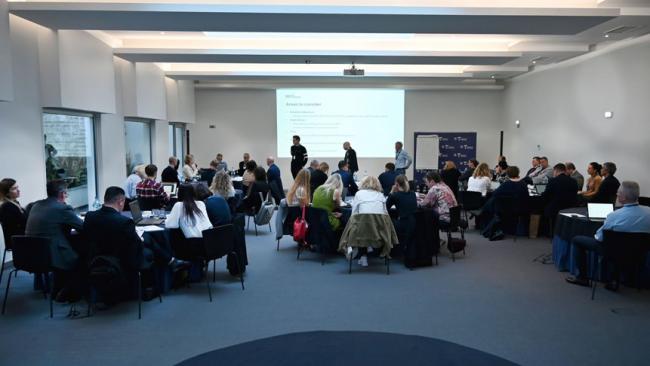


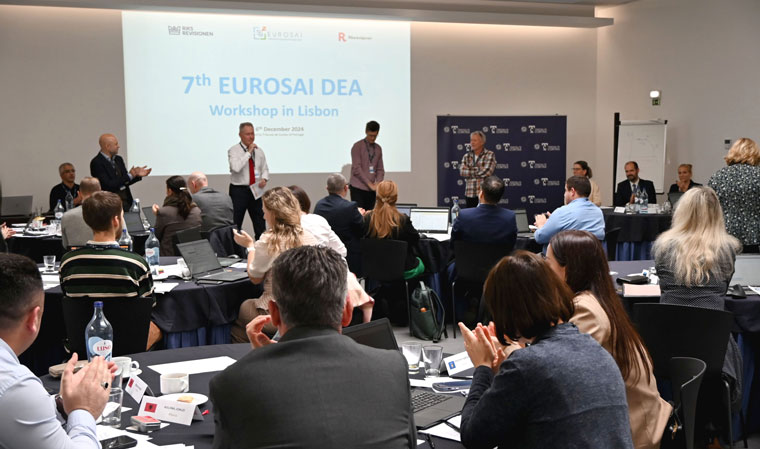
At the beginning of December 2024, the 7th edition of workshop on data envelopment analysis in performance auditing was held in Lisbon. The workshop was conducted by the SAI of Norway and the SAI of Sweden with the participation of academic community representatives.
The workshop is organised as part of the second Strategic Goal of the European Organisation of Supreme Audit Institutions – EUROSAI for 2024-2030: Development of institutional capacity. NIK and the SAI of Sweden are responsible for implementing this goal, i.e. projects increasing the audit capacity of European SAIs.
One of the objectives of performance auditing is to examine and evaluate performance of public programmes and projects. A tool often used in this case is the indicator method which, however, has numerous drawbacks and limitations. At the same time, more advanced analytical methods may be too complex to be used in auditing. In the academic community, non-parametric methods have been used since the 1970s, the Data Envelopment Analysis (DEA) in the first place.
It is the promotion of this method and its practical use in auditor’s work that have been the goal of the DEA workshop conducted by experts from Norway and Sweden since April 2022. Last year the workshop was hosted by the Supreme Audit Office of Poland and this year it was the Portuguese Court of Auditors. During this year's edition taking place in Lisbon, functionalities of the pioneeR tool were presented. They were developed by the SAI of Norway for the purpose of applying the DEA method in auditing,. Professor Jonas Månsson from the Blekinge Institute of Technology in Sweden explained practical aspects of using the DEA to measure efficiency and productivity, and Professor Maria Silva from the Catholic Business School in Porto showed how different methods of comparing performance are used to study the quality of public services in Portugal. She stressed that methods such as DEA can be used both to measure performance and to aggregate key indicators. Professor Kristof de Witte from the Catholic University of Leuven, on the other hand, referred to causal reasoning when studying performance, particularly in the education sector. Other benchmarking methods were also presented at the workshop, e.g. SFA (Stochastic Frontier Analysis).
During the practical session, the participants put forward topics of potential audits where the DEA method or other methods of measuring performance could be used. They identified problems, control questions and data collection methods. The most frequently proposed area of research was the health sector and the functioning of hospitals. Other areas covered e.g. education and infrastructure.
Some audit institutions, e.g. in Norway and Sweden, use the DEA tool on a broad scale, e.g. to investigate the performance of universities or the penitentiary system. But this method is still not very popular in auditing and control. The SAI of Sweden and NIK, which co-coordinate implementation of the second Strategic Goal of EUROSAI: Institutional capacity development, plan to organise more workshop sessions on DEA and other performance measurement methods to be used in performance audits. Other projects carried out by NIK and the Swedish Riksrevisionen to develop the capacity of European SAIs include, among others: training in English auditing vocabulary (Audit English) and meetings of EUROSAI methodologists (Two-day conference of EUROSAI audit methodologists at NIK).